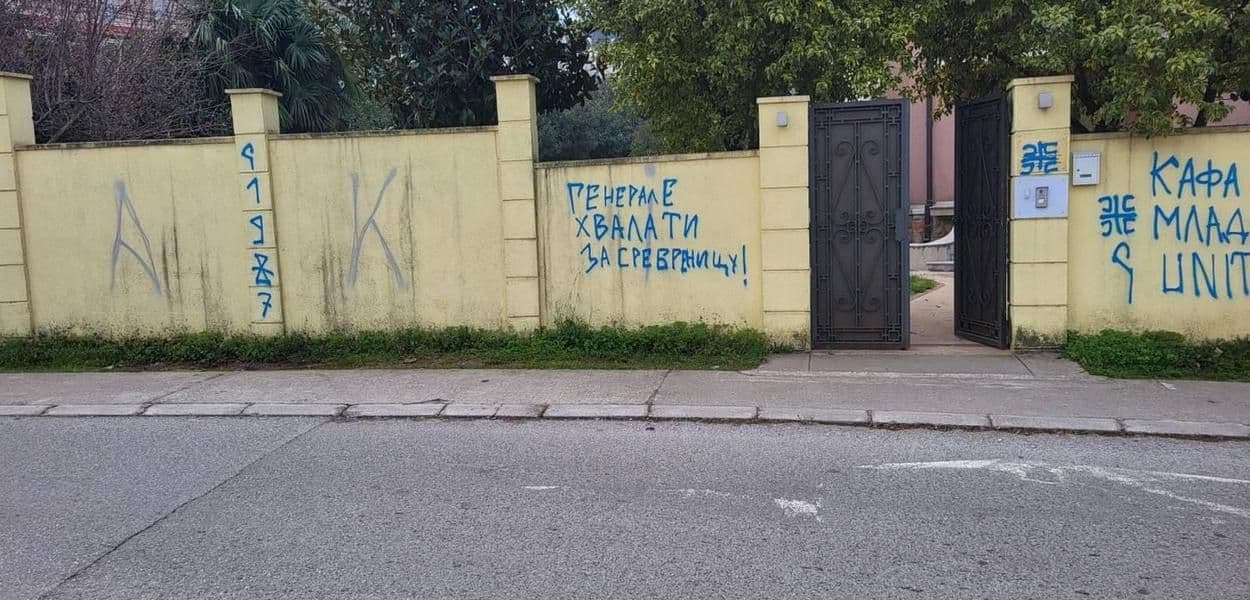
URGENT UPDATE: Hate messages have been discovered at the Embassy of Bosnia and Herzegovina in Podgorica, Montenegro. This incident marks a disturbing rise in hate speech, as graffiti glorifying war criminal Ratko Mladić was found on December 18, 2023, just days before the symbolic December 19 liberation celebration in Podgorica.
One prominent message read, “Generale, hvala ti za Srebrenicu” (“General, thank you for Srebrenica”), a reference to the 1995 genocide where over 8,000 Bosniaks were killed. Another message, which praised Mladić, also appeared alongside disturbing symbols associated with extremist groups.
Authorities have confirmed that these messages were swiftly condemned. Branimir Jukić, the Bosnian ambassador in Montenegro, thanked local institutions for their rapid response after the messages surfaced in the media. He received immediate calls from the Montenegrin Foreign Ministry and Minister Ervin Ibrahimović expressing solidarity.
“This vandalism is not only an attack on our embassy but also on fundamental civilizational values,”
Jukić stated, emphasizing the importance of unity against hate speech.
The Ministry of Foreign Affairs of Montenegro issued a statement condemning the graffiti, labeling it a direct assault on diplomatic relations. They reaffirmed their commitment to regional stability and condemned any form of genocide denial.
Following the incident, the graffiti was painted over, but the emotional impact remains. Local human rights organizations, including the Action for Human Rights (HRA) and the Civil Alliance, have called for urgent action to identify and prosecute those responsible. They highlight that public approval of genocide is not merely a matter of opinion but a serious crime punishable by imprisonment.
The graffiti incident occurs amid heightened sensitivity surrounding the 30th anniversary of the Srebrenica genocide, a grim reminder of Europe’s darkest moments. Montenegro’s parliament previously adopted a resolution recognizing the genocide, yet incidents like these reveal ongoing tensions and the need for vigilance against hate.
As public outrage ignites, citizens and officials alike express their shock and determination to combat rising extremism. Local community reactions have been swift, with many condemning the messages as unacceptable and a threat to the values of a civilized society.
The situation is developing, and further responses from law enforcement and judicial authorities are anticipated. Observers are closely watching how Montenegro addresses this incident, particularly as it relates to its European Union aspirations and commitments to human rights.
Stay tuned for more updates as this situation unfolds. The growing public discourse around these hate messages underscores the crucial fight against intolerance and the importance of remembering the past to build a peaceful future.