
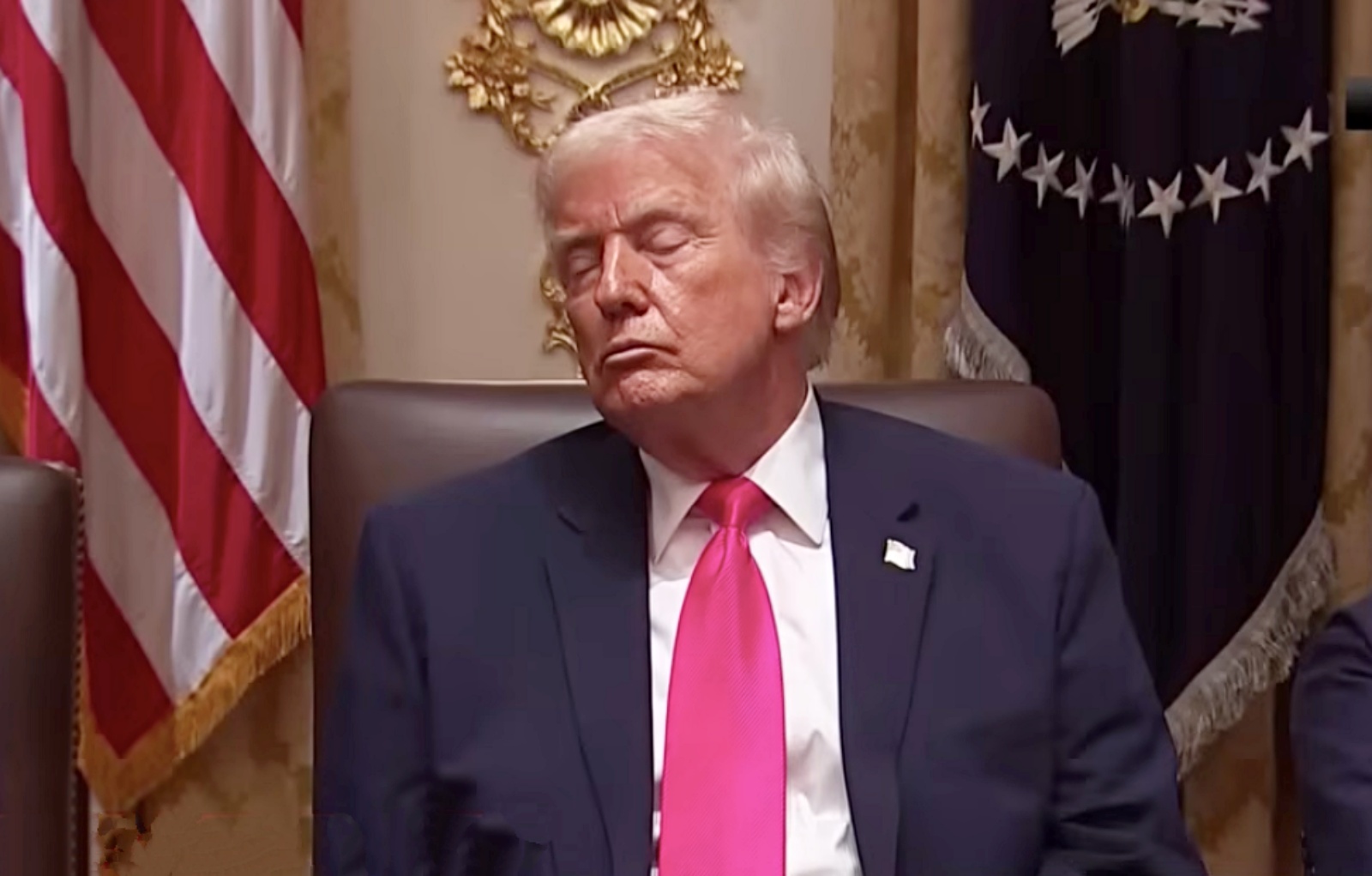
Concerns regarding the physical health of former President Donald Trump have emerged following the circulation of a video that appears to show him with a drooping face and struggling to maintain alertness at a public event. The footage, widely shared on social media platforms including TikTok, has led to increased scrutiny and speculation about Trump’s health, particularly among critics who interpret his fatigue as a potential indicator of serious medical issues.
The White House has firmly disputed these interpretations, asserting that Trump remains healthy and capable of fulfilling his presidential duties. In a Cabinet meeting, a clip showing Trump with his eyes closed for extended periods heightened concerns regarding his alertness. Independent news outlets reported that he seemed to struggle to keep his eyes open while senior officials spoke, further fueling speculation.
Critics have highlighted these moments as troubling signs of possible health concerns. A report from the Pakistan-based Geo TV noted that Trump’s eyes appeared to droop during key discussions, resonating across social media and contributing to the video’s viral spread. Users on platforms like Reddit drew attention to perceived changes in Trump’s facial expressions over time, although these claims lack verified medical evidence and often reflect personal interpretations rather than clinical assessments.
In response to the emerging concerns, senior aides from the White House defended Trump’s conduct. Susie Wiles, Chief of Staff, stated in an interview that the president was not asleep but merely resting his eyes during the meeting, emphasizing that he was fully engaged. Additionally, Karoline Leavitt, Press Secretary, characterized Trump’s demeanor as attentive, despite the visual impressions presented in the video.
Medical Evaluations and Transparency
The public’s attention has also turned toward Trump’s medical evaluations and the transparency surrounding his health disclosures. In October 2025, Trump underwent a comprehensive health assessment at Walter Reed National Military Medical Center. The results, released by Captain Sean P. Barbabella, the White House physician, described advanced imaging tests of Trump’s cardiovascular system and abdomen as “perfectly normal,” with no signs of arterial abnormalities or organ dysfunction. These tests were characterized as standard preventive assessments for someone of Trump’s age.
Trump acknowledged the MRI scan in conversations with reporters, stating that the results were “perfect,” although he expressed uncertainty about which part of his body had been examined. White House officials later clarified that the MRI focused on his heart and abdominal region. Nonetheless, commentary from the medical community has not been entirely consistent. A report by Scientific American pointed out that preventive MRI screening for abdominal or cardiac health is not considered standard medical practice, often reserved for specific clinical indications rather than routine checks.
In a previous annual physical report from spring 2025, Barbabella concluded that Trump was in “excellent cognitive and physical health” following a five-hour evaluation that included neurological, cardiovascular, and psychological testing. The report indicated that Trump scored perfectly on the Montreal Cognitive Assessment (MoCA), a common cognitive screening tool.
Public Confidence and Health Discourse
The ongoing debate raises critical questions about the balance between medical privacy and public demand for transparency regarding the health of political leaders. In the United States, presidents are not legally obligated to disclose comprehensive medical records, and past presidents have varied significantly in the extent of health information they have shared. Trump’s approach has leaned towards summary statements from White House doctors rather than detailed disclosures.
Critics have pointed to a pattern of behavior suggesting that Trump’s health may not be as robust as claimed. Observers have noted that he previously mocked President Joe Biden with the “Sleepy Joe” slogan, leading to contrasting perceptions of their respective alertness levels. Some health policy experts advocate for more thorough and independent health reporting for heads of state, particularly as age intersects with the pressures of leadership. Conversely, others argue that speculation cannot substitute for clinical evidence and that occasional lapses in public focus do not necessarily indicate serious health conditions.
As public discourse continues, the interplay between health, transparency, and political perception remains a crucial topic in American political life.


