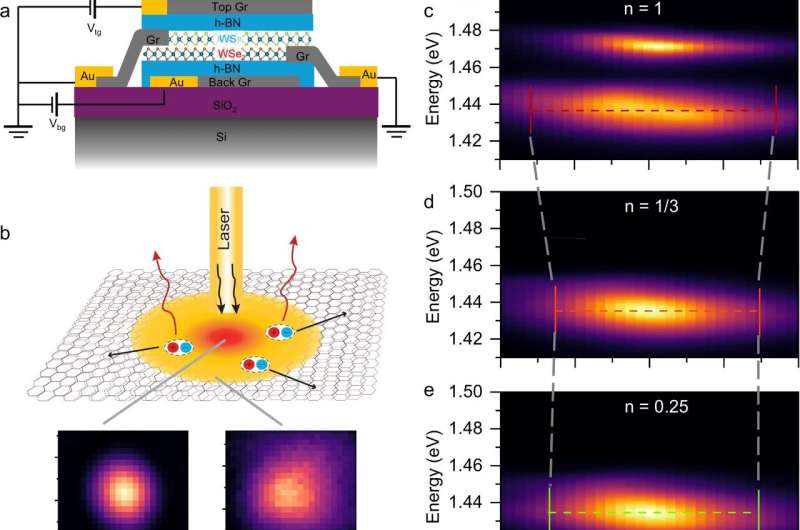
A team of researchers from Carnegie Mellon University, UC Riverside, and other institutions has developed a new method for controlling the flow of excitons in moiré superlattices. This innovative approach, detailed in a paper published on December 21, 2025, in Nature Communications, leverages the interactions between correlated electrons to enhance energy transport in two-dimensional materials.
Excitons, which are pairs of negatively charged electrons and positively charged holes, play a crucial role in the transport of energy within electronic devices. These pairs are particularly significant in transition metal dichalcogenides, thin semiconducting materials made from transition metals and chalcogen atoms. The research focuses on structures formed by stacking two layers of transition metal dichalcogenides with a slight rotational mismatch, leading to the formation of moiré superlattices.
Innovative Techniques for Enhanced Energy Transport
The team, led by senior author Sufei Shi, has been investigating quantum many-body phenomena resulting from strong electron-electron and exciton-exciton interactions in the WS2/WSe2 system. Shi explained that their research built upon earlier findings from 2021, where they discovered significant interactions between interlayer excitons and correlated electrons. This paved the way for manipulating exciton dynamics using electron-exciton interactions.
To conduct their study, the researchers created a moiré superlattice by stacking transition metal dichalcogenide layers at a carefully chosen angle. By applying optical techniques, they induced exciton formation within these layers and adjusted the electron density through electrostatic doping, which is achieved by applying gate voltage. This allowed them to measure how far and quickly excitons spread, a property known as diffusivity.
“We controlled the exciton diffusivity in our system by electrostatic doping,” Shi remarked. “These electrons are highly interacting and are what we call correlated electrons. Once the electrons form in the Mott insulator, the exciton diffusivity is greatly modified.”
The findings revealed that in conditions where the electron density was sufficient to form a Mott insulator state, the diffusivity of excitons could be enhanced by as much as 100 times. Conversely, the research indicated that exciton diffusivity decreased when electrons organized into a rigid, crystal-like pattern, known as Wigner crystal states.
Implications for Future Quantum Devices
The implications of this research are significant. The new method presents a promising avenue to enhance exciton diffusivity specifically in transition metal dichalcogenide-based moiré superlattices. This could lead to the development of advanced quantum and optoelectronic devices that utilize excitons as information carriers, offering a distinct advantage over traditional electron-based systems.
“With the robust exciton in 2D semiconductors, it has been widely proposed to use excitons for possible devices,” Shi stated. “However, there is an intrinsic problem, namely that the exciton is charge neutral and cannot be controlled easily with an electric field, unlike electrons. By utilizing the interaction between correlated electrons and excitons, we have achieved electrically tunable exciton diffusivity.”
The research opens the door for further exploration by other teams aiming to exploit moiré superlattices to control exciton flow, potentially leading to the emergence of desired physical states. Additionally, the findings could inspire fundamental studies into the physical principles governing interlayer exciton diffusivity and its experimental modulation.
Looking ahead, Shi expressed plans to further investigate how exciton diffusivity can be controlled through electric fields or nanoscale device patterns. The team is also interested in exploring how exciton-exciton interactions can be harnessed to manipulate diffusion further, aiming to construct new correlated exciton states.
This groundbreaking research exemplifies the potential of using advanced materials to enhance energy transport mechanisms, paving the way for next-generation technologies in quantum computing and optoelectronics.