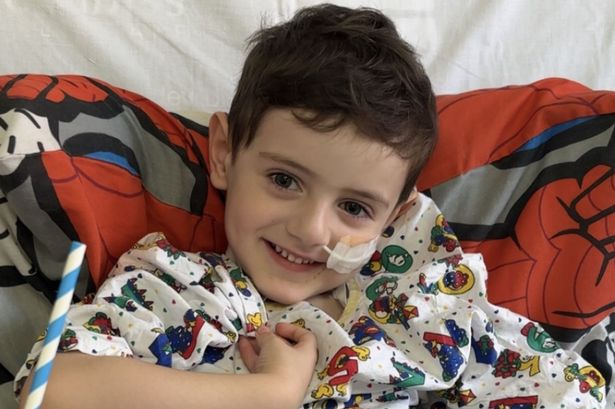
When six-week-old Atlas Jukes developed what his parents believed to be a common cold, they never anticipated the life-threatening condition that lay beneath the surface. After noticing symptoms such as sniffles and labored breathing, Matt Jukes and partner Tansy Simpson rushed their son to the hospital. Within days, Atlas was diagnosed with a serious congenital heart defect that required emergency surgery.
Matt, an artist from Peckham, South London, recalls the harrowing experience: “It started as any normal day would. Suddenly, Atlas became very difficult, crying a lot and not settling. He also wasn’t feeding.” Concerned for their child, they sought medical attention. What unfolded next was a parent’s worst nightmare as they learned that Atlas’s condition was far more serious than a simple cold.
After various tests came back normal, a consultant ordered an X-ray, a decision that would prove crucial. “By 11 am on January 10, 2023, we discovered the truth,” Matt explains. “Atlas had fluid in his lungs and an enlarged heart. His ‘cold’ turned out to be a congenital heart defect.” He was diagnosed with coarctation of the aorta, which involves a narrowing of the main artery leaving the heart, and a large ventricular septal defect, a hole between the heart’s two chambers.
Atlas underwent open-heart surgery just a week later, on January 17, 2023. The couple faced an emotional journey as they walked their child to the operating theatre. “We were petrified,” Matt admitted. “But five and a half hours later, we got a call to say it had been a success.” The family spent over a month in the hospital, surrounded by machines and uncertainty.
Congenital heart disease affects approximately one in 100 babies born in the UK, according to the NHS. Although the exact causes often remain unknown, factors such as maternal diabetes and infections during pregnancy can contribute. Common symptoms include rapid heartbeat, tiredness, and blue lips. Treatment varies by condition but often involves surgery to restore normal heart function.
Following the surgery, Atlas was placed on a ventilator for three days before his parents were finally allowed to hold him. “I would make up stories that I would tell him late at night when only the machine could be heard beeping,” Matt recalls. These moments of storytelling became a therapeutic outlet for the anxious father, who also began sketching imaginary landscapes as a form of emotional release.
Matt’s artwork later contributed to the heART project, a charity auction benefiting Heart Research UK. “They weren’t necessarily the happiest of stories, but they represent intimate moments between my son and me,” he reflects. The project features contributions from various artists, including notable names such as Russell Tovey and Robert Smith of The Cure.
Atlas was discharged from the hospital on February 4, 2023. Matt expressed his gratitude for the medical team, saying, “I was blown away by the sheer talent of the doctors.” The transition to home life was daunting. “We’d gone from having all these people looking after our son to suddenly being the only ones responsible for him,” he shared. “That was one of the moments when we thought, ‘Are we really ready for this?’”
Despite the challenges ahead, including regular hospital visits, Atlas has thrived and is currently off all medication. “He is just a normal boy,” Matt states. “Yes, he’ll have hospital visits probably for the rest of his life, but he’s doing well, and that’s what matters.”
The journey has fostered a sense of community among families dealing with similar challenges. “There’s a whole community of wonderful people around what we call ‘heart babies’. That support network has been incredible,” Matt noted.
Reflecting on the broader implications of heart research, he remarked, “When it comes to heart research, I’m struck by how little we actually know about the body. Research is the only way forward.” Since its inception, the heART project has raised over £515,000 for heart research, demonstrating the collective effort to support children like Atlas and their families.
Matt’s commitment to sharing their story emphasizes the importance of awareness and support in the face of health challenges. “If my experience can help someone else with their own journey, then it’s worthwhile sharing,” he added. The family’s experience serves as a reminder of the advances in medical care, highlighting that in 1967, 80 percent of babies with congenital heart defects did not survive, whereas today, around 80 percent thrive.