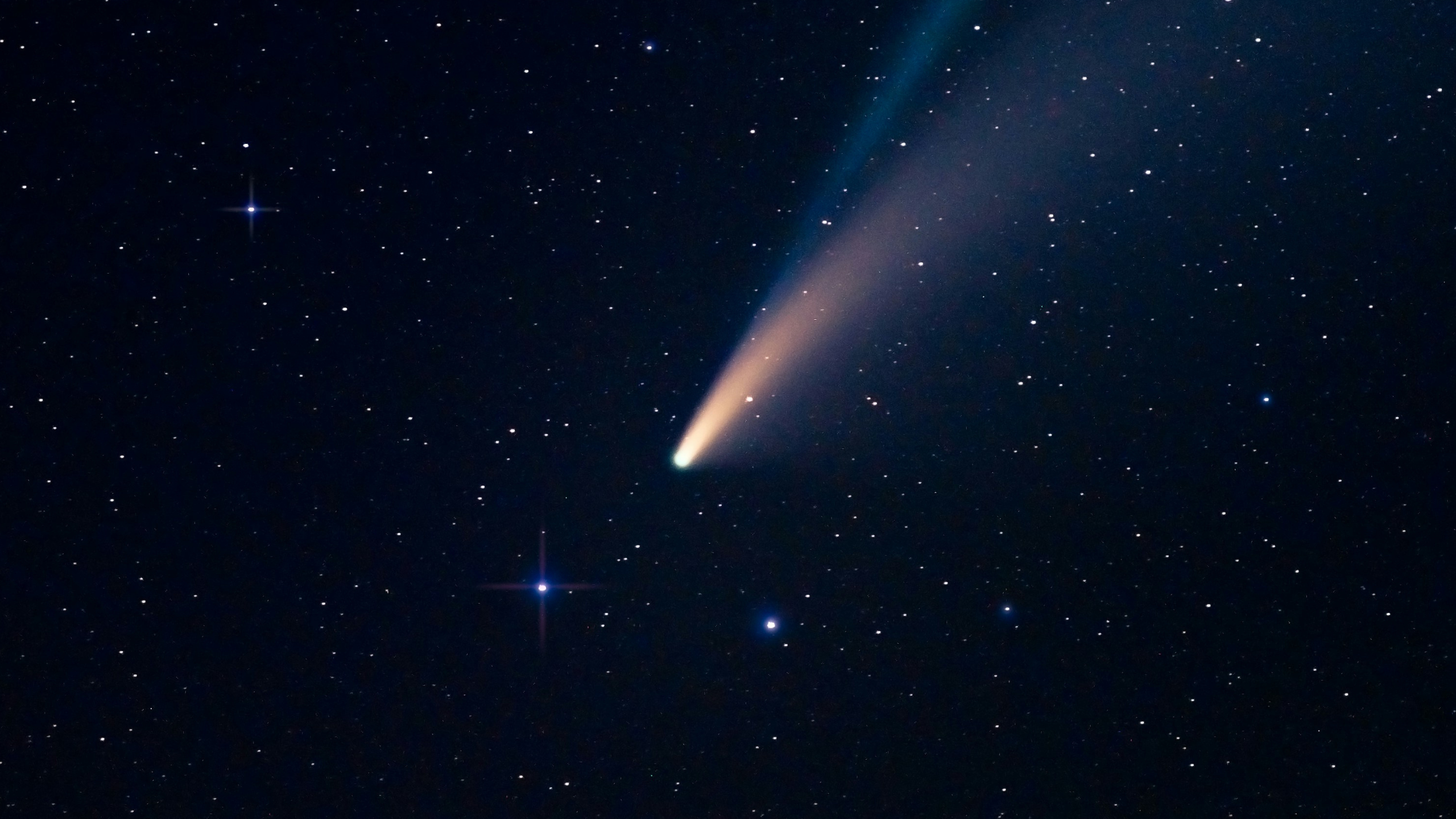
A recent analysis of the interstellar comet 3I/ATLAS has sparked significant intrigue among astronomers, prompting a call for deeper investigation into its unusual behavior. Discovered on July 1, 2025, by the NASA-funded ATLAS survey in Chile, this comet is only the third confirmed interstellar object to enter our solar system, following ‘Oumuamua and 2I/Borisov. Researchers, including Harvard astrophysicist Avi Loeb, have noted that the comet’s motion and brightness fluctuations cannot be fully explained by known forces such as gravity and sunlight.
Unexpected Behavior Raises Concerns
The findings regarding 3I/ATLAS challenge established notions of how small celestial bodies behave as they travel through space. On December 19, 2025, the comet made its closest approach to Earth, passing approximately 270 million kilometers away, traveling at an astonishing speed of 58 kilometers per second. These observations are particularly pressing given that asteroid 99942 Apophis is expected to approach Earth on April 13, 2029, passing within 32,000 kilometers — closer than some satellites.
Researchers have employed various instruments, including optical, infrared, and ultraviolet tools, to monitor 3I/ATLAS. They have identified small, measurable changes in its velocity and direction over time, alongside brightness variations that often correlate with shifts in direction rather than distance from the sun. Some images have even shown material structures emerging and dissipating without clear symmetry, indicating that additional forces may be at play.
A Call for Enhanced Planetary Defense
Avi Loeb emphasizes the need for further examination of these anomalies, asserting that interstellar objects represent a new class of celestial phenomena that require comprehensive understanding. He has pointed out several noteworthy features of 3I/ATLAS, such as its rare “anti-tail” stretching towards the sun and its unique chemical composition, which includes a plume of nickel with low iron content. Loeb suggests this composition resembles industrial alloys used in aerospace applications, raising questions about the object’s origin.
“These interstellar visitors could have properties that challenge existing planetary defense frameworks,” said Loeb.
While NASA’s Planetary Defense Coordination Office has confirmed that Apophis poses no collision threat in 2029, the flyby presents a critical opportunity for data collection, including radar and thermal readings. Agencies like NASA, the European Space Agency, and Japan’s Aerospace Exploration Agency are intensifying their tracking efforts from late 2028 into April 2029 to maximize data acquisition during this crucial window.
The behavior of 3I/ATLAS pushes the boundaries of current understanding in planetary defense planning. Loeb has criticized delays in the release of high-resolution imagery from NASA’s Mars Reconnaissance Orbiter, advocating for prioritization of scientific inquiry over bureaucratic processes to better identify the nature of such objects. Analysts have noted that the changes in motion of 3I/ATLAS are not entirely accounted for by gravitational pull or solar heating, suggesting the influence of internal structures or unknown external reactions.
As humanity’s population grows and urban areas expand, the imperative for precise tracking of celestial objects becomes clearer. The risks associated with impacts, such as tsunamis caused by unseen asteroids, underscore the need for enhanced preparedness. Experts recommend validating predictive models against real data, testing response systems, and refining simulations with new information to better prepare for potential threats.
The upcoming encounter with Apophis is not an apocalyptic event, but it serves as a reminder of the vast unknowns in the universe. The unique characteristics of 3I/ATLAS and its anomalies highlight the unpredictability of interstellar objects. As the comet races toward Jupiter and prepares to exit our solar system by March 2026, questions remain about humanity’s readiness for the next cosmic visitor.
Ultimately, billions of people depend on the ongoing study of these interstellar objects to safeguard against potential threats, transforming surprising data into crucial vigilance for planetary defense. The findings related to 3I/ATLAS illuminate the substantial gaps in our understanding of the cosmos and the need for continued investigation into the mysteries that lie beyond our solar system.