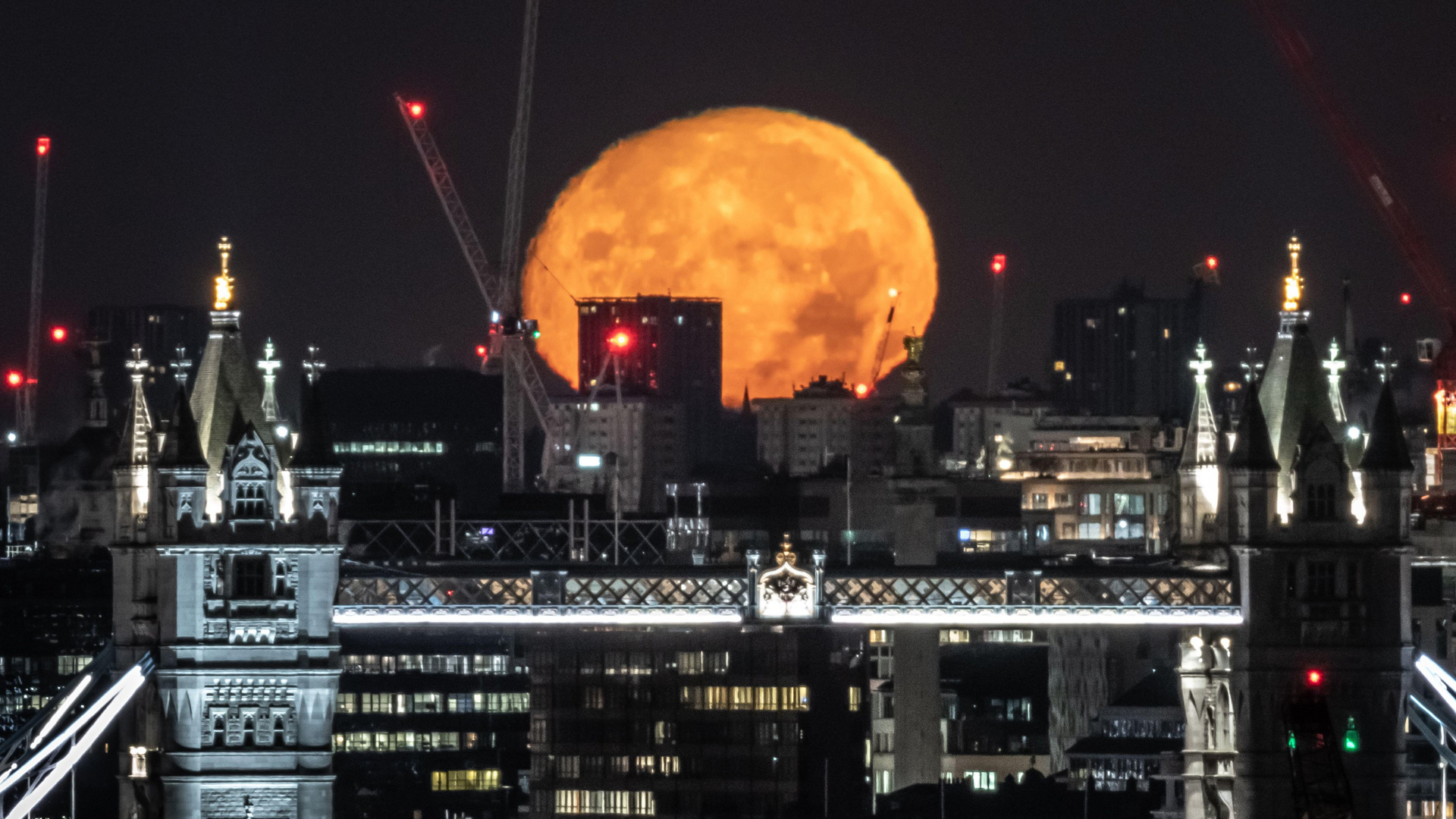
Tonight, the skies will be illuminated by the first supermoon of 2026, offering stargazers a spectacular view of our lunar neighbor. This full moon marks the beginning of a trio of supermoons expected this year, with the next two set for November 24 and December 24. A supermoon occurs when the Moon is at its closest point to Earth, resulting in a larger and brighter appearance.
A supermoon is not an actual increase in the Moon’s size but rather a result of its elliptical orbit around Earth. According to the Royal Greenwich Observatory, “The distance between the Moon and the Earth varies, because the Earth is not right at the centre of the Moon’s orbit and the Moon’s orbit is not a circle.” When the Moon reaches its closest point, known as lunar perigee, around the time of a full moon, it is classified as a supermoon.
Understanding the Wolf Moon
The supermoon occurring on January 3 is often referred to as a “Wolf Moon.” This name, popularized by The Old Farmer’s Almanac, relates to the historical practice of naming full moons based on seasonal events or behaviors. The Wolf Moon is named after the howling of wolves during the cold winter nights, symbolizing the harsh conditions many animals face.
In 2026, the full moons will carry unique names throughout the year, including the Snow Moon in February and the Strawberry Moon in June. Each name reflects the time of year and associated natural phenomena. The December supermoon will be particularly noteworthy, as it will be approximately 221,000 miles from Earth, compared to the average distance of 238,000 miles.
Tips for Viewing and Photographing the Supermoon
To fully appreciate tonight’s supermoon, observers should seek out locations with minimal light pollution. Urban environments can significantly diminish the visibility of celestial events, so finding higher ground or rural areas can enhance the experience.
Checking the local weather forecast is essential to ensure clear skies for optimal viewing. For those interested in photography, using a tripod can help stabilize images and reduce motion blur, especially when zooming in on the Moon. Additionally, smartphones may have a night mode feature that enhances low-light photography, making it easier to capture the beauty of the supermoon.
Experts recommend observing the Moon during its rise or set, as this can create an optical illusion that makes it appear larger against the horizon. This phenomenon occurs because our brains perceive objects near the horizon as larger than they are due to the context of the surrounding landscape.
As this supermoon lights up the night sky, viewers will have an excellent opportunity to connect with the wonders of astronomy. Whether simply gazing at the Moon or attempting to photograph it, tonight’s event is a reminder of the beauty and complexity of our universe. Be sure to dress warmly and enjoy the celestial spectacle.