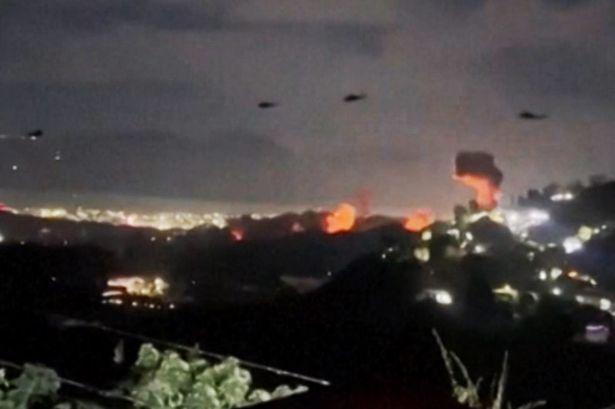
The US Army has conducted a significant operation in Venezuela, resulting in the capture of President Nicolas Maduro and his wife, Cilia Flores. This high-profile raid has been described by Donald Trump as “large scale” and a successful mission that underscores the United States’ commitment to addressing political corruption in the region.
According to a statement from the US Department of Justice, both Maduro and Flores have been indicted in a New York court on charges related to drug trafficking and money laundering. The indictments stem from an investigation that began several years ago, focusing on the Venezuelan government’s alleged ties to narcotics trade. The court appearance marks a significant escalation in the US government’s efforts to hold Maduro accountable for his actions.
Venezuela has been mired in a political crisis for several years, with Maduro’s government facing widespread accusations of human rights abuses and economic mismanagement. The operation to apprehend him came as part of a broader strategy by the US to support opposition movements and restore democratic governance in the country.
The raid took place on the morning of April 10, 2024, during a time when tensions were already high in the region. Reports indicate that US forces executed the operation with precision, aiming to minimize civilian casualties and disruption. Eyewitness accounts describe a swift and coordinated effort that surprised Maduro’s security forces.
In response to the events, the Venezuelan government condemned the US intervention, labeling it an act of aggression. Foreign Minister Carlos Faría stated, “This is an affront to our sovereignty and an attempt to undermine our democratic institutions.” He vowed that the Maduro administration would fight back against what he termed “imperialist aggression.”
The international community has reacted with mixed responses. Some countries have expressed support for the US action, viewing it as a necessary step towards restoring democracy in Venezuela. Others have criticized the approach as an overreach of US influence in Latin America and a violation of Venezuelan sovereignty.
As the legal proceedings unfold in New York, the implications of this operation could have lasting effects on Venezuela’s political landscape. Analysts suggest that the capture of Maduro may embolden opposition groups within the country, while simultaneously provoking a more aggressive stance from his loyalists.
The situation remains fluid as both the US and Venezuelan governments navigate the fallout from this major operation. With Maduro now in custody and facing serious charges, the world watches closely to see how these developments will shape the future of Venezuela and its citizens.