A significant breakthrough in geometry has occurred, as Dr Baek Jin Eon, a mathematician from South Korea, has solved the long-standing “moving sofa problem.” This puzzle, which has perplexed researchers for nearly 60 years, asks for the two-dimensional shape with the largest possible area that can be transported through a right-angled corridor of fixed width. Dr Baek’s proof, published in 2024, asserts that no shape larger than the one previously proposed can navigate such a space.
The moving sofa problem was first introduced in 1966. It challenges mathematicians to visualize the largest shape that can maneuver through an L-shaped corridor measuring one unit in width. In 1992, mathematician Joseph Gerver suggested a complex design, known as Gerver’s sofa, as a possible solution. Despite its elegance, the proof that no larger shape could exist remained elusive for decades.
Dr Baek’s work culminated in a comprehensive 119-page proof demonstrating that Gerver’s design is, indeed, optimal. Unlike many of his predecessors, who relied on extensive computer simulations, Dr Baek’s methodology was grounded purely in logical reasoning. He expressed the emotional rollercoaster that accompanied his research, stating, “You keep holding on to hope, then breaking it, and moving forward by picking up ideas from the ashes.”
Recognition and Impact
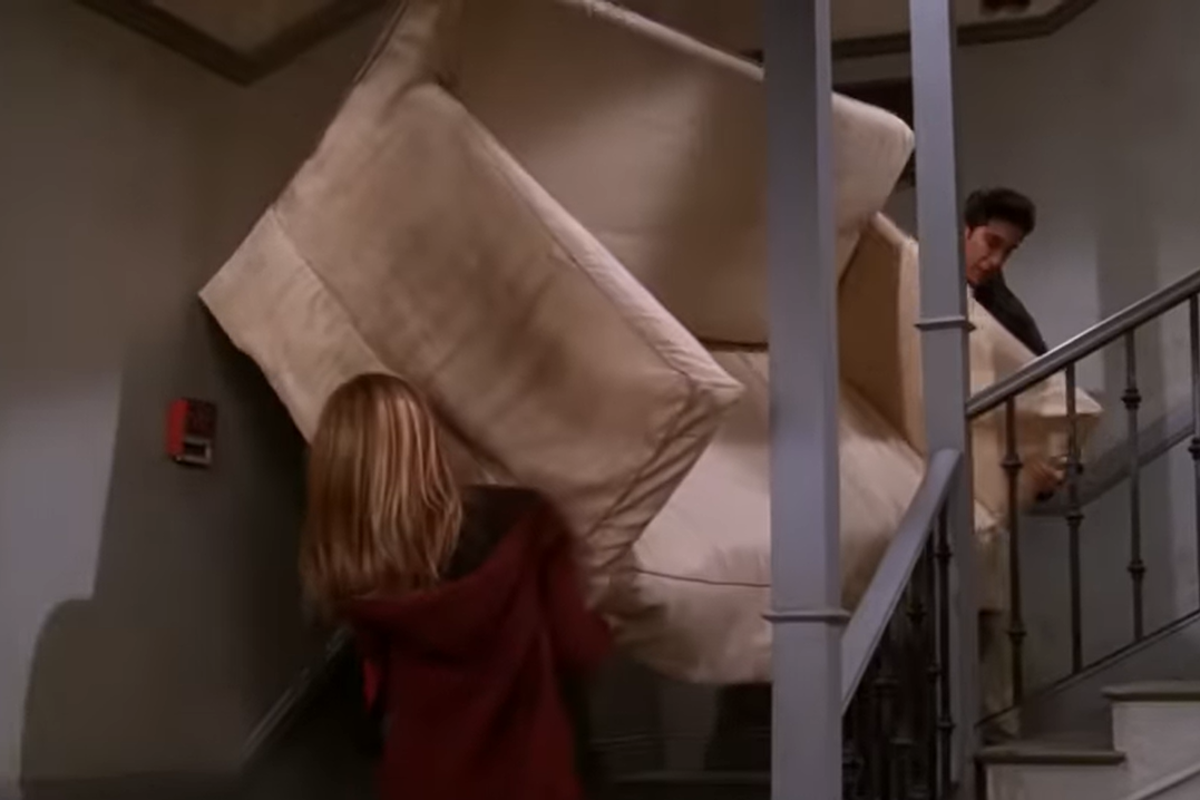
The significance of Dr Baek’s discovery has not gone unnoticed. Scientific American recognized it as one of its “Top 10 Math Discoveries of 2025,” highlighting the innovative approach that does not depend on computational tools. The magazine humorously remarked that explaining the famous “Pivot!” scene from the sitcom Friends, where characters struggle to move a sofa, would require a substantial mathematical treatise.
Currently, Dr Baek’s proof is under peer review at the Annals of Mathematics, a leading journal in the field. The mathematical community expresses strong confidence in his findings, anticipating that the review will validate his groundbreaking work.
Dr Baek’s journey began while he was serving as a research specialist during his mandatory military service, where he first encountered the moving sofa problem. His pursuit continued through his doctoral studies in the United States and as a postdoctoral researcher in South Korea. In recognition of his contributions to the field, he was selected for the June E Huh Fellow program, which supports emerging mathematicians under the age of 39 for a maximum of ten years.
Future Endeavors
Following this remarkable achievement, Dr Baek is now focused on further exploration in optimization problems and combinatorial geometry. His work not only resolves a long-standing mathematical enigma but also inspires future research in the field. As he continues to dream and innovate, the impact of his discovery will likely resonate within both academic circles and popular culture for years to come.