Researchers at the University of Konstanz have introduced a novel, contact-free technique for efficiently removing liquids from delicate microstructures. This advanced method employs vapor condensation to generate surface currents that transport droplets away from surfaces, a significant breakthrough for industries reliant on microscopic elements, including microchips in smartphones.
The study, published on January 13, 2026, in the journal Proceedings of the National Academy of Sciences, was led by Stefan Karpitschka and his team. The manufacturing of microchips often involves exposing surfaces to various liquids that must be thoroughly eliminated afterward to ensure product integrity. Karpitschka explains, “In order to turn very thin silicon disks, known as silicon wafers, into finished microchips, several of the necessary steps require the material to be wet. For example, transistors must be etched in acid baths and dried afterward.”
Surface tension plays a critical role in this new method. Every liquid possesses a unique surface tension, which can impact the manufacturing process. For instance, while water’s surface tension allows small insects like the water strider to traverse ponds, it can also pose a risk to fragile microstructures. Consequently, traditional methods of wiping or boiling off remaining liquid are unsuitable, as they can leave harmful residues.
To address this challenge, Karpitschka and his colleagues devised a technique that utilizes the Marangoni force, which occurs due to differences in surface tension. This force creates liquid currents that can effectively move water away from surfaces. The researchers achieved this by introducing additional liquid—specifically, alcohol—which has a lower surface tension than water. As the alcohol vapor condenses on the surface, it creates the necessary tension difference to initiate movement.
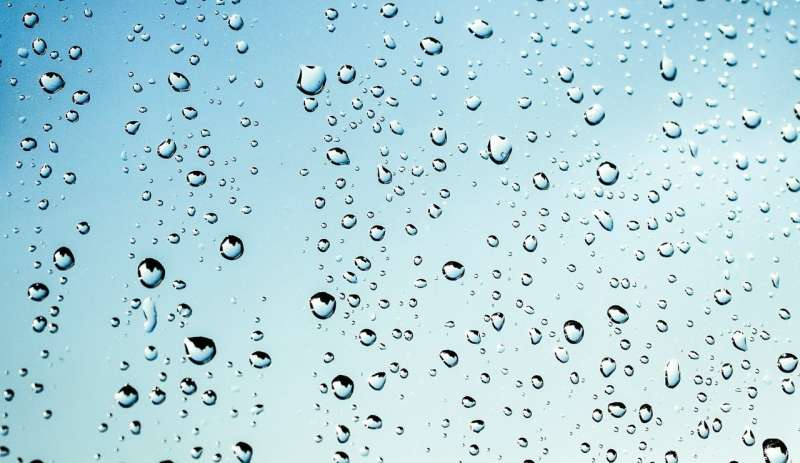
Karpitschka elaborates, “We steer the ensuing currents across the entire surface to gather the tiny amounts of remaining liquid into larger drops.” This process mirrors raindrops coalescing on a windowpane, but the researchers control the droplets’ trajectories to ensure efficient removal.
The implications of this groundbreaking method extend across various fields that utilize micropatterned surfaces. By enabling the drying of small structures without causing damage, this technique enhances the production efficiency of various micro- and nanomaterials.
This innovation marks a significant step forward in fluid physics and its applications in technology, paving the way for more effective manufacturing processes in sectors that depend on delicate microstructures. The research team’s findings, detailed in the work titled “Vapor-mediated wetting and imbibition control on micropatterned surfaces,” set a new standard for fluid management in microscopic environments.
For further information, refer to the article by Ze Xu et al. in the Proceedings of the National Academy of Sciences, DOI: 10.1073/pnas.2519761122.