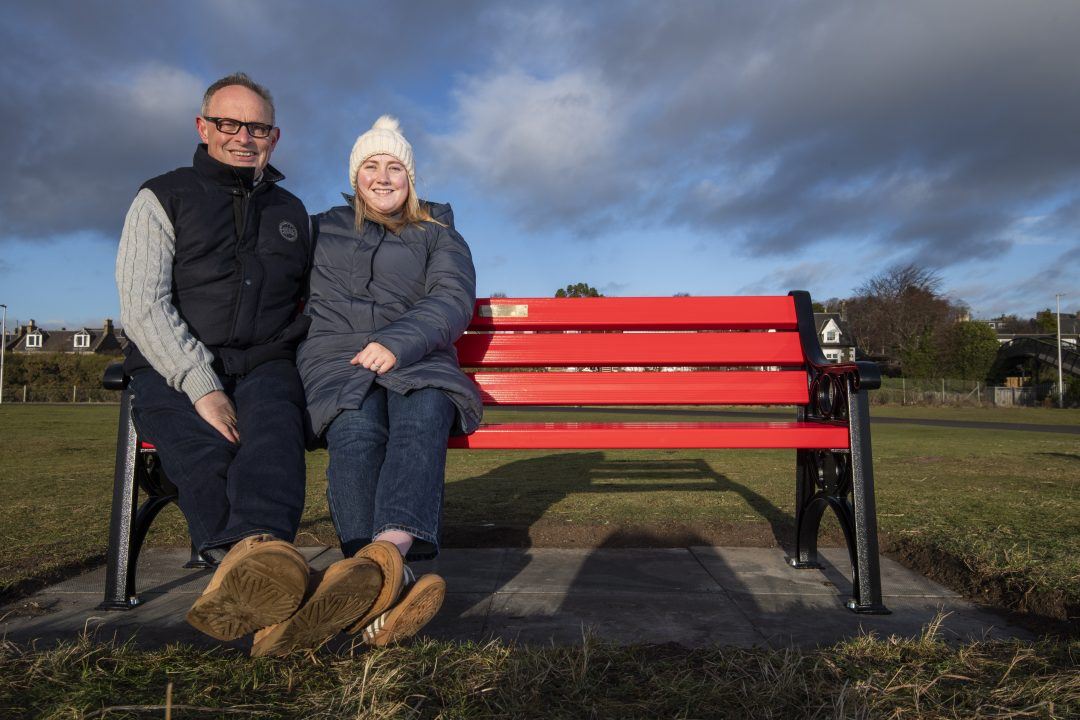
A grandfather has been commemorated with a bench after he walked his daughter down the aisle just hours after being discharged from the hospital post-heart attack. John Smith, 57, from Monifieth, Scotland, faced a second heart attack in December 2023, just days before his daughter Lauren‘s wedding. Remarkably, he left the hospital at 1:30 PM on the day prior to the ceremony and successfully delivered his father-of-the-bride speech during the event.
The bench, located on the banks of the River Tay, serves as a tribute to John’s resilience and aims to inspire others facing similar health challenges. John hopes it will become a “symbol of hope” and help to break down barriers surrounding cardiac disease. “It’s a message that even after devastating health events, there can be joy, connection, and meaningful experiences ahead,” he stated. He also expressed a desire to eventually enjoy packed lunches with his grandson Rory, who was born in May 2023, on this bench.
John, a former Scotland hockey player and triathlete, is among those sharing their experiences as part of a national campaign by the British Heart Foundation (BHF). To commemorate 65 years since its establishment, the charity is unveiling 65 red benches across the UK, each representing a unique story of individuals living with cardiovascular disease. Five of these benches will be placed throughout Scotland.
Cardiovascular disease is a serious concern, with someone in the UK succumbing to it every three minutes. The condition affects more than 730,000 people in Scotland alone. A recent survey commissioned by the BHF, involving 2,000 UK adults living with cardiovascular disease, revealed that many face stigma and embarrassment regarding their condition. Over half of the respondents reported feeling judged, and one in three encountered instances where others believed their condition was self-inflicted.
Mental health challenges are prevalent among those with cardiovascular issues, with 65% of participants indicating they have faced difficulties in this area. Many believe cardiovascular disease is not taken as seriously as other health conditions, with 68% stating it is poorly understood. Misconceptions persist, as 73% of respondents agreed that people often think cardiovascular disease primarily affects older individuals.
John shared that the emotional aftermath of his two heart attacks has been more challenging than the physical recovery. He recalled being discharged from the hospital the day before his daughter’s wedding, stating, “I wouldn’t have been there had it not been for scientific research.” Despite appearing physically well after receiving stents, John struggled mentally and could not return to work for several months.
He described the profound loss of his former identity as a multiple Ironman triathlete and the isolation he felt, even among his family. “There was a recognisable shift in my mood, behaviour and overall demeanour which led to a downward spiral where I began to feel even more depressed,” he said.
Support from counselling and testimonials on the BHF website proved helpful for John. Seeing stories of others who had similar experiences gave him hope and reassurance that cardiovascular disease does not have to define one’s life. “Almost everyone I’ve spoken to cannot believe that I suffered two heart attacks. We need to educate the masses,” he emphasized.
The evolution of heart attack survival rates has been significant due to advancements in medical research. In 1961, survival rates were only 30%, but thanks to decades of research funded by the BHF, approximately 70% of heart attack victims now survive. The charity’s efforts have led to the establishment of coronary care units in hospitals, which have played a critical role in reducing mortality rates.
David McColgan, head of BHF Scotland, highlighted John’s story as an essential reminder of the realities of living with cardiovascular disease. “We are so grateful that he is courageously sharing his experiences to help others,” he said. McColgan noted that despite being one of the UK’s leading causes of death, cardiovascular disease remains misunderstood, with many facing social stigma.
The introduction of the red benches is intended to spark conversations about cardiovascular disease and encourage individuals to share their experiences. The BHF hopes that through this initiative, awareness will grow, ultimately leading to more support for research that can save lives.