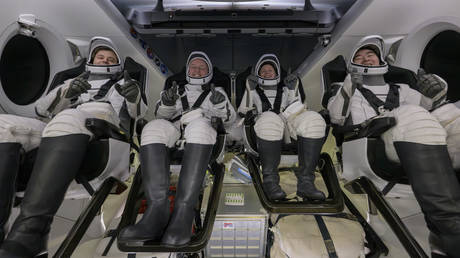
BREAKING: A crew of four astronauts has safely returned to Earth after an urgent medical evacuation from the International Space Station (ISS), marking a historic first in the station’s 25-year history. The crew departed the ISS a month ahead of schedule, landing in the Pacific Ocean off the coast of San Diego at 3:41 AM ET on Thursday.
The astronauts, comprising Roscosmos cosmonaut Oleg Platonov, NASA astronauts Zena Cardman and Mike Fincke, and Japan’s Kimiya Yui, had been conducting research aboard the ISS since August. They were initially slated to remain until next month, following a planned handover with the incoming Crew-12 mission.
The decision to evacuate was prompted by a medical issue affecting one crew member, whose identity has not been disclosed. NASA confirms the astronaut is in stable condition and is expected to be taken to the hospital for further evaluation. The agency has not revealed the specifics of the medical issue, but earlier Wednesday, a scheduled spacewalk was canceled due to the situation.
“This is not an injury that occurred during operations,” stated Dr. James Polk, NASA’s chief health and medical officer. “The issue stemmed from the difficult areas of microgravity, and the astronaut is being brought home to take advantage of Earth-based diagnostic tools.”
After splashdown, the crew was seen smiling and waving as they exited the SpaceX capsule. They are now aboard a recovery ship that lifted their capsule from the ocean. NASA has indicated that the returning astronauts will undergo routine medical checks, as is standard protocol for all returning space travelers.
While the specific circumstances surrounding the medical evacuation remain unclear, Japan’s space agency, JAXA, has confirmed that Kimiya Yui was not the affected crew member. Meanwhile, the ISS will continue operations under the oversight of Russian cosmonauts Sergey Kud-Sverchkov and Sergey Mikaev, along with NASA astronaut Chris Williams, who launched to the station aboard the Russian Soyuz MS-28 in November.
This unprecedented early return underscores the complexities and challenges of life in microgravity, reminding us of the inherent risks involved in space exploration. As details emerge, the global space community watches closely, with implications for future missions and the health protocols for astronauts in orbit.
Stay tuned for updates on this developing story as NASA and international authorities provide more information on the situation.