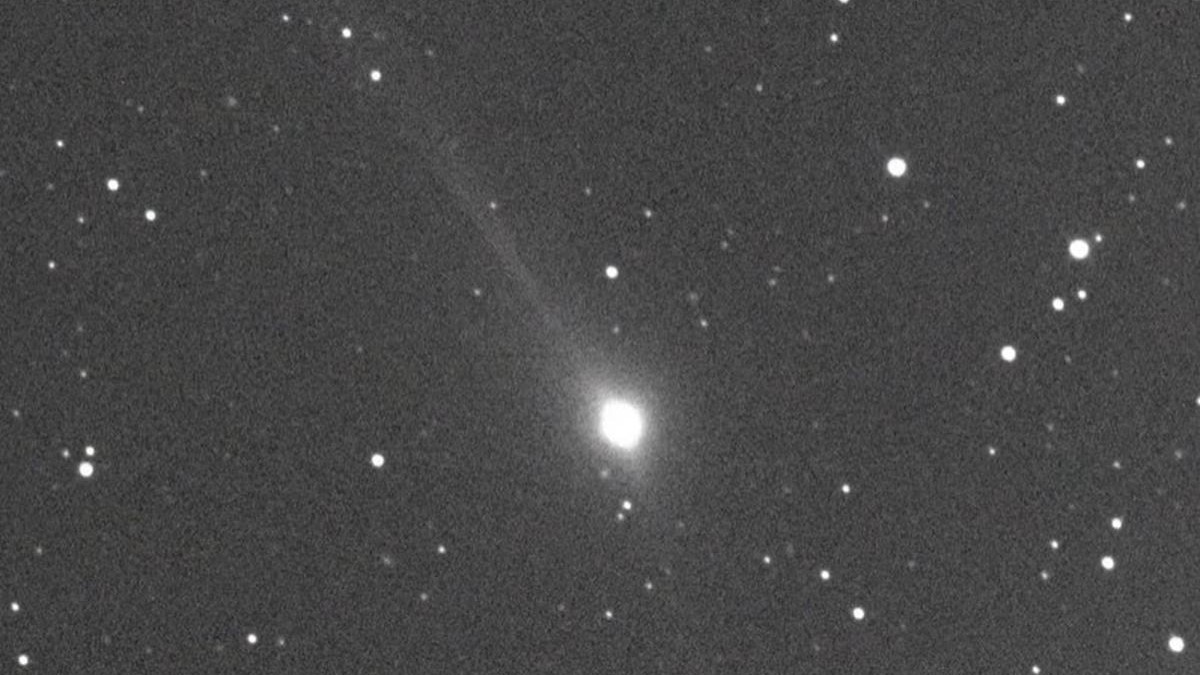
The solar system is preparing to bid farewell to the rare Comet 3I/ATLAS, which is set to exit our celestial neighbourhood permanently. Originally detected on July 1, 2025, by a remote telescope in Río Hurtado, Chile, the comet has sparked considerable interest due to its unusual trajectory and origins. After inclement weather delayed the live broadcast of its final view, stargazers will have a last opportunity to observe this interstellar visitor on 22 January 2024 at 11:30 p.m. GMT.
The event, hosted by the Virtual Telescope Project, will take place in Manciano, Italy. The live feed, titled “Farewell, 3I/ATLAS: a final view of this exceptional object,” will provide real-time views from robotic telescopes as Earth positions itself directly between the sun and the comet. This alignment allows sunlight to illuminate the comet, enhancing visibility against the backdrop of space, despite the comet’s faintness.
3I/ATLAS has a compelling history. Initially labeled A11pl3Z, it was later renamed C/2025 N1 ATLAS when scientists identified its comet-like behavior. Upon analyzing its trajectory, researchers confirmed it is on a hyperbolic orbit, meaning it is not bound by the sun’s gravity. This conclusion indicates that 3I/ATLAS originated from a different star system, making it only the third known interstellar visitor to pass through our solar system, following 1I/’Oumuamua in 2017 and 2I/Borisov in 2019.
The arrival of 3I/ATLAS has led to much speculation regarding its nature. Harvard astrophysicist Dr. Avi Loeb controversially suggested it could be an alien spacecraft rather than a natural comet. While this theory has generated excitement and debate online, the prevailing scientific evidence strongly supports a natural origin. Observations from NASA’s Psyche mission and the European Space Agency’s (ESA) Mars Trace Gas Orbiter indicate that the comet is accelerating in a manner consistent with natural outgassing. This process involves jets of vaporized gas escaping the surface, acting as tiny thrusters and confirming its identification as an icy body reacting to solar heat.
Observing 3I/ATLAS will require specialized equipment, as the comet is currently too faint for the naked eye or standard binoculars. It is advised that viewers use at least an 8-inch digital telescope to capture images, while those wishing for optical views should consider a 16-inch telescope. Given these requirements, the upcoming livestream is crucial for most enthusiasts wishing to catch a glimpse of this fleeting visitor.
As 3I/ATLAS journeys back into the interstellar medium, it is likely headed toward the centre of the Milky Way. Once this final viewing opportunity passes, the comet will disappear from sight, marking the end of its brief but intriguing passage through our solar system. For those interested in astronomy, this event represents a rare moment to engage with an extraordinary cosmic phenomenon before it is lost to the vastness of space.