
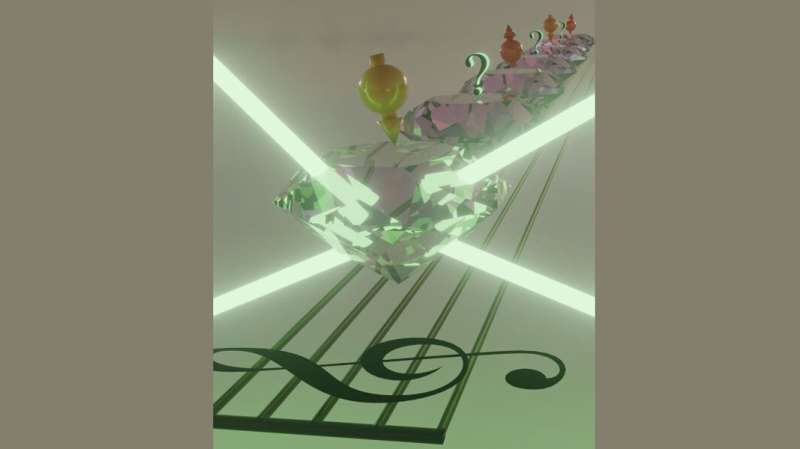
In a groundbreaking study published in Nature Physics, researchers have made the first experimental observation of a time rondeau crystal. This unique phase of matter combines long-range temporal order with short-term disorder, a concept inspired by classical music forms, such as Mozart’s Rondo alla Turca. The discovery opens new avenues in understanding the complexities of order and chaos in both art and scientific phenomena.
The term “time rondeau crystal” refers to a system that exhibits regular, predictable behavior at specific intervals while allowing for random fluctuations between those points. According to Leo Moon, a Ph.D. student at UC Berkeley and co-author of the study, this research highlights how order and variation coexist across different domains, from art to nature. Moon noted, “Repetitive periodic patterns naturally arise in early art forms due to their simplicity.”
The study’s findings extend beyond aesthetics; they relate to the behavior of familiar substances such as ice, where oxygen atoms form a crystalline structure while hydrogen nuclei remain disordered. Previously studied time crystals have displayed long-lived periodic oscillations, but exploration into non-periodic temporal order has mostly centered on deterministic patterns, such as quasicrystals.
Creating a New Phase of Matter
The research team utilized carbon-13 nuclear spins in diamond as their quantum simulator. This setup featured nuclear spins arranged randomly at room temperature, interacting through long-range dipole-dipole couplings. The initial step involved hyperpolarizing these spins using a technique that exploits nitrogen-vacancy (NV) centers, defects in the diamond lattice that become spin-polarized when exposed to laser light. This process increased the nuclear spin polarization nearly 1,000-fold beyond its equilibrium state, allowing for a strong and prolonged signal.
Subsequent microwave pulse sequences were applied, combining protective “spin-locking” pulses with precisely timed polarization-flipping pulses. This structured yet partially random approach gave rise to the rondeau order. Moon emphasized the suitability of the diamond lattice for this research, stating, “Diamond itself is incredibly stable—it doesn’t react chemically, it’s insensitive to temperature changes, and it shields the spins well from outside noise.”
The researchers devised what they termed random multipolar drives (RMD). These structured sequences allowed for systematic control of randomness, enabling the nuclear spins to exhibit predictable behavior during designated intervals while fluctuating randomly at other times. This balance of order and disorder is the defining characteristic of the rondeau crystal.
Significance of the Findings
The team successfully maintained the rondeau order for over 170 periods, corresponding to more than four seconds. Their analysis demonstrated that, in contrast to conventional discrete time crystals that present a singular peak in frequency, the time rondeau crystal displayed a smooth, continuous distribution across all frequencies. This finding serves as a “smoking gun” confirming the coexistence of temporal order and disorder.
Moon remarked, “Rondeau order shows that order and disorder don’t have to be opposites—they can actually coexist in a stable, driven quantum system.” The researchers were able to manipulate the system’s behavior by adjusting drive parameters, mapping out an extensive phase diagram that identified regions of stability for the rondeau order.
The study also explored the potential for encoding information within the temporal disorder. By engineering specific sequences of drive pulses, the researchers encoded the study’s title, “Experimental observation of a time rondeau crystal. Temporal Disorder in Spatiotemporal Order,” into the micromotion dynamics of the nuclear spins. This innovative approach allows information to be stored in time rather than space, depending on the spins’ orientations at various moments during each cycle.
While practical applications are still on the horizon, Moon expressed enthusiasm about the implications of their findings. “The idea itself is fascinating that disorder in a non-periodic drive can actually store information while preserving long-time order,” he said.
The research team anticipates that the controllability of disorder could make this platform advantageous for designing quantum sensors that selectively respond to specific frequencies. Additionally, they have broadened the landscape of non-equilibrium temporal order by demonstrating related phenomena with deterministic aperiodic drives, such as the Thue-Morse sequence and Fibonacci sequence.
Looking forward, the researchers are investigating other material platforms beyond diamond, including pentacene-doped molecular crystals, which could offer enhanced sensitivity. Moon concluded, “Harnessing the tunable disorder in such systems could pave the way for practical quantum sensors or memory devices that exploit stability in the temporal domain.”
This study represents a significant advancement in the field of quantum physics, showcasing the intricate relationship between order and disorder and promising new applications in quantum technology.


