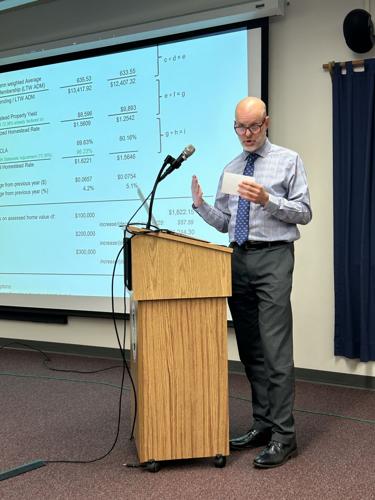
Bennington’s newly appointed school superintendent, Tim Payne, addressed the Select Board on the complexities of the current school funding process and the potential implications of upcoming education reforms. During a meeting on Monday, he elaborated on how local budget formation interacts with state funding mechanisms and what changes could arise from Act 73, which aims to transform public education in Vermont.
Payne commenced his presentation by outlining the steps that lead to school budget approval. Local school boards first draft budgets, which community members then vote on during Town Meeting. If approved, the school board submits the budget to the State of Vermont, which pays using funds from the state’s education budget. This process is far from straightforward. In some instances, the increase in school taxes can outpace the growth of the local budget itself.
“My purpose this evening is to talk a little bit about school funding,” stated Payne. “Vermont has a relatively unique system.” He emphasized that the current mechanisms could change significantly due to Act 73, which was signed into law last legislative session.
The intricate funding process begins with local school boards creating a budget, followed by community approval. The state then collects all approved budgets to determine the total “Education Spending” required for the coming year. This figure is divided by the number of students in each district to establish the “Equalized Homestead Tax Rate,” which can vary by town.
Payne noted, “In some cases, the governor may propose partial use of the state’s surplus to ‘buy down’ property taxes.” This method can temporarily reduce tax burdens for residents but may lead to funding shortages in other state budget areas. “Last year, the governor made the decision to buy down property taxes. It’s a relief for taxpayers, but not a sustainable long-term strategy,” he added.
As Vermont embarks on reforms under Act 73, significant changes are expected in the coming years. One of the first steps involves the redistricting committee, which is tasked with submitting three maps by December 1, 2024, to redefine school districts across the state.
Looking ahead, Payne highlighted key milestones set forth by the act. By July 2026, minimum class sizes will be established in schools. New school districts are to be agreed upon by January 2027, coinciding with the submission of a statewide school calendar. A foundation formula, which dictates funding per student, will be implemented by July 2028.
“This is a political process that will require spirited conversations about various aspects, including transportation and student weightings,” Payne remarked. He encouraged community members to engage with local officials about their perspectives on the outcomes of Act 73, emphasizing that discussions surrounding the reform’s potential to provide equitable opportunities for all students are crucial.
“Some assume this will save us a lot of money, while others believe it will allow us to begin rebuilding outdated educational facilities,” he noted.
As Vermont navigates these changes, the role of local communities and their input will be vital in shaping the future of education in the state. The implications of these reforms will likely resonate throughout the educational landscape for years to come.