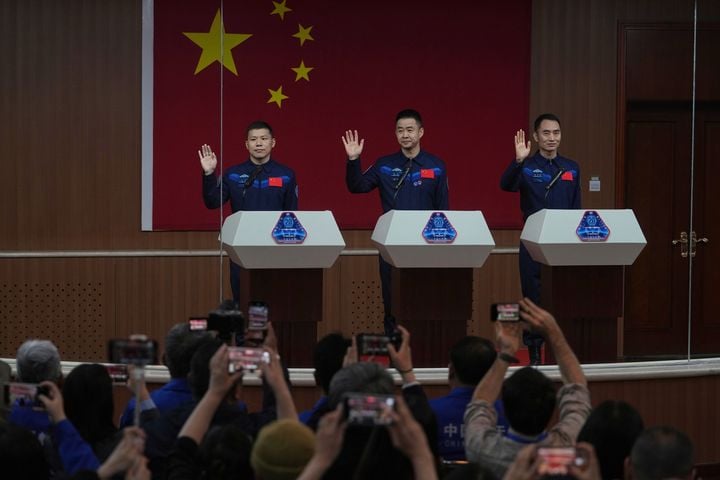
URGENT UPDATE: Three Chinese astronauts have successfully returned from the Tiangong space station, concluding a mission that faced a significant delay due to damage caused by space debris. Originally scheduled to return on November 5, the astronauts spent an additional nine days in space before their safe landing in the Gobi Desert.
The astronauts—Chen Dong, Chen Zhongrui, and Wang Jie—left their Shenzhou-20 spacecraft in orbit and returned using the newly arrived Shenzhou-21, which had just delivered a replacement crew. This emergency switch was prompted after the Shenzhou-20 capsule was found to have cracks in a window, likely due to an impact from space debris, according to the China’s Manned Space Agency.
The return capsule deployed a distinctive red and white striped parachute, successfully landing in the remote northern region of China’s Gobi Desert approximately five-and-a-half hours after departing the space station. The astronauts, who had been on a six-month mission, were reported to be in good condition, having conducted various experiments with the new crew during their extended stay.
The implications of this mission are significant as China continues to advance its space program. The space agency confirmed the upcoming launch of Shenzhou-22, although specific details regarding the timeline remain unclear. The delay in returning raises questions about the potential impact on future missions to the Tiangong space station.
Space debris poses a growing risk to both astronauts and spacecraft, with millions of pieces orbiting the Earth at high speeds. These particles can originate from previous launches and collisions, highlighting the increasing dangers in low Earth orbit.
China’s space program has made remarkable strides since its inception in 2003. The nation has successfully built its own space station and explored Mars with a robotic rover, with ambitions to land a human on the Moon by 2030. The Tiangong space station, also known as the “Heavenly Palace,” was developed after China was excluded from the International Space Station due to US national security concerns.
In addition to the astronauts, the latest mission included four mice to study the effects of weightlessness and confinement, which is crucial for mastering technologies related to breeding and monitoring small mammals in space.
This developing story underscores the ongoing challenges and achievements of China’s space exploration efforts, and the urgent need for continued attention to the safety of astronauts in an increasingly crowded orbital environment.