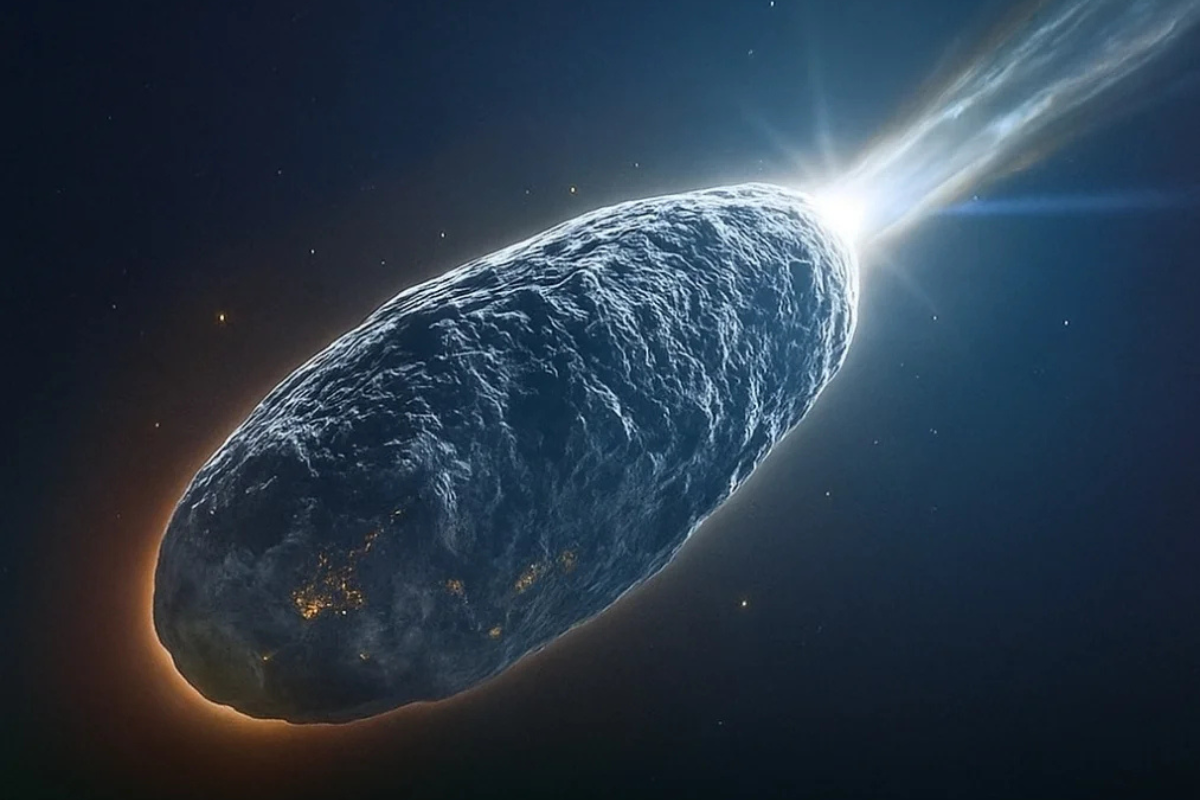
Avi Loeb, a prominent astrophysicist at Harvard University, has put forth a provocative theory regarding the interstellar object 3I/ATLAS. He suggests that if this celestial body, which appears to be a comet, does not exhibit a detectable gas cloud, it could indicate the presence of artificial technology rather than a natural phenomenon. This theory challenges conventional understanding and raises questions about the nature of interstellar visitors.
3I/ATLAS was first identified by the ATLAS survey team in Rio Hurtado, Chile, on July 1, 2025. It holds the distinction of being the third confirmed interstellar object to pass through our solar system. Unlike typical comets that orbit within the solar system due to the Sun’s gravity, 3I/ATLAS comes from beyond the heliosphere, indicating it was potentially ejected from another star system billions of years ago. Its hyperbolic trajectory confirms its interstellar origin, with speeds reaching up to 244,600 km/h.
Unusual Characteristics Spark Debate
Since its discovery, 3I/ATLAS has garnered significant attention from astronomers. It follows the earlier interstellar visitors: 1I/’Oumuamua, which exhibited no visible gas cloud, and 2I/Borisov, which behaved like a traditional comet by releasing gas. The naming convention—’3I’ signifies it is the third interstellar object, while ‘ATLAS’ references the discovery team—highlights its importance for studying extraterrestrial chemistry and motion.
Estimates of the object’s size suggest its nucleus could range between 0.44 and 5.6 km in diameter, translating to a mass of at least 33 billion tons if it is solid. This makes 3I/ATLAS significantly larger and heavier than 2I/Borisov. The object reached its closest point to the Sun, known as perihelion, on October 29, 2025, passing approximately 1.36 AU away, coinciding with a period when solar heat intensified and produced unexpected behaviors.
Loeb noted that the surface area required to account for the mass flow from large-scale jets extending towards the Sun is “untenable.” He stated, “Given the solar power per unit area, the jets require an object larger than Manhattan Island.” The latest images obtained by the Nordic Optical Telescope suggest that 3I/ATLAS does not exhibit the expected signs of fragmentation that would typically result in such jets.
Acceleration Raises Questions of Origin
One of the most intriguing aspects of 3I/ATLAS is its non-gravitational acceleration. This phenomenon, initially highlighted by Davide Farnocchia, a navigation engineer at NASA’s JPL, was observed through data collected by the Atacama Large Millimeter/submillimeter Array (ALMA). The object showed a 4 arcsecond deviation in its trajectory from what gravity alone would predict, suggesting an additional force at play.
“The acceleration must then point toward artificial propulsion,” Loeb argued, echoing earlier debates surrounding ‘Oumuamua.
Calculations indicate that the object would need to lose between 13% and 16% of its total mass to account for the observed change in trajectory. Notably, the first observations following perihelion showed no significant visible coma or typical comet tail, raising doubts about the efficiency of the outgassing process.
In addition to its unusual acceleration, 3I/ATLAS has displayed a striking change in color. Initially appearing reddish, the object shifted to a deep blue during its closest approach, which is atypical for comets. This color change might be attributed to ionized carbon monoxide emissions rather than the dust that usually contributes to a comet’s coloration.
Loeb has identified several additional anomalies, including the object’s orbit, which closely aligns with the solar system’s plane, a feature rarely observed in computer simulations. Its high speed and significant mass further complicate the narrative, as it is estimated to be a million times the mass of ‘Oumuamua and travels twice as fast.
Despite these anomalies, some scientists argue that natural explanations remain plausible. They suggest that interstellar objects, after enduring extensive exposure to galactic cosmic rays, may develop hard surfaces that trap volatile materials, causing unpredictable gas releases. Additionally, the characteristics of 3I/ATLAS could indicate it originated in a star system rich in carbon.
The broader implications of studying 3I/ATLAS extend beyond its peculiar behaviors. The insights gained could enhance understanding of the diverse environments in which planets form outside our solar system. Ongoing observations from NASA’s ExoMars TGO, the European Space Agency’s Hubble, and ground-based observatories such as the Keck Observatory will be essential in verifying predictions about mass loss and the object’s behavior.
If subsequent observations planned for December 2025 do not confirm the presence of a gas cloud, the debate regarding the nature of 3I/ATLAS is likely to intensify. For now, while some evidence hints at extraordinary possibilities, the prevailing view still leans towards a natural, albeit highly unusual, comet.
This ongoing investigation serves as a reminder of the complexities of our universe. As new data emerges, the scientific community must navigate the balance between empirical evidence and innovative theoretical possibilities.