
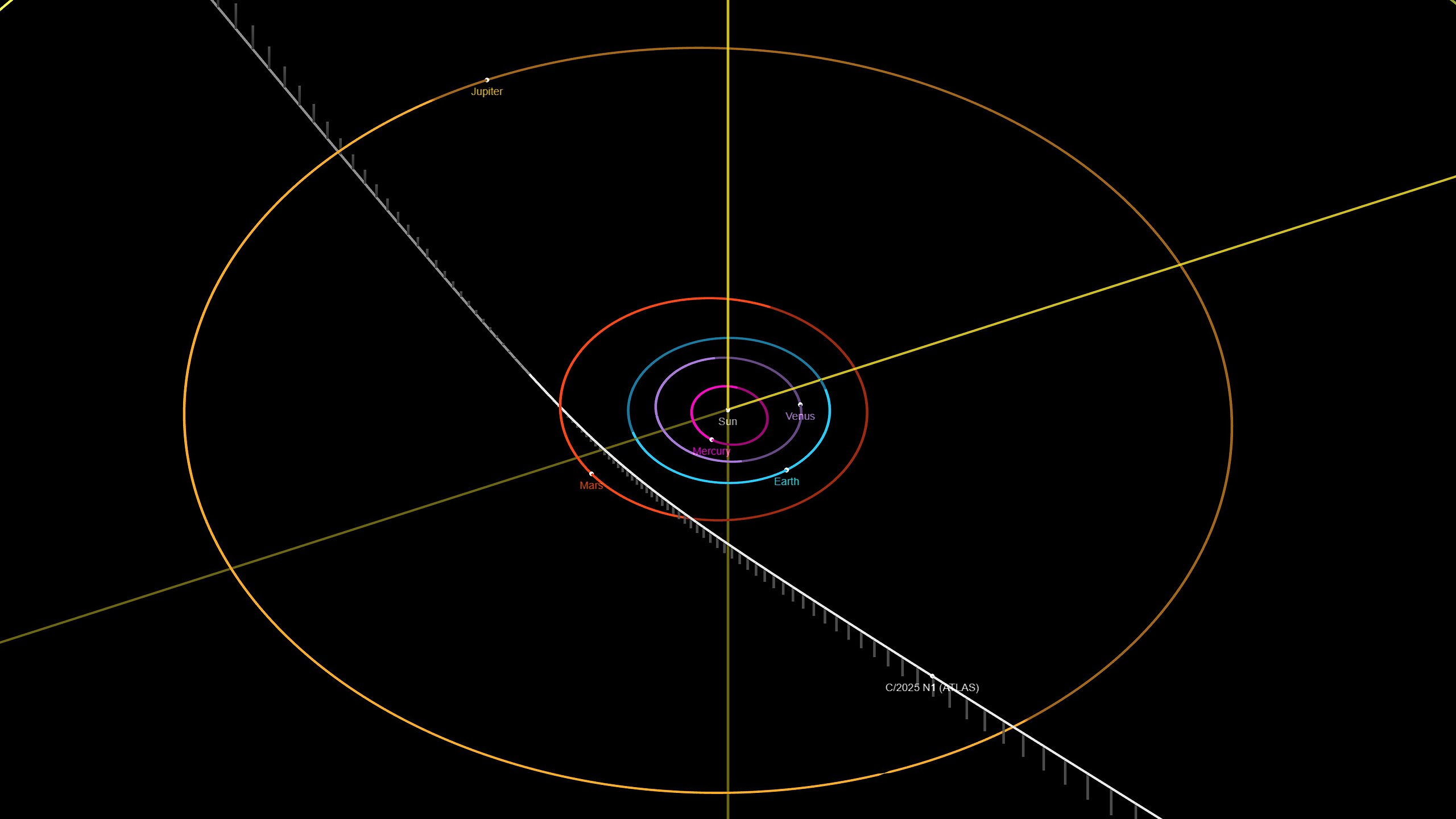
The interstellar comet known as 3I/ATLAS has drawn significant attention since its discovery, particularly regarding its unusual behavior and characteristics. Harvard astrophysicist Avi Loeb has raised questions about whether the comet’s jets and other features may indicate a non-natural origin, possibly hinting at extraterrestrial life.
In a recent update on his blog, Loeb pointed out that the jets emanating from 3I/ATLAS are unlike those typically observed in natural comets. He noted that even after the comet’s close passage to the Sun, it has not exhibited the expected breakup typical of such celestial objects. “Images taken of 3I/ATLAS on 11 November 2025 show a single body, with no evidence for breakup following the perihelion passage two weeks earlier,” he stated, emphasizing the comet’s intact nature despite the presence of large-scale jets.
Loeb’s hypothesis suggests that these jets might be indicative of a technological origin rather than a natural one. He proposed that “technological thrusters which point their exhaust towards the Sun would accelerate away from the Sun.” This maneuver could be employed by a spacecraft aiming to gain speed, rather than slow down during its approach to the Sun. To categorize interstellar objects, Loeb introduced a “Loeb Scale,” where a score of “0” indicates a natural object, while a score of “10” represents a technological object. Currently, he places 3I/ATLAS at a score of “6,” pending further observations as it draws nearer to the Sun.
Despite Loeb’s assertions, some experts remain skeptical. Qicheng Zhang, a postdoctoral fellow at the Lowell Observatory, argues that 3I/ATLAS appears to be a typical comet. “All the images I’ve seen show a fairly ordinary/healthy looking comet,” Zhang stated in an interview. “There’s no sign at all that the nucleus broke apart.” Zhang criticized Loeb’s interpretation, suggesting that it stems from a flawed understanding of the comet’s orbital parameters.
The renewed interest in 3I/ATLAS follows its recent visibility after disappearing behind the Sun in late October. As the comet approaches Earth, it is expected to make its closest approach on December 19, 2025.
While the scientific community continues to debate the implications of Loeb’s claims, the upcoming observations of 3I/ATLAS may provide more clarity on its enigmatic nature. The excitement surrounding the comet underscores the ongoing fascination with interstellar objects and their potential to reshape our understanding of the cosmos.


