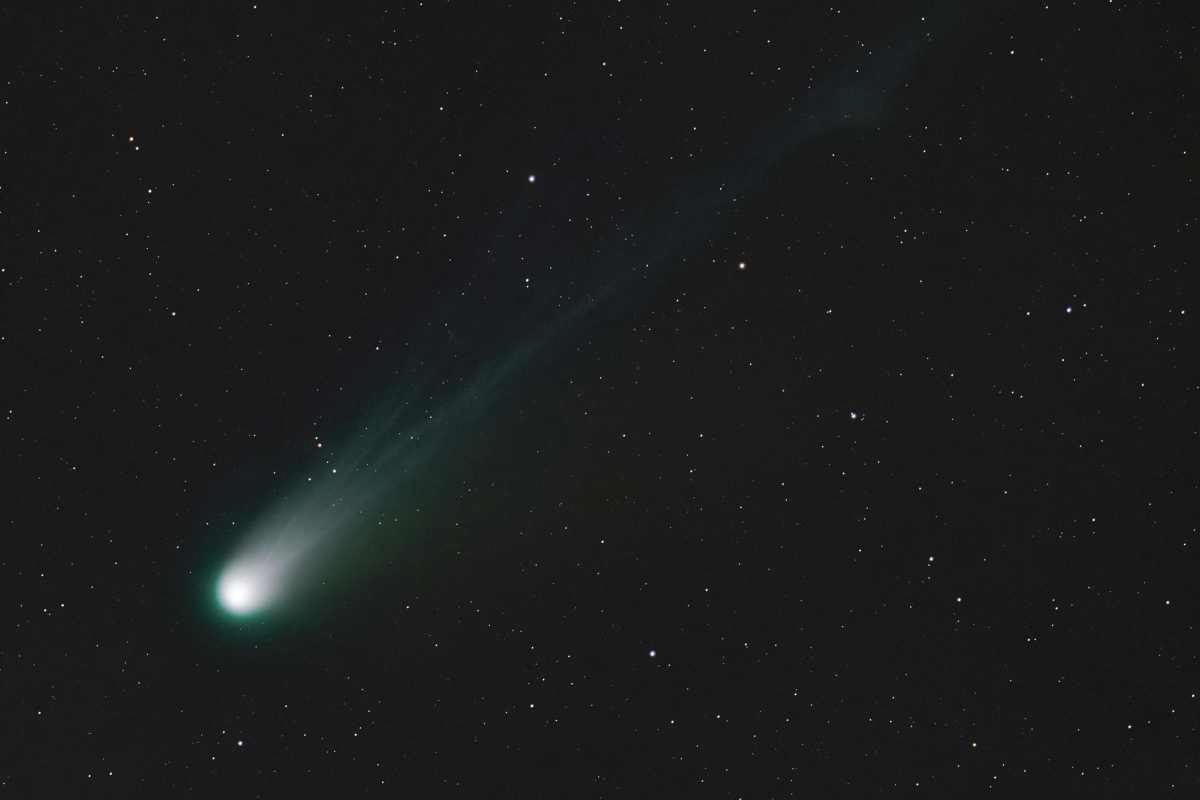
The discovery of the interstellar comet 3I/ATLAS on July 1, 2025, has intensified speculation about extraterrestrial life. Tesla CEO Elon Musk recently shared his views during an interview on the Joe Rogan Experience, addressing the growing theories surrounding this celestial object. As the third confirmed interstellar visitor, following 1I/’Oumuamua and 2I/Borisov, 3I/ATLAS exhibits unusual characteristics that have captivated both scientists and the public.
Astronomers from the Asteroid Terrestrial-impact Last Alert System first detected 3I/ATLAS as it traveled through our Solar System on a trajectory that will take it beyond the Sun. This Manhattan-sized object is believed to have been wandering for approximately 10 billion years. Its closest approach to Earth is scheduled for December 19, 2025, at a distance of 270 million kilometers. As it nears Earth, its velocity has been recorded at 57 km/s, prompting global interest and scrutiny.
3I/ATLAS’s perihelion, which occurred on October 30, 2025, revealed peculiar accelerations: a radial acceleration of 1.1 x 10^{-6} au per day squared away from the Sun, and a transverse acceleration of 3.7 x 10^{-7} au per day squared. Recent images captured by the Hubble Space Telescope show an increasing ion tail, while a radio signal detected from the comet has sparked further intrigue, although experts confirmed it as a natural emission.
Musk’s comments during the podcast reflect a mix of skepticism and curiosity. He dismissed the notion that 3I/ATLAS is an alien spacecraft, stating, “No, there are definitely comets and asteroids which are primarily made of nickel.” Yet, he also acknowledged the object’s unsettling traits, adding, “It could be alien, I don’t know.” This admission has only fueled the ongoing theories about the comet’s origins.
The discussion surrounding 3I/ATLAS has gained momentum, particularly after Avi Loeb, a Harvard astrophysicist, suggested that the comet’s non-gravitational accelerations and lack of a visible tail might indicate extraterrestrial technology. Loeb’s comments have contributed to a vibrant public discourse, as enthusiasts speculate about the implications of potential alien contact.
Amid this speculation, experts stress the need for empirical evidence. A growing body of observations suggests that 3I/ATLAS is a natural comet, not an artificial construct. “Despite claims that 3I/ATLAS may be an alien spaceship, a growing body of observations reveals it’s a natural comet,” a recent study noted. This clash between imaginative speculation and scientific inquiry highlights the thrilling nature of contemporary astronomy.
As the comet approaches its flyby, NASA plans to capture high-resolution images that may provide clearer insights into its nature. Whether 3I/ATLAS serves as a harbinger of alien contact or remains an icy relic from the depths of space, its journey reignites humanity’s quest to understand the cosmos. The anticipation surrounding its approach underscores the importance of vigilance against potential interstellar threats.
In summary, 3I/ATLAS represents a fascinating intersection of science, speculation, and public interest, drawing attention to the mysteries that lie beyond our planet. As we continue to explore these cosmic phenomena, the dialogue surrounding them will likely evolve, prompting further investigations into the origins and implications of such interstellar visitors.