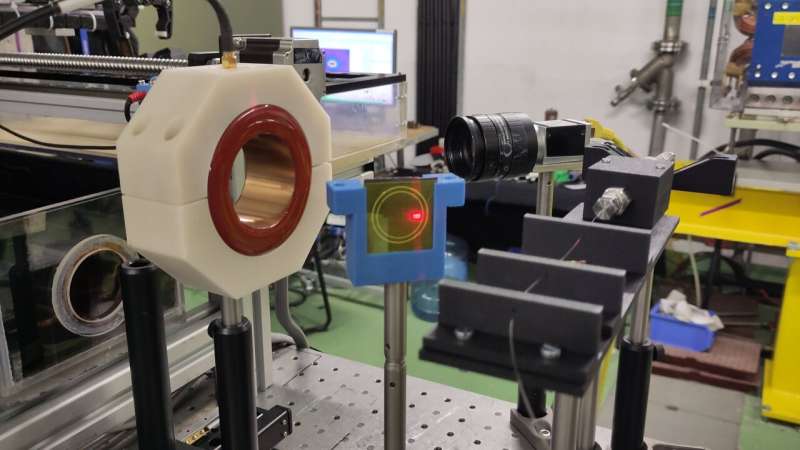
A team of researchers at the European Organization for Nuclear Research (CERN) is testing innovative hollow-core optical fibers that could significantly enhance monitoring capabilities in particle accelerators. These slender glass fibers, no thicker than a human hair, have demonstrated remarkable resilience under extreme radiation conditions, paving the way for improved beam diagnostics in future accelerator experiments.
The focus of this research is the use of hollow-core optical fibers to measure the profile and position of particle beams extracted from the Super Proton Synchrotron (SPS), CERN’s second-largest accelerator. Unlike traditional fibers that guide light through solid glass, these innovative fibers utilize a microstructured design that allows light to travel through a mostly empty core by leveraging resonance and antiresonance effects on the electromagnetic field.
By filling the hollow fibers with a scintillating gas—a gas that emits faint flashes of light when impacted by particles—scientists can create effective radiation sensors. These sensors not only help in adjusting beam profiles and positions but also have the potential to measure the delivered beam dose in real time. This represents a significant advancement compared to existing technologies like multi-wire proportional chambers, which struggle in high-radiation environments.
Enhancing Reliability for Future Accelerators
Reliable measurement of particle beams is essential for both experimental physicists and beam physicists. CERN’s accelerators depend on data from thousands of beam sensors distributed throughout the facilities. However, the integrity of these sensors can be compromised at high energies or intensities. This concern extends to researchers developing accelerators for medical applications, particularly in techniques like FLASH radiotherapy, which administers radiation at ultra-high dose rates for cancer treatment.
The collaboration between CERN’s beam diagnostics team and medical researchers is exploring new monitoring tools that can endure extreme radiation. This partnership aims to leverage accelerator expertise for the safe delivery of FLASH therapy to patients. Initial tests were conducted at CERN’s facilities, including CLEAR, in 2024 and 2025. During these tests, a fiber filled with an argon-nitrogen mixture was placed in the path of an electron beam, connected to a silicon photomultiplier capable of detecting single photons.
Each encounter with the beam caused the gas within the fiber to emit light, which was then transmitted to the detector. The results presented at the International Beam Instrumentation Conference were impressive. According to Inaki Ortega Ruiz, who leads the beam instrumentation consolidation for the SPS North Experimental Area, “The fiber’s measurements of the beam profile closely matched those from a traditional YAG screen, a crystal that glows when struck by particles.” Remarkably, even after exposure to radiation doses that would typically impair other instruments, the fiber exhibited no signs of performance degradation.
Future Developments and Long-term Goals
These initial findings are promising, but further research is planned to enhance the connection between the fibers and detectors. Future studies will involve testing sealed fibers pre-filled with gas and evaluating the long-term radiation hardness of the materials.
The potential applications of these hollow glass fiber sensors extend beyond theoretical research. As CERN continues to explore new technologies, the insights gained from these tests may contribute to advancements in both particle physics and medical treatment methodologies. The ongoing development of such tools could ultimately transform the way radiation therapy is administered, ensuring safer and more effective treatment options for patients facing cancer.
CERN’s dedication to advancing scientific knowledge through innovative research is evident in this project, highlighting the seamless integration of technology and healthcare. As the team forges ahead with their experiments, the future of particle accelerator monitoring and its medical applications looks increasingly bright.