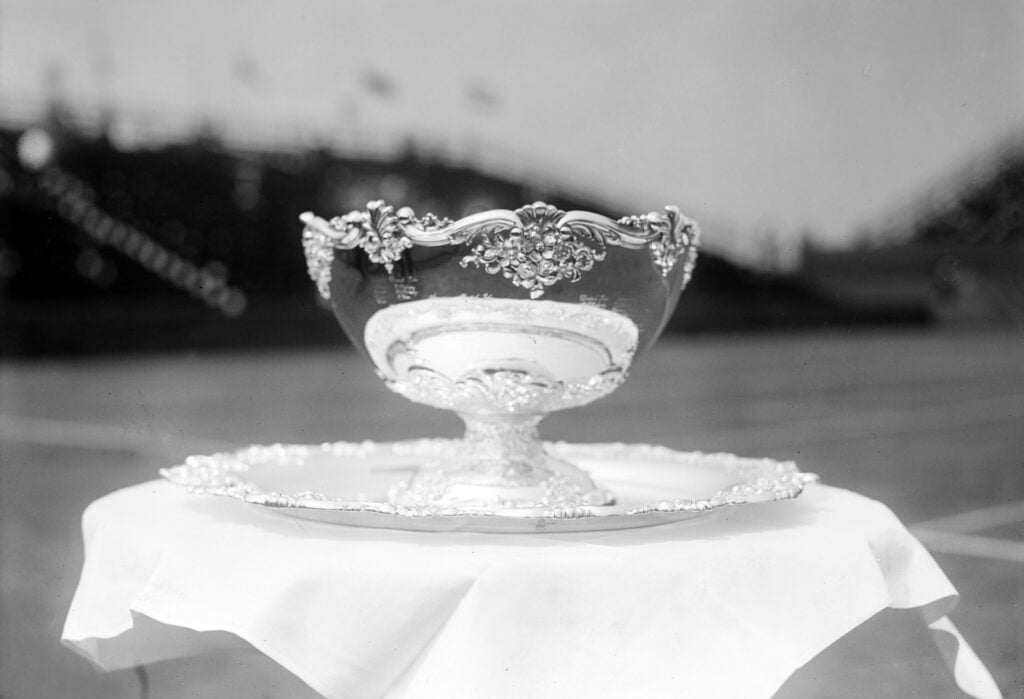
The Davis Cup marks its 125th anniversary this year, celebrating a significant milestone in the world of tennis. This prestigious competition originated in 1900, when members of the Harvard University Tennis Team proposed a challenge to their British counterparts. Following approval from the United States Lawn Tennis Association and the British Lawn Tennis Association, the inaugural match was set to take place at the Longwood Cricket Club in Boston, Massachusetts.
The first tournament featured a talented American team composed of Dwight Davis, Holcombe Ward, and Malcolm Whitman, while the British team included Ernest Black, Arthur Gore, and Herbert Roper Barrett. Initially recognised as the International Lawn Tennis Challenge, the event would later be named the Davis Cup in honour of its co-founder.
In the opening match, Dwight Davis set the tone for the competition by defeating Ernest Black with a score of 4-6, 6-2, 6-4, 6-4. Following this, Malcolm Whitman secured a second victory over Arthur Gore, who would eventually become a three-time Wimbledon champion, winning in 1901, 1908, and 1909. Whitman’s triumph came with a scoreline of 6-1, 6-3, 6-2, allowing Davis and Ward to clinch the overall tie in the doubles match. The American duo successfully defeated Black and Barrett 6-4, 6-4, 6-4, securing the first-ever Davis Cup victory for the United States.
Over the years, the United States has emerged as the most successful nation in Davis Cup history. The American team has claimed the title on 32 occasions, with their last win occurring in 2007 thanks to contributions from players such as Andy Roddick, James Blake, and the Bryan Brothers.
Great Britain, referred to as the British Isles during the early years of the competition, won its first title in 1903 by defeating the United States 4-1 at the Longwood Cricket Club. Since then, Great Britain has secured the trophy nine additional times, with the most recent victory in 2015.
The legacy of the Davis Cup owes much to its namesake, Dwight Davis, who not only contributed to the establishment of the competition but also purchased the first trophy, donating it for the inaugural contest. After a successful career in tennis, Davis transitioned into politics and was later inducted into the Tennis Hall of Fame.
In 1946, the competition was officially renamed the Davis Cup in memory of Davis, who passed away in 1945. That year, the United States claimed its 13th title by defeating Mexico 5-0, further solidifying its dominance in the tournament.
As the Davis Cup celebrates this significant anniversary, it continues to be a cornerstone of international tennis, reflecting the sport’s rich history and the enduring spirit of competition among nations.