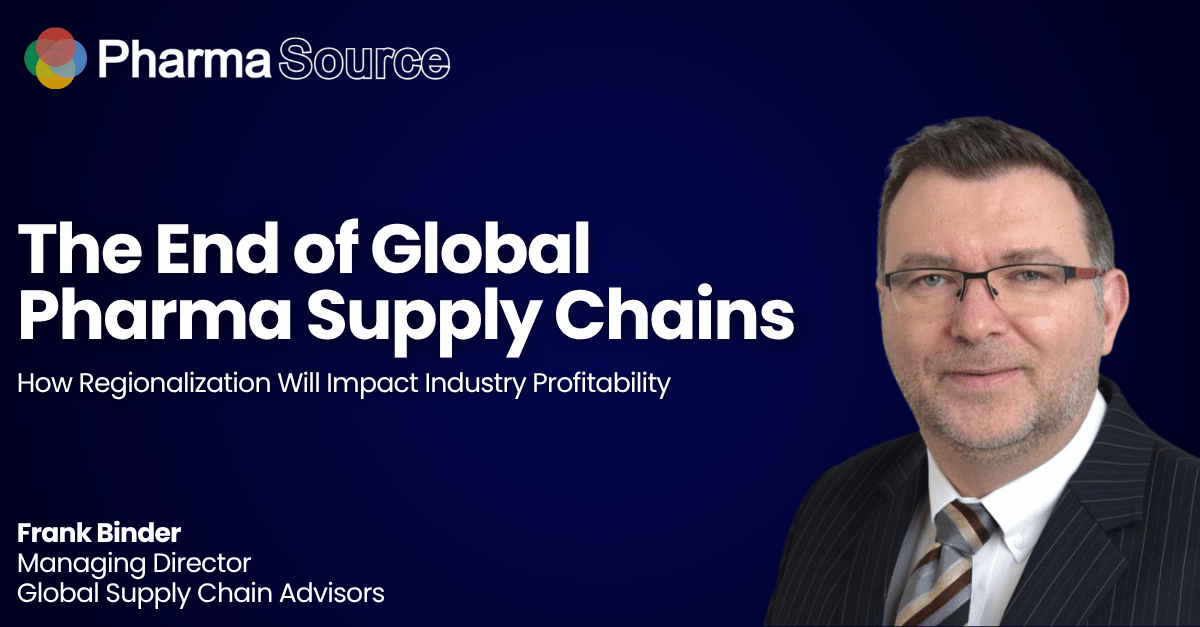
The pharmaceutical industry is facing a seismic shift in its supply chain operations due to recent U.S. tariff announcements and a move toward regionalization. According to Frank Binder, Managing Director at Global Supply Chain Advisors (GSCA), the disruptions witnessed in 2025 are not a temporary phase but a long-term transformation that will impact industry profitability for decades.
Binder emphasizes that the era of rule-based international trade has ended, creating a new landscape where pharmaceutical companies must adapt quickly. In a recent episode of the PharmaSource podcast, he outlined the challenges and practical steps companies can take to build resilient supply chains in this evolving environment.
The Impact of U.S. Tariffs on Pharmaceuticals
The U.S. represents over 10% of global trade across all industries, but its significance is pronounced in pharmaceuticals. While the U.S. market dominates, recent tariff announcements have unsettled the sector. Binder notes, “For pharma, it has been quite unsettling. Even though the U.S. makes about 10% of all trades globally, for pharmaceuticals it’s very different. The U.S. as a market is still number one in the world.”
The proposed 100% tariffs on pharmaceuticals would mark a major departure from previous trade practices where the industry enjoyed exemptions. Although many of these tariff threats have been suspended pending individual company negotiations, the uncertainty surrounding tariffs and pricing, particularly due to the Most Favored Nation policy, has left companies paralyzed in decision-making.
Short-Term Disruptions and Compliance Challenges
The consequences of these tariffs have already manifested in altered shipping patterns. Swiss and European pharmaceutical companies rushed to ship significant volumes of finished products into the U.S. before the implementation of tariffs, resulting in temporary spikes in shipping activity.
“Import complexity has increased significantly,” Binder explains. “When I talk to my colleagues engaged in trade compliance in the U.S., the rules have multiplied and are not always clear.” U.S. Customs and Border Protection, alongside the FDA, has heightened enforcement, making compliance more challenging for companies. Binder advises those uncertain about their import compliance to seek expert assistance promptly, as major sourcing shifts are anticipated once trade agreements are finalized.
Despite announcements of over $400 billion in U.S. manufacturing investments, Binder expresses skepticism about the realization of these commitments. “There is a movement toward reshoring that’s very clear, but making sound investment decisions amidst such uncertainty is a real challenge,” he states. The previous norms of international trade and tariff exemptions are rapidly evolving, necessitating immediate action from companies to adapt.
Infrastructure Challenges and Investment Competition
Even legitimate reshoring efforts face hurdles. Investments are likely to concentrate in established pharmaceutical hubs such as Research Triangle Park, Boston, and San Diego, leading to fierce competition for construction labor, operators, and specialized equipment. “Construction costs will rise due to tariffs on aluminum and steel, making it increasingly difficult and expensive to secure specialized equipment,” Binder warns.
As companies navigate these challenges, the shift from global to regional supply chains is becoming apparent. While some active pharmaceutical ingredients (APIs) will continue to be globally sourced, Binder anticipates that for high-revenue drugs particularly exposed to tariffs, companies will adopt dual sourcing strategies to enhance supply chain resilience.
Embracing Contract Manufacturing for Speed and Flexibility
Contract development and manufacturing organizations (CDMOs) present a faster alternative to building new plants. “Starting a project to build a new manufacturing plant can take years and cost hundreds of millions of dollars,” Binder explains. Collaborating with a suitable CDMO can facilitate quicker market entry without significant investments.
Companies like Wuxi are leading the charge by providing dual sourcing options from the outset, even during clinical development. This approach not only accelerates technology transfers but also enhances supply chain resilience in an environment of increasing protectionism.
Active pharmaceutical ingredients (APIs) are crucial for maintaining supply chain stability. Their longer shelf life and retest options enable better inventory management. “APIs can be stored more easily due to smaller volumes, which can significantly improve supply chain resilience,” Binder highlights.
Learning from Rare Earth Elements
Binder cites the example of rare earth elements, where China controls 80% of global supply, as a cautionary tale for the pharmaceutical sector. Many countries have allowed their industries to decline in this area, thus forfeiting supply chain resilience. “As a pharma industry, we shouldn’t get ourselves into this kind of situation,” he warns, calling for sharper risk assessment and strategic thinking in sourcing decisions.
Strategic Recommendations for the Future
To navigate these complexities, Binder advocates for comprehensive Enterprise Risk Management programs that identify critical products and areas requiring resilience. “Pharma companies need to ensure they have well-resourced and well-funded programs in place that align with commercial priorities,” he advises.
Business continuity management plans must include specific actions to enhance supply chain flexibility and agility. Companies should also consider implementing end-to-end planning systems that support scenario planning to react effectively to disruptions.
Looking ahead, Binder expects the push for onshoring and regionalization to persist. Governments worldwide are increasingly advocating for domestic production, which will likely lead to higher costs and reduced profitability in the pharmaceutical industry. “Pharma supply chains will be more regionalized within three to five years, though global elements will remain,” he concludes.
Companies that proactively build resilient and flexible networks, supported by thorough risk assessments and technological infrastructure, will be better positioned to thrive in this new era of supply chain management.