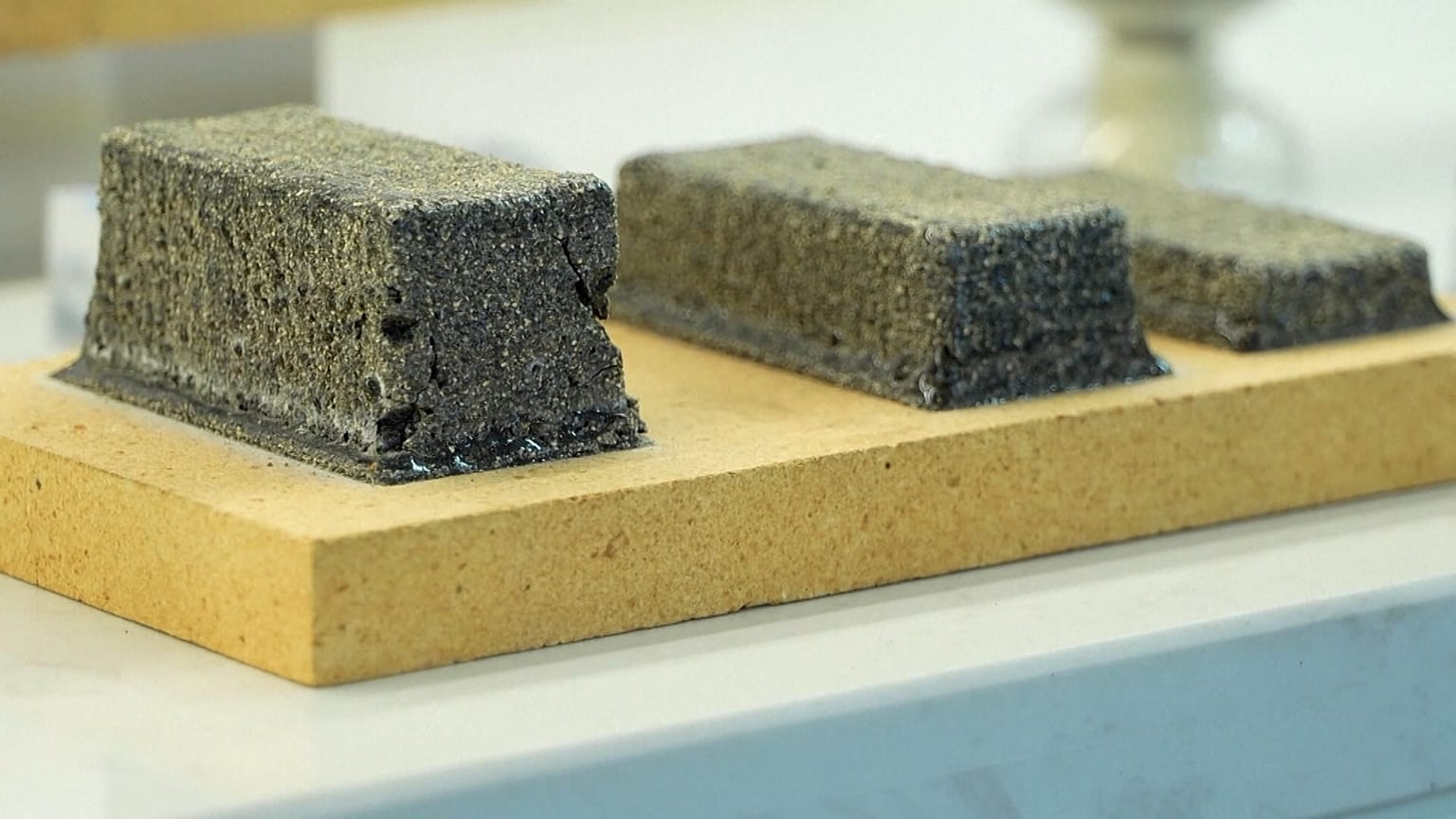
China has made significant strides toward its goal of establishing a base on the Moon with the successful return of experimental ‘lunar soil bricks’ from space. These specially engineered blocks, which spent a year exposed to the harsh conditions of low Earth orbit, were recovered last week aboard the Shenzhou-21 spacecraft, which also brought back three astronauts completing a six-month mission.
Initial assessments of the 34 lunar soil bricks indicate they withstood the rigors of space travel remarkably well. According to Zhou Yan, an associate professor at Huazhong University of Science and Technology in Wuhan, “Upon opening the lid, we found that the samples were in good condition. There were no dents, holes, or other visible defects that we thought they might have because of impacts by meteorites or space debris.” He noted that the bricks appeared slightly lighter in color than before, prompting further investigation into the changes.
Innovative Techniques for Lunar Construction
Each brick, weighing approximately 100 grams, was crafted using materials designed to mimic the composition of lunar regolith. The manufacturing process involved techniques such as hot pressing, electromagnetic induction, and microwave sintering. These methods resulted in bricks boasting a compressive strength nearly three times that of standard bricks, making them more suitable for the extreme conditions on the Moon.
Graduate student Qin Yiheng, involved in the project, explained that some samples were sent into space complete, while others were pre-designed with 45-degree symmetrical seams. This was done to observe how their mechanical properties would change after a year in orbit. The ongoing experiment also examines the thermal behavior and radiation resistance of the bricks under prolonged exposure to space conditions. A control group on Earth will provide a basis for researchers to analyze the differences and effects of the space environment.
Long-Term Goals and Future Research
With the return of these samples, researchers aim to establish a predictive model for the bricks’ performance over extended periods—specifically, five, ten, and even twenty years of service on the lunar surface. Zhou stated, “After the return of the third batch of samples, based on more horizontal comparisons, we may be able to discover a pattern and ultimately build a model, so that we can predict what they will look like after five, 10 or 20 years of service.”
China’s ambitious lunar program envisions landing astronauts on the Moon by 2030 and constructing a basic version of its planned International Lunar Research Station by 2035. To minimize the high costs associated with transporting materials from Earth, the country plans to capitalize on in-situ resources such as lunar soil, solar energy, and surface minerals. The successful return of the lunar soil bricks represents a crucial step toward making this vision a reality and advancing human presence on the Moon.