
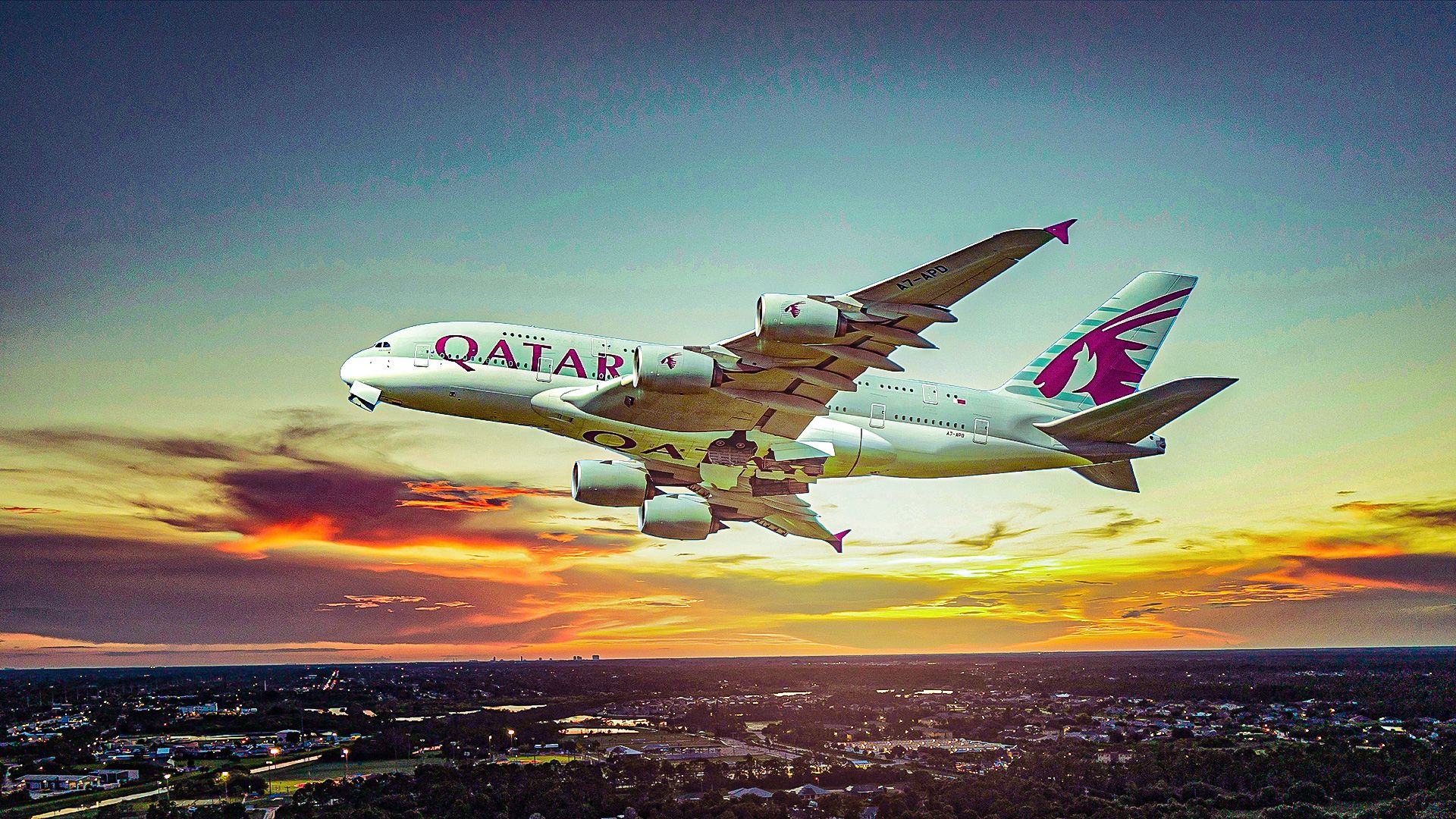
The aviation landscape between Europe and the Middle East is bustling this December, with a total of 42,650 flights planned, according to scheduling data from Cirium, an aviation analytics company. These routes will offer 10,171,306 seats and cover an impressive 23,760,435,486 available seat miles. Among the airlines operating these routes, Qatar Airways leads the field with the highest frequency of flights.
Qatar Airways Takes the Lead
In December, Qatar Airways will operate 292 flights each way between Doha (DOH) and London Heathrow Airport (LHR), averaging approximately 9.4 flights daily. The airline’s fleet includes the Boeing 777-300ER for half of these flights, while the remainder will be serviced by the Airbus A350-900, A350-1000, A380, and Boeing 777-200LR. Earlier this year, Qatar Airways announced an increase in its service on this route, expanding from eight to a maximum of ten daily return flights. This boost is supported by two daily flights from its oneworld partner, British Airways.
Thierry Antinori, Chief Commercial Officer of Qatar Airways, expressed that this increase in frequency reflects the airline’s commitment to enhancing passenger experiences at Hamad International Airport, which has been recognized as the best airport in the Middle East.
Other Key Players in the Market
In addition to Qatar Airways, other significant airlines are contributing to high-frequency routes between Europe and the Middle East. flydubai ranks second this December with a planned 217 round trips to Moscow Vnukovo (VKO), averaging seven flights per day using the Boeing 737-800 and 737 MAX 8. Emirates closely follows, with 213 flights scheduled in each direction between Dubai and London Heathrow, primarily utilizing the Airbus A380, alongside occasional services from the Boeing 777-300ER.
Turkish Airlines also plays a crucial role in this market, operating the fourth, fifth, and sixth most frequent routes from its hub at the new Istanbul Airport (IST). These routes include Jeddah (JED) with 169 flights, Tehran (IKA) with 138 flights, and Beirut (BEY) with 132 flights, all scheduled for December 2023. The airline reported a nearly 20% increase in passenger traffic in October, indicating a strong demand for travel in the region.
While frequency provides an insight into route popularity, it does not fully capture passenger capacity. For example, while flydubai and Emirates show similar frequencies between Dubai to Moscow and London, the seat capacity on the London route is significantly higher. Emirates’ flights between Dubai and London Heathrow feature a total of 101,821 seats, compared to flydubai’s 36,650 seats for the Moscow route.
In terms of seat capacity, Qatar Airways’ Doha to Heathrow route leads with 102,457 outbound seats and 102,501 inbound seats scheduled this December. Emirates’ additional routes to London Gatwick and Manchester (MAN) also rank high, with 54,031 and 52,746 seats respectively. Furthermore, Etihad Airways is positioned fifth for seat capacity on its route from Abu Dhabi International (AUH) to London Heathrow, offering 50,820 seats each way with four daily rotations primarily using the Airbus A380 and Boeing 787-9.
As the December travel season approaches, the competition among these airlines underscores the strategic importance of the Europe-Middle East corridor, not only for direct travel but also as a hub for connecting flights to Asia and beyond.


