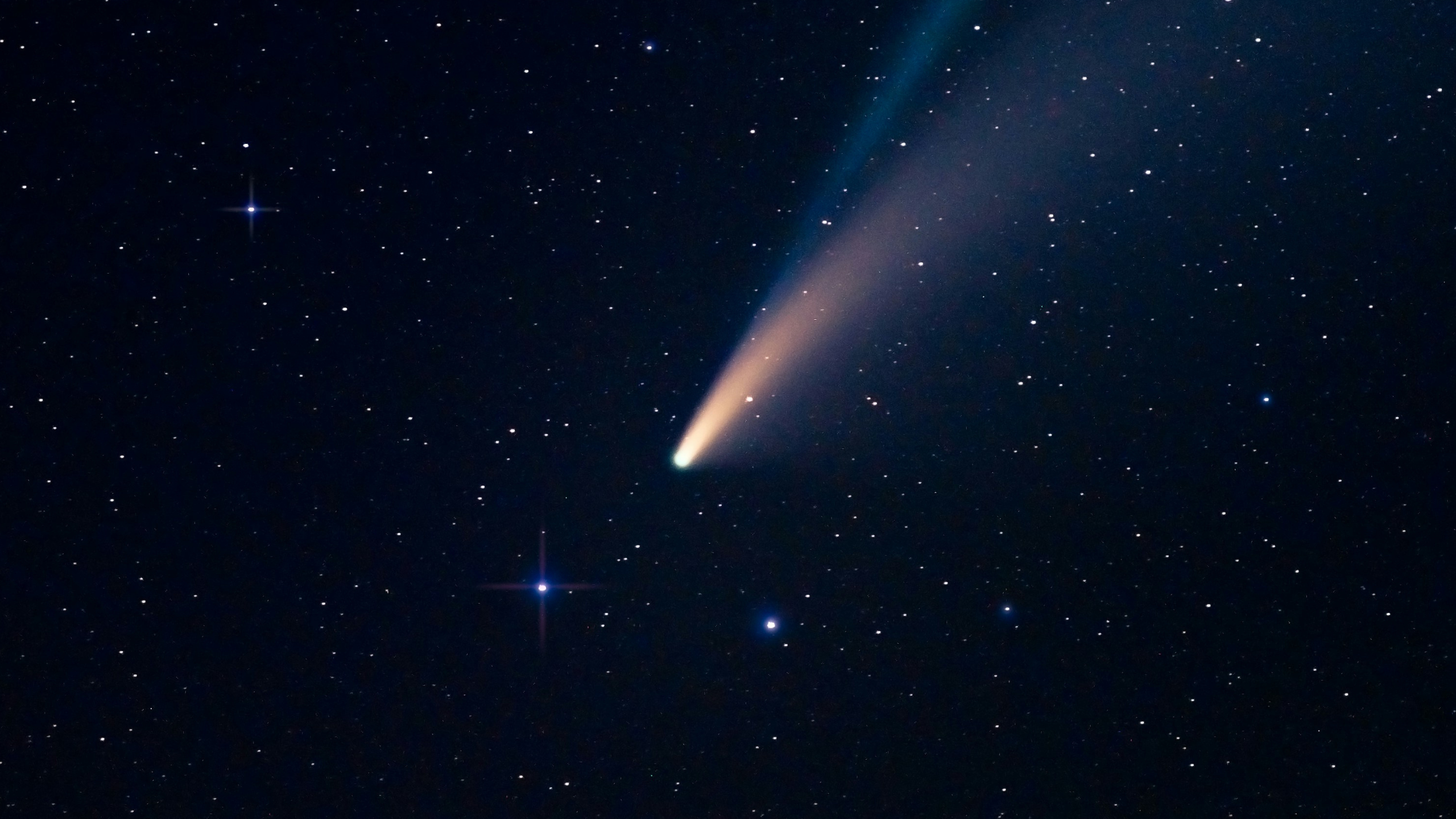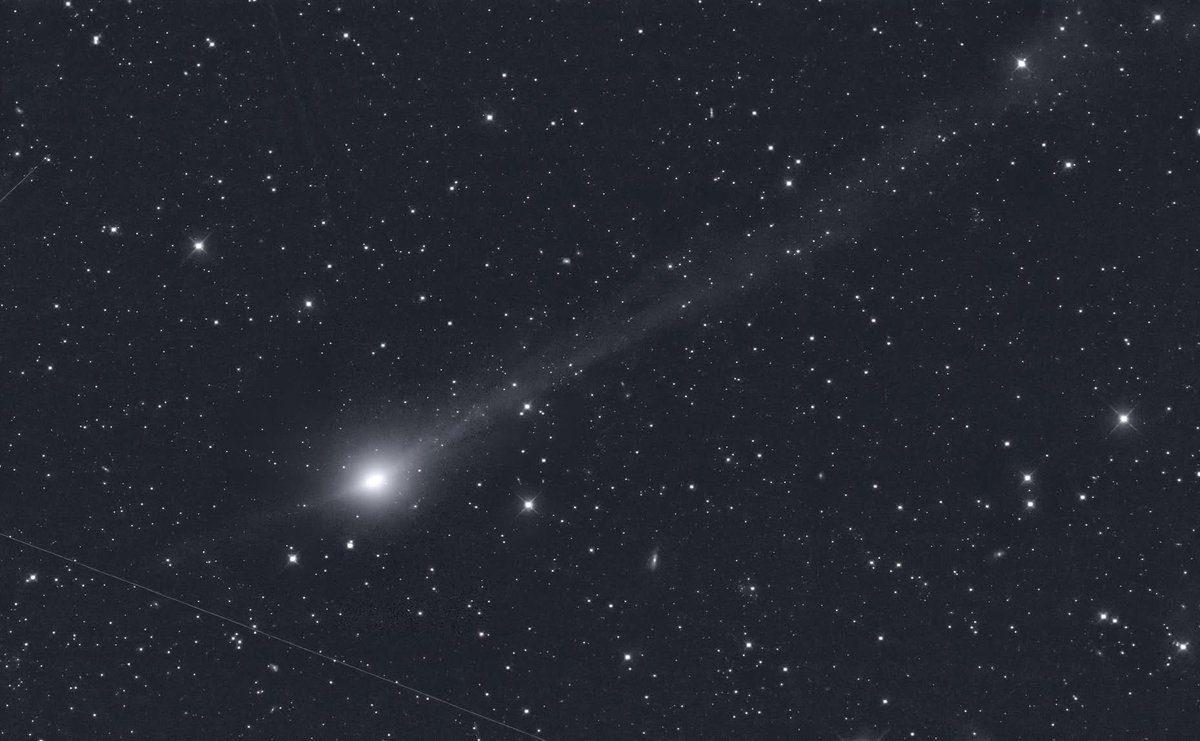
Astronomers have unveiled remarkable new images of comet 3I/ATLAS, showcasing a spectacular double tail as it approaches Earth. First identified in July, this rare interstellar visitor has been under close observation by leading observatories worldwide. As it prepares for its closest approach on December 19, 2023, significant data has emerged from the joint efforts of the European Space Agency (ESA) and NASA.
These organizations are utilizing instruments such as the Hubble Space Telescope and the Jupiter Icy Moons Explorer (Juice) to gather vital information about the comet’s trajectory and composition. The observations are crucial for understanding the nature of celestial bodies that originate outside our solar system. Comet 3I/ATLAS is notable because it is only the third interstellar object recorded passing through our solar system.
Since its discovery, researchers have been eager to gather as much information as possible before the comet departs. The latest images highlight the comet’s chaotic surface, particularly during its recent solar encounter, which intensified the sublimation process. As the comet neared the sun in October, it released gases that provided scientists with valuable insights into its elemental makeup.
Hubble was one of the first telescopes to capture detailed images of 3I/ATLAS shortly after its discovery. Its initial observations revealed the comet’s teardrop shape, paving the way for subsequent imaging efforts. On November 30, 2023, Hubble again focused its Wide Field Camera 3 on the comet, which at that time was approximately 286 million kilometres (or 178 million miles) from Earth. The telescope managed to obtain even clearer images of the comet as it approached.
Meanwhile, the ESA’s Juice mission, currently en route to study Jupiter and its icy moons, took advantage of its position to observe 3I/ATLAS in early November. At that time, Juice was about 66 million kilometres (or 41 million miles) away from the comet. The mission team employed five scientific instruments alongside the onboard Navigation Camera (NavCam) to gather data. To expedite the process, they downloaded a quarter of a single image from NavCam, which has already provided crucial information about the comet’s activity.
The images released from Juice show a glowing coma—an envelope of gas surrounding the comet—along with two distinct tails. The plasma tail is composed of electrically charged gas, while the dust tail is formed by solid particles being released into space. The ESA noted via Twitter, “Our @ESA_JUICE spacecraft captured comet #3IATLAS during its active phase, showing its glowing coma, plasma tail, and possibly a dust tail.”
Due to Juice’s location, retrieving high-quality images has been challenging. Most of the data from this flyby is expected to arrive on Earth in mid-February 2024, with a full dataset anticipated between February 18 and 20, 2024. Scientists are eager for this information, which could provide clearer images and possibly reveal more about the comet’s origins.
Comet 3I/ATLAS is projected to pass within 270 million kilometres (or 167 million miles) of Earth on December 19. Experts have confirmed that it will be on the opposite side of the sun during this pass, posing no danger to our planet. For context, Earth is situated roughly 150 million kilometres (or 93 million miles) from the sun.
According to NASA, the comet is expected to remain visible to telescopes and space missions for several months before it exits our solar system. While the appearance of 3I/ATLAS is captivating, the Juice mission has a much longer journey ahead. Launched in April 2023, the probe is scheduled to arrive at Jupiter in July 2031, focusing on whether its three largest moons—Ganymede, Callisto, and Europa—could potentially harbor life beneath their icy surfaces.