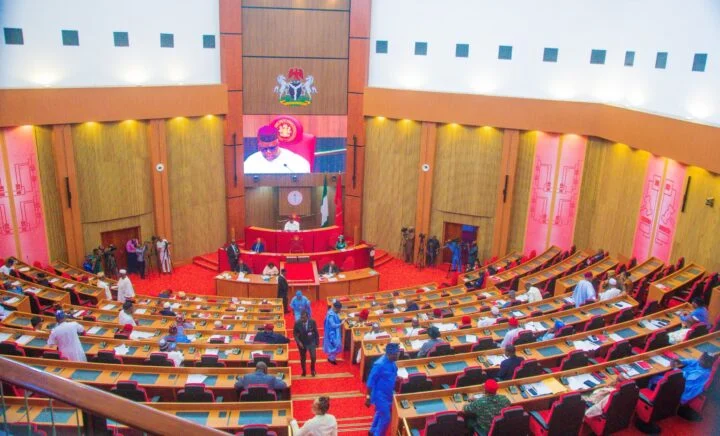
The Nigerian Senate has issued a stern warning regarding the proposed N58.472 trillion 2026 budget, indicating that it may face cuts due to what lawmakers describe as unrealistic revenue projections and shortcomings in capital budget implementation. This warning emerged during a heated session between the Senate Committee on Appropriations and the federal government’s economic team on October 19, 2023, where legislators raised serious concerns about the credibility of key financial assumptions underpinning the ambitious budget proposal.
Lawmakers expressed skepticism over the government’s anticipated oil performance benchmarks, pointing to historical discrepancies between projected and actual oil revenues. Senator Solomon Adeola, chairman of the Senate Committee on Appropriations, highlighted that previous years saw performance rates as low as 18% and 36.5%, questioning the government’s ability to meet its revenue targets. He stated, “How do we explain this level of underperformance?” Adeola emphasized that the budget must reflect realistic projections, especially in light of Nigeria’s debt stock, which currently stands at approximately N152 trillion.
In response to these concerns, the National Assembly has proposed a take-off grant of N1.5 trillion for the Federal Ministry of Art, Culture, Tourism and the Creative Economy (FMACTCE). This funding aims to reposition the sector as a significant contributor to economic diversification, reducing the nation’s reliance on oil revenue. During the ministry’s budget defense, Hannatu Musa Musawa, the minister in charge, projected that the creative economy could contribute $100 billion to Nigeria’s Gross Domestic Product (GDP) and generate over 2.5 million jobs by 2030.
The Senate’s scrutiny of the budget continued with Wale Edun, the Minister of Finance and Coordinating Minister of the Economy, defending the oil production benchmark of 1.84 million barrels per day as a “stretch target.” He explained that this target is intended to encourage higher performance and avoid complacency in oil production. Edun maintained that as long as the government does not exceed its spending limits, the budget remains manageable. He assured the committee that security spending is prioritized, revealing that emergency funds have already been allocated for military procurements.
The discussion also included input from Dr. Zacch Adedeji, chairman of the Nigeria Revenue Service (NRS), who aligned with lawmakers on the necessity of realistic revenue projections. He cautioned that overestimating revenue could lead to budget inefficiencies. Adedeji explained that under the current Petroleum Industry Act, government revenue from oil derives mainly from taxes and royalties, rather than direct sales, underlining the need for scrutiny of cost structures and fiscal discipline.
Concerns over poor capital budget releases were also revisited, particularly regarding the minimal implementation of the 2024 and 2025 appropriations. Dr. Doris Nkiruka Uzoka-Anite, Minister of State for Finance, assured the committee that outstanding capital components for these years would be fully implemented by March 31, 2026. She stated that disbursements for capital projects would commence immediately, and that ministries have been instructed to submit their cash plans.
The Senate’s deliberations concluded with a clear message: unless the executive branch revises its assumptions and offers more credible revenue guarantees, the National Assembly may have to reduce the proposed budget. This decision, lawmakers argue, is essential for ensuring fiscal realism and sustainable economic management.
In a related development, Senator Mohammed Onawo, chairman of the National Assembly Joint Committee on Culture, Art and Creative Economy, indicated that the legislature is prepared to engage President Bola Tinubu regarding the need for substantial seed capital to enable the ministry to operate autonomously. Onawo challenged the ministry to determine the necessary funding to function without relying on federal allocations, stating, “Whatever we agree here, we will discuss with the Senate leadership and Mr. President.”
This ongoing dialogue highlights the potential transformative role of Nigeria’s creative and tourism sectors, which lawmakers believe could significantly enhance the country’s economic landscape. With appropriate funding and policy reforms, the ministry could emerge as a leading revenue-generating agency for the government.