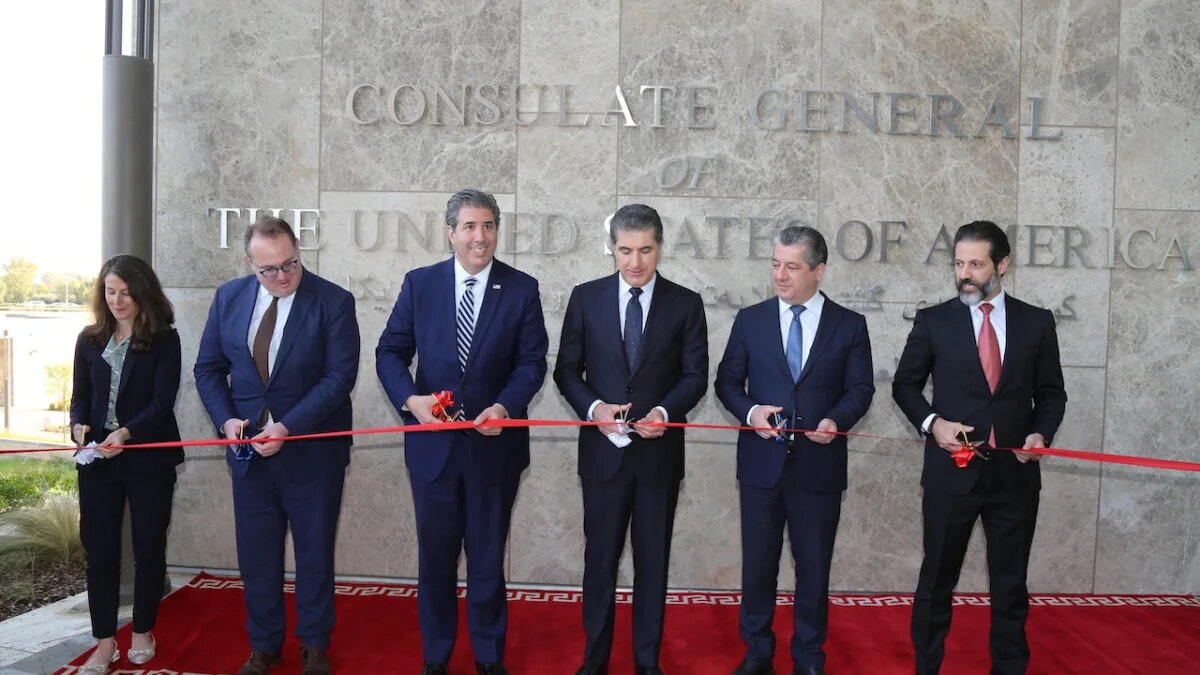
The United States inaugurated a new diplomatic compound in Erbil, the capital of Iraq’s semi-autonomous Kurdistan region, on Wednesday. This facility, which spans 206,000 square meters, is now the largest US consulate globally. The unveiling comes as the US draws down its military presence in Baghdad and other areas of Iraq, shifting focus toward the Kurdish region.
Construction of the consulate began in 2018, with a reported cost of approximately $800 million, according to a 2019 US government report. Over the years, Erbil has served as a key base for US troops involved in operations against the Islamic State militant group (IS). Earlier this year, the US military announced the completion of combat operations in Iraq against IS. In a strategic pivot, the US plans to transition the rationale for its troop presence from countering IS to establishing a mutual defense partnership with the Iraqi government.
Iraqi news outlet Kurdistan 24 reported that most US forces remaining in Iraq will be relocated to Erbil. The US military presence has been a contentious topic for both American and Iraqi citizens. Many Americans express frustration over prolonged military engagements, while Iraqis reflect on the legacy of the 2003 US invasion and the ensuing conflict.
As Iraq approaches elections scheduled for November 2024, Prime Minister Mohammed Shia al-Sudani emphasized the challenges in disarming Iran-backed militias, stating that such efforts could only proceed after foreign troops depart. His political bloc recently secured the largest number of seats in the election, but ongoing negotiations with other parties leave his leadership uncertain.
“There is no ISIS. Security and stability? Thank God it’s there … so give me the excuse for the presence of 86 states,” al-Sudani commented, referencing the coalition formed against IS in 2014.
While the new consulate is primarily a diplomatic entity, its presence carries political weight. During the opening ceremony, Michael Rigas, US Deputy Secretary of State for Management and Resources, described the building as a testament to America’s commitment to Iraq and the Kurdistan Region. He stated, “The existence of this diplomatic center here is a clear political message regarding the importance of Erbil and the Kurdistan Region.”
In his remarks, Nechirvan Barzani, President of the Kurdistan Region, highlighted the consulate’s significance in fostering a deeper partnership with the US. Rigas noted that Washington views the Kurdistan Region as a vital gateway for American companies to access Iraqi markets. Numerous US firms, including oil giant ExxonMobil, have significant investments in the region and have resumed operations after recent absences.
Erbil has long contested with Baghdad over the management of Iraq’s oil resources. The US has been active in lobbying for the reopening of a crucial pipeline that links the Kurdistan region’s oil fields to Turkey’s Ceyhan port. This pipeline had been closed in 2023 due to disputes over oil sales profits between Erbil and Baghdad, though it reopened earlier this year. The status of the pipeline remains uncertain as negotiations continue among Erbil, Ankara, and Baghdad.
In recent months, security in the region has faced challenges. A July 2024 drone attack attributed to Iranian-backed militias targeted oil fields in the Kurdistan region. Additionally, a rocket attack last month affected facilities at the Khor Mor gas field, disrupting production and causing power outages.
The Erbil government has sought enhanced US security cooperation, including the acquisition of air defense systems, a request opposed by both Baghdad and Iran. The opening of the new consulate underscores the evolving dynamics in US-Iraq relations and the strategic importance of the Kurdistan region in the broader geopolitical landscape.