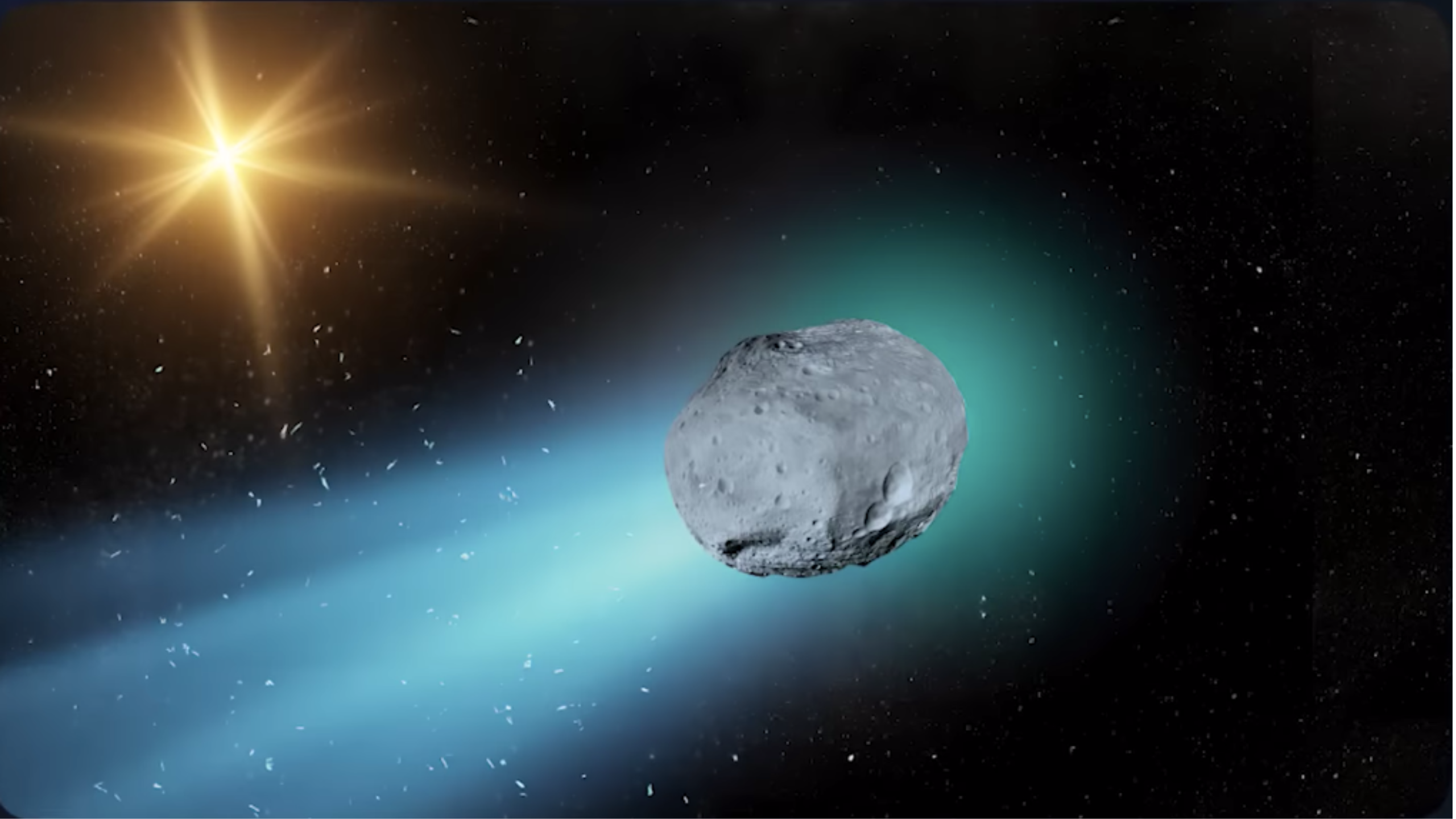
The interstellar object known as 3I/ATLAS has undergone a dramatic transformation following its close pass by the Sun. Rather than simply surviving the encounter, the object now emits a hazardous mix of gases, showcasing characteristics that diverge significantly from typical comet behavior. Recent data from advanced observatories reveal that the intense solar heat has instigated chaotic changes, including the release of toxic chemicals into space.
Observations from the SPHEREx space observatory during the period from December 8 to December 15, 2025, provide critical insights into these changes. The observatory captured infrared images across wavelengths from 0.75 to 5.0 microns, covering expansive areas approximately 300,000 kilometres in size, equivalent to the distance between Earth and the Moon. These images depict a distinct pear-shaped distribution of dust and organic material, with an unusual ‘anti-tail’ extending toward the Sun, contrasting sharply with nearly round gas plumes identified in earlier data.
Among the chemical signatures detected were significant amounts of cyanide at 0.93 microns and carbon monoxide within the 4.7–4.8 microns range. This creates a dangerous envelope surrounding the nucleus of 3I/ATLAS. The spectral data also indicated the presence of water, organics, and carbon dioxide, with the latter forming a massive plume that extends hundreds of thousands of kilometres outward.
A comparative analysis of this new data with earlier observations reveals striking differences. In August 2025, features indicating the presence of water ice were prominent; however, these have since disappeared. According to a January 16, 2026, post by Harvard professor Avi Loeb, the current spectrum is dominated by organo-silicaceous dust grains instead of ice. Notably, the production of water gas has surged dramatically, increasing by a factor of approximately 20 compared to pre-perihelion levels.
This surge in water emission appears to have facilitated the release of other materials, as spectral features for cyanide and organic compounds emerged post-encounter. Furthermore, the data highlighted a notable absence of submicron dust particles, aligning with the object’s unusual behavior. Unlike typical comets that form tails driven by radiation pressure, 3I/ATLAS is shedding mass in a distinct manner.
Research led by Carey Lisse indicates that the object is losing water at a rate of about 180 kilograms per second, a figure comparable to the mass loss of carbon dioxide and about two-thirds of the carbon monoxide loss rate. Brightness maps suggest that the origins of these emissions vary; cyanide and organic materials stem from the dust itself, while water, carbon dioxide, and carbon monoxide gases appear to be released from a symmetric region around the nucleus. This symmetry, combined with the extensive carbon dioxide plume, suggests that an internal process is driving the gas emissions.
To supplement the infrared data, the Hubble Space Telescope captured images on January 14, 2026, revealing further structural complexities of 3I/ATLAS. These images showed a glowing halo extending over 130,000 kilometres toward the Sun, alongside a sunward-directed anti-tail and three evenly spaced mini-jets. Research co-authored by Loeb and Toni Scarmato suggests that the orientation of this jet system exhibits a wobble with a 7.1-hour period.
The findings from both SPHEREx and Hubble challenge conventional comet models, as 3I/ATLAS displays unique composition and geometry. The ongoing study of this interstellar object not only enhances our understanding of celestial phenomena but also raises questions about the processes that govern such transformations in space. As more data emerges, astronomers are eager to unravel the mysteries surrounding 3I/ATLAS and its implications for our understanding of interstellar visitors.