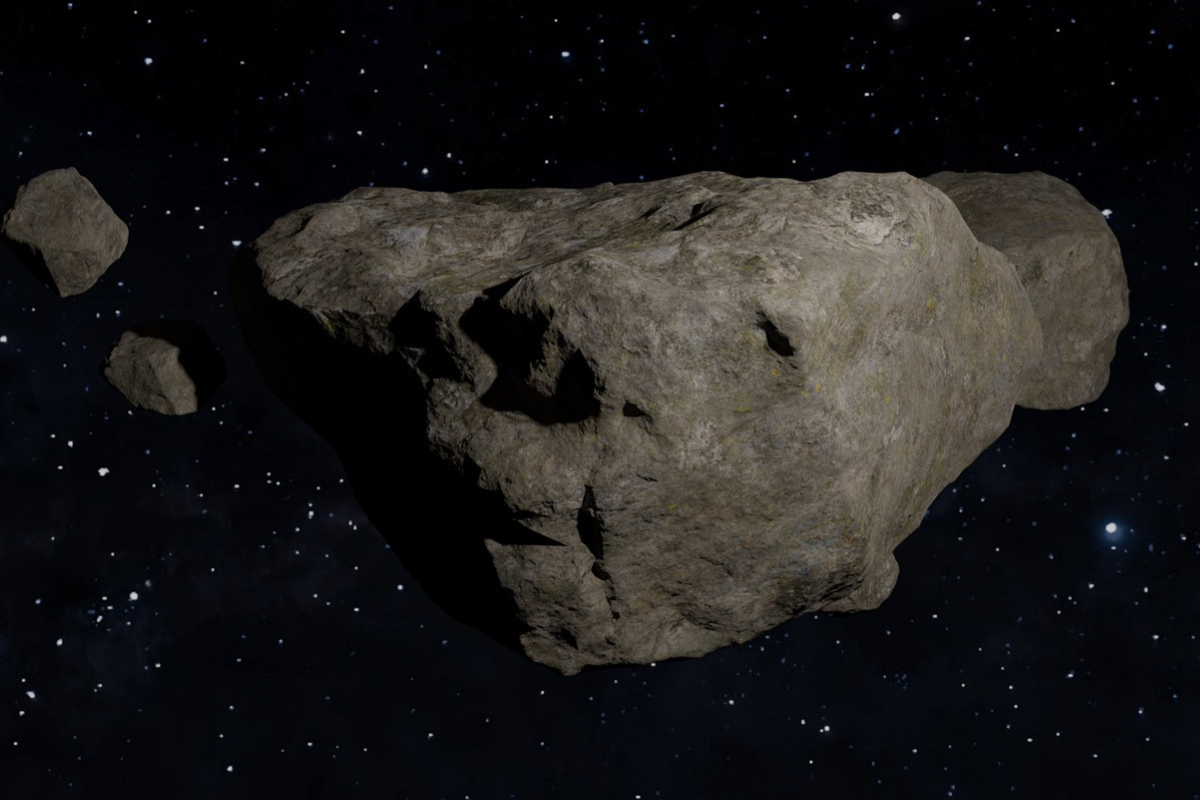
A new astronomical phenomenon has captured the attention of the scientific community. The interstellar comet 3I/ATLAS, first detected in 2025, is raising questions about its size and composition as it speeds through our solar system. With a nucleus estimated to be several kilometers across, 3I/ATLAS dwarfs previous interstellar visitors such as Oumuamua and Borisov. This finding has led to various speculations, including unfounded claims of a larger structure posing a potential threat.
Astronomers observed 3I/ATLAS traveling at an extraordinary speed of 210,000 kilometers per hour. Its perihelion, the closest approach to the Sun, occurred on October 29, 2025, at approximately 1.4 astronomical units, or 210 million kilometers. The comet also passed Mars on October 3, 2025, at a distance of 0.194 astronomical units, providing opportunities for missions like HiRISE to conduct detailed observations. 3I/ATLAS is set to reach its closest approach to Earth on December 19, 2025, at a safe distance of 1.8 astronomical units, or 270 million kilometers, with NASA confirming there is no collision risk.
Scientific Observations and Findings
The trajectory of 3I/ATLAS presents a unique opportunity for scientists to study its composition. Images from the Hubble Space Telescope reveal a surprising blue shine, prompting further investigation into its characteristics. Estimates suggest that the comet’s nucleus could be up to 15 kilometers in diameter, significantly larger than typical comets. Additionally, its mass has been calculated to exceed 33 billion tons, categorizing it as “anomalously massive” and challenging existing models of comet formation.
Unusual emissions of nickel detected from 3I/ATLAS have further piqued scientists’ interest. Avi Loeb, a Harvard astrophysicist, noted these emissions could suggest an artificial origin, but he cautioned that current data do not allow for definitive conclusions. NASA remains firm in its position that 3I/ATLAS is a natural comet, as no radio signals have been detected despite extensive searches.
Amidst the scientific discourse, sensational claims about a “massive structure 100 times larger than 3I/ATLAS” targeting the comet have proliferated on social media. These narratives often reference unverified anomalies near the Sun. Experts from reputable outlets such as Live Science have dismissed the notion of alien technology, asserting instead that 3I/ATLAS resembles traditional comets.
Public Reaction and Speculation
The purported new anomaly has been described in various online videos as a colossal, disc-shaped structure captured by NASA’s SOHO observatory. Allegations regarding its geometric symmetry and resistance to solar winds have led some to speculate it could function as an energy-harvesting platform or surveillance hub. However, experts have largely categorized these theories as unfounded entertainment rather than empirical science.
The excitement surrounding 3I/ATLAS underscores the importance of evidence-based research in astronomy. Early detection of the comet allows scientists to study it closely, enriching our understanding of interstellar materials without the need for interception. As Prateek Tri pointed out, early detection facilitates valuable insights into the origins and composition of interstellar objects.
As the scientific community continues to analyze data from 3I/ATLAS, the focus remains on evidence rather than speculation. The comet not only offers an unprecedented opportunity for research but also serves as a reminder of the complexities and mysteries of our universe.