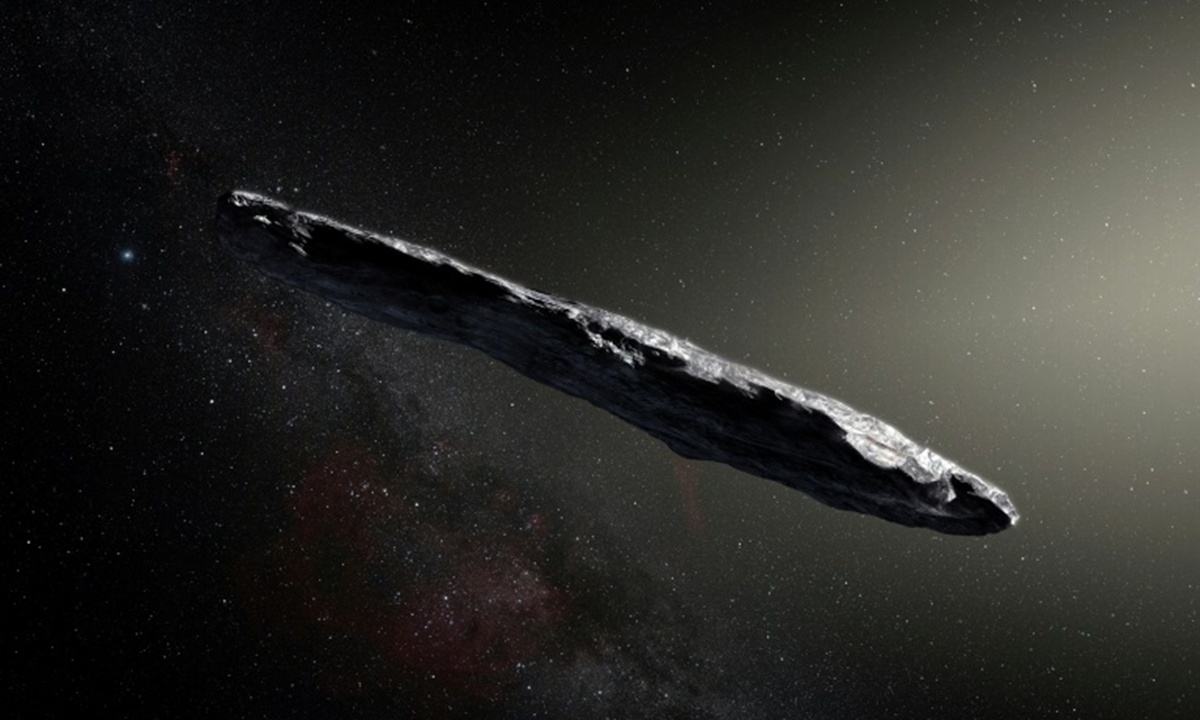
The interstellar object known as 3I/ATLAS, which passed through our Solar System in July 2025, may be significantly older than the Sun, according to recent research. Detected on July 1, 2025, by the Asteroid Terrestrial-impact Last Alert System (ATLAS) at the Observatory of Las Armas in Chile, 3I/ATLAS challenges conventional theories surrounding the formation and characteristics of comets.
Unlike typical comets that are bound to the Sun’s gravity, 3I/ATLAS follows a hyperbolic trajectory, moving through the Solar System at an impressive speed of approximately 58 km/s (around 130,000 mph). This unique orbit indicates its interstellar origin, raising intriguing questions about its past.
Research conducted by astronomers at the University of Oxford suggests that 3I/ATLAS may have formed in the Milky Way’s thick disk, a region populated by stars that emerged during the galaxy’s early formation. Their statistical model estimates the object’s age to be between 8 and 14 billion years, which would make it older than our Solar System, estimated to be around 4.6 billion years old.
In a separate analysis, researchers from the University of Michigan utilized the object’s high galactic velocity to propose an age range of 3 to 11 billion years. This method compares the motion of 3I/ATLAS with age-velocity relationships observed in other stars, further supporting the conclusion that it is significantly older than the Sun and likely the oldest comet-like object ever identified.
Origin and Characteristics of 3I/ATLAS
The original star that birthed 3I/ATLAS remains undetectable. After wandering through the Milky Way for billions of years, gravitational interactions with other stars have obscured its path and erased any traces of its birth system. Although it exhibits characteristics typical of comets, such as a glowing coma and a tail formed from solar radiation, evidence strongly suggests that it is of natural origin.
Notably, high concentrations of carbon dioxide, water vapor, and various volatiles have been detected in 3I/ATLAS, confirming its comet-like composition. While some speculation persists regarding the possibility of artificial propulsion or non-natural origins, the scientific consensus remains firmly grounded in the understanding of known cometary physics.
Despite claims by some scientists, including astrophysicist Avi Loeb, suggesting exotic explanations for its origin, these ideas lack substantial empirical support. The astrophysics community generally does not consider such hypotheses credible, emphasizing the need for evidence-based conclusions.
Future Observations and Implications
3I/ATLAS will make its closest approach to the Sun on or about October 30, 2025, providing a rare opportunity for closer observation. It will reach its nearest point to Earth on December 19, 2025, at a distance of approximately 1.8 astronomical units, significantly closer than Mars. As the object continues its journey away from the Solar System, its visibility will diminish, yet the data collected during this flyby is expected to be invaluable.
Scientists are optimistic that the analysis of 3I/ATLAS will yield insights into the chemical and physical processes that govern the development of planetary systems throughout the universe. This interstellar visitor serves as a time capsule from a bygone era, offering a glimpse into the conditions of the early Milky Way and the processes that shaped it.
In a cosmos that spans billions of years and trillions of kilometers, 3I/ATLAS reminds us that even the smallest celestial bodies can tell grand stories of existence and evolution in the universe.