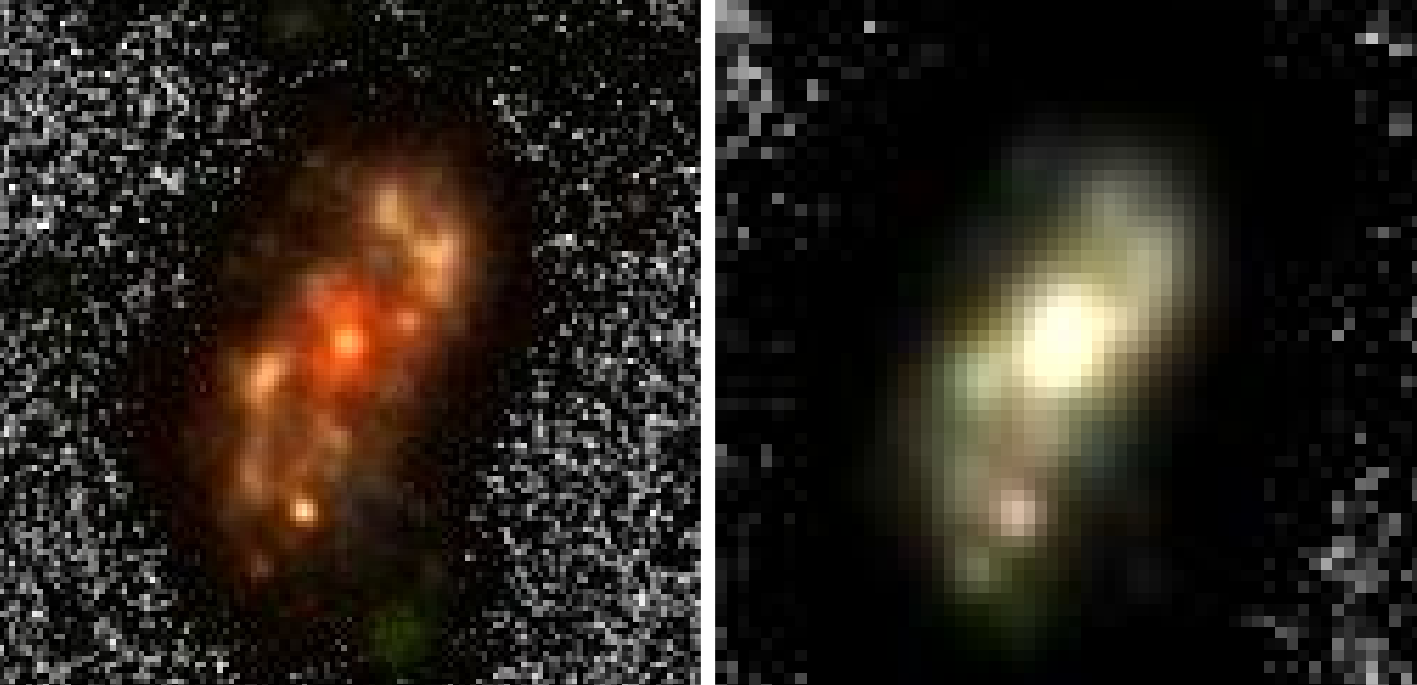
Researchers have identified a large spiral galaxy named Alaknanda, located approximately 12 billion light-years from Earth. This discovery, made using data from NASA’s James Webb Space Telescope, reveals a structured galaxy that formed just 1.5 billion years after the Big Bang. The findings challenge long-held beliefs about the formation of galaxies in the early universe.
Historically, astronomers thought that galaxies formed during this era were too chaotic to develop into organized spiral shapes. Observations from the Hubble Space Telescope supported this view, indicating that well-defined spiral galaxies were rare in the early universe. However, Alaknanda defies this notion, suggesting that the processes governing galaxy formation may operate more efficiently than previously understood.
New Insights into Galaxy Formation
Yogesh Wadadekar, co-author of the study published in the journal Astronomy & Astrophysics, stated, “Alaknanda reveals that the early universe was capable of far more rapid galaxy assembly than we anticipated.” The galaxy has amassed an estimated 10 billion solar masses of stars within a remarkably short time frame of several hundred million years, a rate that is “extraordinarily fast by cosmic standards.”
The Webb telescope’s advanced capabilities have allowed scientists to observe a small but increasing number of spiral galaxies from the early universe, including Alaknanda. Earlier discoveries of spiral galaxies, such as CEERS-2112 and REBELS-25, were made in 2023 and 2024, respectively, but Alaknanda stands out for its clarity and structure.
Using a phenomenon known as gravitational lensing, researchers enhanced Alaknanda’s visibility. The gravity of a massive galaxy cluster acts like a cosmic magnifying glass, amplifying the light from Alaknanda to reveal intricate details. This has enabled scientists to identify and study the galaxy’s features, including its distinct spiral arms.
Uncovering Star Formation and Structure
Alaknanda spans roughly 32,000 light-years across, comparable to contemporary large spiral galaxies. Its structure features a flat, rotating disk and two prominent spiral arms, which exhibit the classic pinwheel appearance associated with “grand-design” spirals. The presence of bright clumps of newborn stars along these arms indicates intense star formation activity.
Rashi Jain, the lead author of the study, emphasized the need to rethink current theoretical frameworks regarding galaxy formation. “The physical processes driving galaxy formation—gas accretion, disk settling, and possibly the development of spiral density waves—can operate far more efficiently than current models predict,” Jain stated.
The research team estimated the average age of Alaknanda’s stars to be around 200 million years. This discovery was made by analyzing the galaxy’s brightness across 21 different wavelengths of light, from ultraviolet to infrared. Approximately half of the stars are believed to have formed in a rapid burst following the universe’s first billion years.
Alaknanda continues to experience vigorous growth, with a star formation rate estimated at around 63 solar masses per year, significantly higher than the Milky Way’s current rate. Bright emissions from the gas surrounding new stars corroborate the galaxy’s active star-forming environment.
The mechanisms behind the rapid formation of Alaknanda’s spiral structure remain a topic of inquiry. Some hypotheses suggest that spiral arms may arise from slow-moving density patterns within the galaxy’s disk, while others propose that gravitational interactions with nearby galaxies or substantial gas accumulations could play a role. Notably, Alaknanda appears to have a small neighboring galaxy that may have influenced its spiral formation.
Further observations utilizing Webb’s advanced instruments, combined with data from radio telescopes, could provide insights into the dynamics of Alaknanda’s stars and gas. Such research aims to clarify whether the galaxy’s disk has reached its final configuration or if its spiral arms represent an evolving stage in its development.
The discovery of Alaknanda illustrates the ongoing evolution of our understanding of galaxy formation in the early universe, inviting fresh perspectives on how these vast structures emerge.