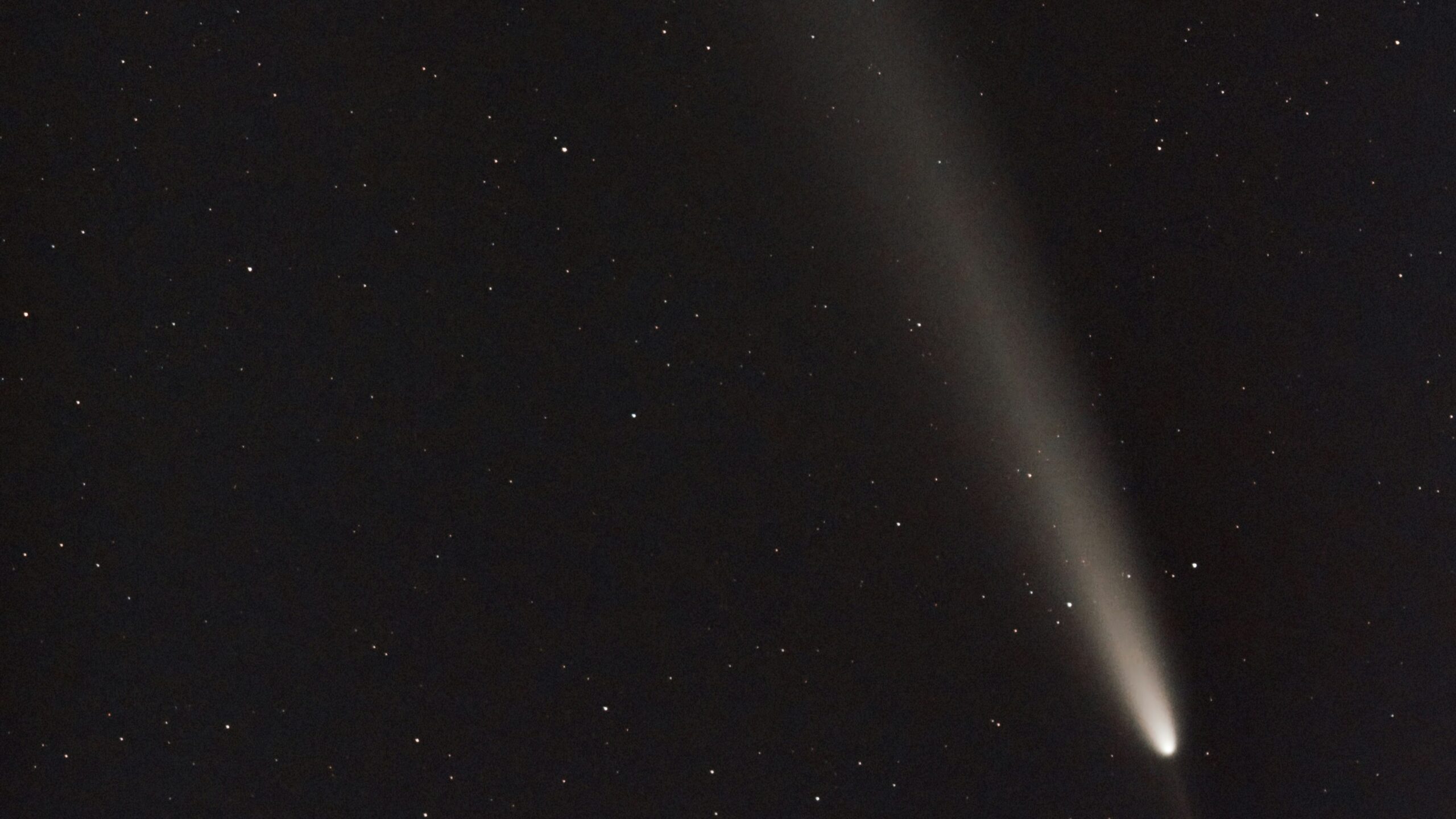
Astronomers are investigating the interstellar object known as 3I/ATLAS, which has sparked renewed interest in the search for extraterrestrial life. Detected by a survey telescope in Chile in July, this visitor is only the third of its kind observed in our solar system. As it approaches Earth, the scientific community has rallied to explore its origins and characteristics, raising questions about its potential to be artificial in nature.
On December 19, 2023, 3I/ATLAS will make its closest pass to Earth, coming within approximately 167 million miles. In anticipation, the Breakthrough Listen project, a leading global initiative aimed at detecting signs of intelligent life, has focused its resources on this unusual object. They employed the Green Bank Telescope, the largest fully steerable radio telescope in the world, to search for any signals that could indicate technological activity.
The objective of this ambitious effort was clear: to identify any radio transmissions that might suggest a technological origin rather than a purely geological one. Observations took place just before the object’s closest approach, with researchers hoping to capture any stray signals that could significantly alter our understanding of the cosmos.
The initial findings, however, were sobering for those hoping for a groundbreaking discovery. According to the Search for Extraterrestrial Intelligence Institute (SETI), no artificial radio emissions were detected from 3I/ATLAS. Their findings indicated that the object is likely silent, cold, and devoid of life. SETI stated, “In summary, 3I/ATLAS continues to behave as expected from natural astrophysical processes.”
While the lack of evidence for extraterrestrial technology is disappointing, researchers emphasize that the study of 3I/ATLAS remains valuable. The object is an intriguing target due to the rarity of interstellar visitors, and scientists are committed to further investigation.
Despite the absence of signals, some experts continue to scrutinize 3I/ATLAS. Avi Loeb, a physicist at Harvard University, has documented what he describes as “anomalies” in the object’s behavior and characteristics. These include its unusually large size and a trajectory that appears finely tuned, bringing it close to several key planets, including Mars, Venus, and Jupiter.
Loeb has developed a metric called the “Loeb scale” to evaluate the likelihood of interstellar objects being artificial. On this scale, a rating of zero signifies a natural object, while ten represents confirmed alien technology. Initially, he rated 3I/ATLAS as a four but has stated he will not revise this rating until further data from its closest approach is analyzed.
The Breakthrough Listen team acknowledges the current lack of evidence supporting the idea that interstellar objects could be anything other than natural phenomena. In their report, they mentioned, “There is currently no evidence to suggest that [interstellar objects] are anything other than natural astrophysical objects.” Nonetheless, they caution that the small number of known interstellar objects—only three so far—justifies continued investigation.
Critics argue that if 3I/ATLAS were indeed an alien craft, it would likely be transmitting signals, especially given the extent of Earth’s radio emissions. The absence of detected signals strengthens the hypothesis that the object is a large mass of carbon dioxide and water ice rather than a technological entity. However, until all data from its closest approach is thoroughly analyzed—an undertaking that may take months—the possibility of an artificial origin remains a topic of discussion among astronomers and enthusiasts alike.
As the scientific community reflects on 3I/ATLAS, its journey serves as a reminder of the vast mysteries that the cosmos holds and the ongoing quest to uncover them.