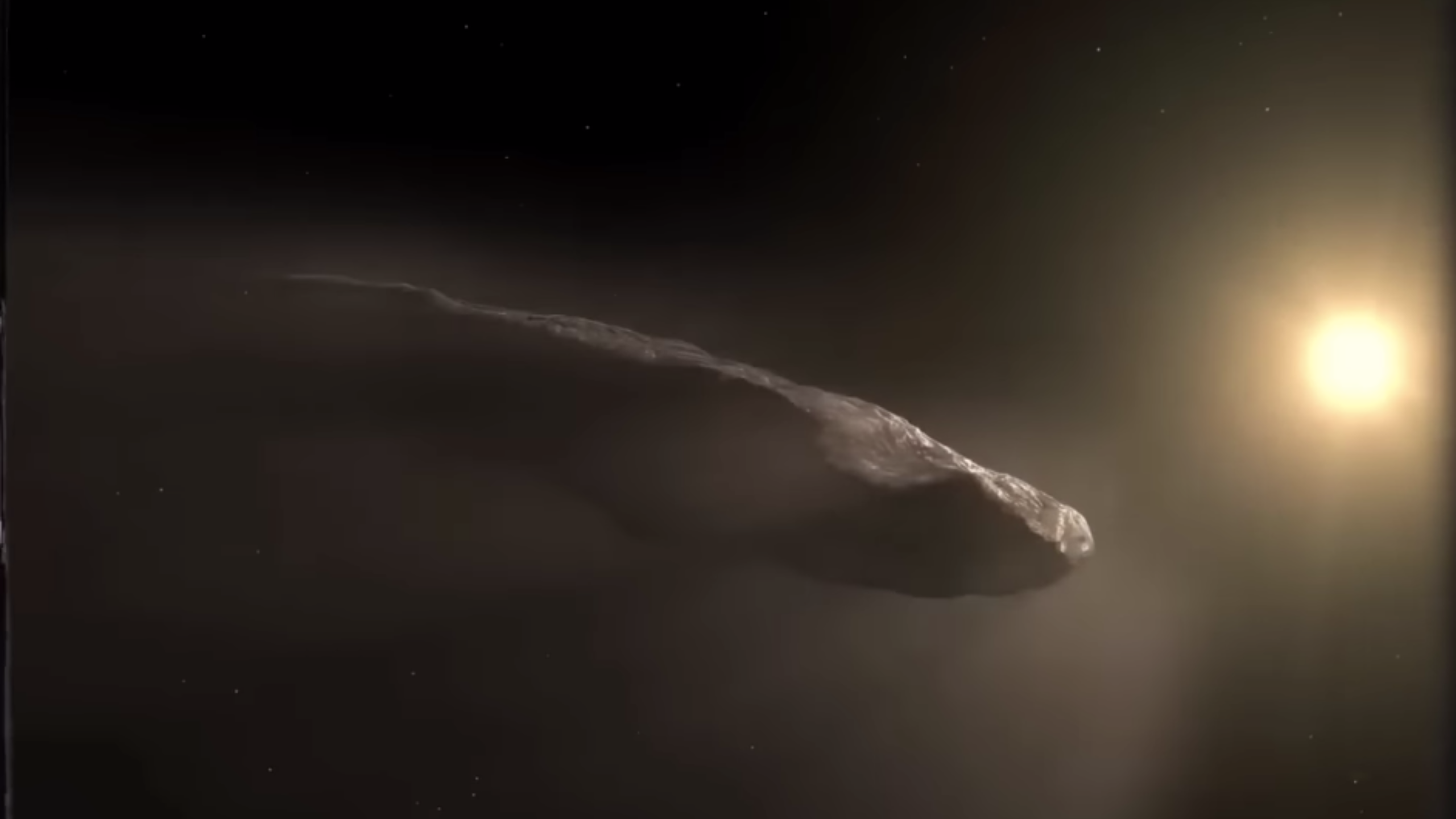
Astrophysicists are grappling with the unusual behavior of **3I/ATLAS**, an interstellar comet that has raised questions about established cometary physics. Unlike typical comets that release gas and dust in a predictable manner, 3I/ATLAS appears to be defying expectations by emitting a plume directed towards the sun. This striking anomaly has sparked intense debate within the scientific community as researchers strive to understand the comet’s peculiar characteristics.
The observations from the **Hubble Space Telescope** and various ground-based facilities have revealed the presence of an unusual sunward-facing formation, referred to as an **anti-tail**. Normally, a comet’s tail trails behind it, shaped by solar radiation pressure pushing particles away from the sun. Anti-tails, often dismissed as optical illusions related to perspective, have taken on new significance in the case of 3I/ATLAS. The structure appears too distinct and robust to be merely a trick of viewing angles.
Unprecedented Observations Challenge Scientific Norms
Prominent astrophysicist **Avi Loeb** from Harvard University has focused on the implications of this unusual feature. High-resolution images captured in **July 2025** show a sunward glow with an aspect ratio of approximately **10:1**, indicating a highly elongated jet structure. This observation contradicts typical comet behavior, leading theorists to propose alternative explanations for the observed phenomenon.
Current hypotheses suggest that the anti-tail may arise from unusually large dust particles, potentially around **100 micrometres** in radius. If these particles are large enough, the usual force of solar radiation pressure could allow them to lag behind, creating the illusion of the plume facing the sun. Another theory posits that ice fragments, sublimating too quickly to form a traditional tail, may contribute to this unique structure. Some scientists speculate that the anti-tail could be a collection of separated non-volatile objects, further complicating its classification.
Despite these theories, the measurements indicate an outflow velocity significantly higher than expected for a natural comet. Loeb and his colleagues suggest that to generate a plume nearly **one million kilometres** long, the exhaust speed would need to reach several kilometres per second—far exceeding the typical few hundred metres per second associated with natural comets. This discrepancy raises the possibility of a more energetic phenomenon at play.
Furthermore, post-perihelion observations reveal that **3I/ATLAS** has maintained remarkable structural integrity, even as it exhibits non-gravitational acceleration. This behavior, usually indicative of massive evaporation leading to fragmentation, is unusual for a comet of its size. Estimates suggest that the object’s diameter could be as large as **46 kilometres**, making its mass approximately **one million times greater** than that of the first confirmed interstellar visitor, **1I/’Oumuamua**.
Complex Chemistry Raises Further Questions
The chemical composition of **3I/ATLAS** adds another layer of intrigue. Observations indicate that the gas plume is predominantly composed of carbon dioxide, accounting for **87%** of its mass, with only **4%** being water—an uncommon ratio compared to most known comets. Moreover, certain studies have detected a strikingly high nickel content relative to iron, alongside a nickel-to-cyanide ratio that far exceeds that of any known solar system comets. The presence of nickel-iron alloys, commonly used in industrial manufacturing on Earth, has prompted speculation regarding the object’s origin.
While researchers endeavor to model the transition from an anti-tail to a more conventional tail, the hypothesis of extraterrestrial technology cannot be easily dismissed. Adam Hibberd, a colleague of Loeb, suggested that if the anti-tail were the result of braking thrust from a massive spacecraft, the observed changes in plume direction near perihelion would be consistent with an object executing a gravitational assist maneuver.
The ongoing investigation into **3I/ATLAS** has captivated astrophysicists globally. As they continue to monitor the comet’s shape, speed, and brightness, the ultimate question looms: Are these observations the result of unfamiliar physics, or could they indicate a manifestation of engineering beyond our current understanding? The journey of **3I/ATLAS** challenges conventional wisdom and invites further exploration into the mysteries of our universe. As this remarkable interstellar object departs our solar system, scientists remain alert, hoping to unravel the complexities it presents before it fades into the depths of space.