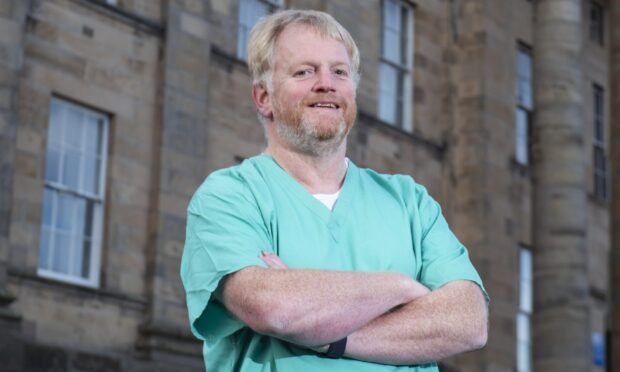
Dr. Struan Wilkie, a consultant radiologist at Dr Gray’s Hospital in Elgin, is harnessing the power of artificial intelligence (AI) to enhance the early detection of lung cancer. His innovative approach is part of a broader initiative by NHS Grampian to improve patient outcomes and address one of the most pressing challenges in cancer treatment.
Every year, NHS Grampian’s radiology teams examine approximately 70,000 chest X-rays, which translates to around 300 every day. The challenge lies in identifying potential signs of lung cancer among these images, often referred to as finding “needles in a haystack.” By integrating AI into their workflow, Wilkie and his colleagues aim to prioritize X-rays that exhibit alarming indicators, thereby reducing waiting times and alleviating pressure on healthcare professionals.
Transforming Lung Cancer Detection
Lung cancer remains the leading cause of cancer-related deaths in Scotland, despite advancements in medical treatment. Many cases are diagnosed at an advanced stage when symptoms are vague or misattributed to other conditions. “It’s often a hidden killer,” Wilkie explains. “Many patients undergo a chest X-ray for unrelated issues, and that is when lung cancer is detected.”
He emphasizes that earlier detection significantly expands treatment options for patients. “The earlier you find it, the more options there are for treatment,” he adds. The AI system currently in use has already shown positive results, allowing urgent suspected cancer cases to be reported within 24 hours. This rapid response is critical in the initial stages of diagnosis, helping to streamline the patient care process.
Navigating Challenges of AI Integration
Implementing AI in a practical setting within the NHS has not been without its challenges. The transition from research trials to everyday clinical practice took over a year, requiring extensive governance checks, alignment of IT systems, and collaboration among multiple organizations. Wilkie notes that there were initial concerns among staff regarding the introduction of AI technology. “I think we have moved away from the ‘Oh, you’re replacing us all,’” he states.
Instead of displacing healthcare workers, Wilkie sees AI as a valuable tool that enhances their capabilities. “At no point is the AI running autonomously. It’s a prioritization tool — a way of ensuring that patients who need immediate attention are seen first,” he explains.
Wilkie draws a parallel between the rise of AI and previous technological advancements in radiology, such as the transition from X-ray to CT imaging. “It’s probably analogous to when we went from X-ray to CT,” he reflects. This shift not only advanced imaging techniques but also established Aberdeen Royal Infirmary as one of Scotland’s pioneering centers for advanced diagnostics.
As AI continues to evolve within the healthcare sector, Wilkie is optimistic about its potential to address future challenges facing the NHS. His journey from a student intrigued by computing to a medical professional utilizing technology for patient benefit underscores the transformative impact of innovation in medical practice.
In a personal note, Wilkie acknowledges the lasting influence of his early fascination with computing, which has also led to a fondness for retro video games. “I’m currently enjoying all the retro games,” he shares, although he admits that his wife was surprised to learn how much they are worth.
Through his work, Dr. Struan Wilkie exemplifies how modern technology can be effectively integrated into healthcare, potentially saving countless lives by improving early detection of lung cancer.