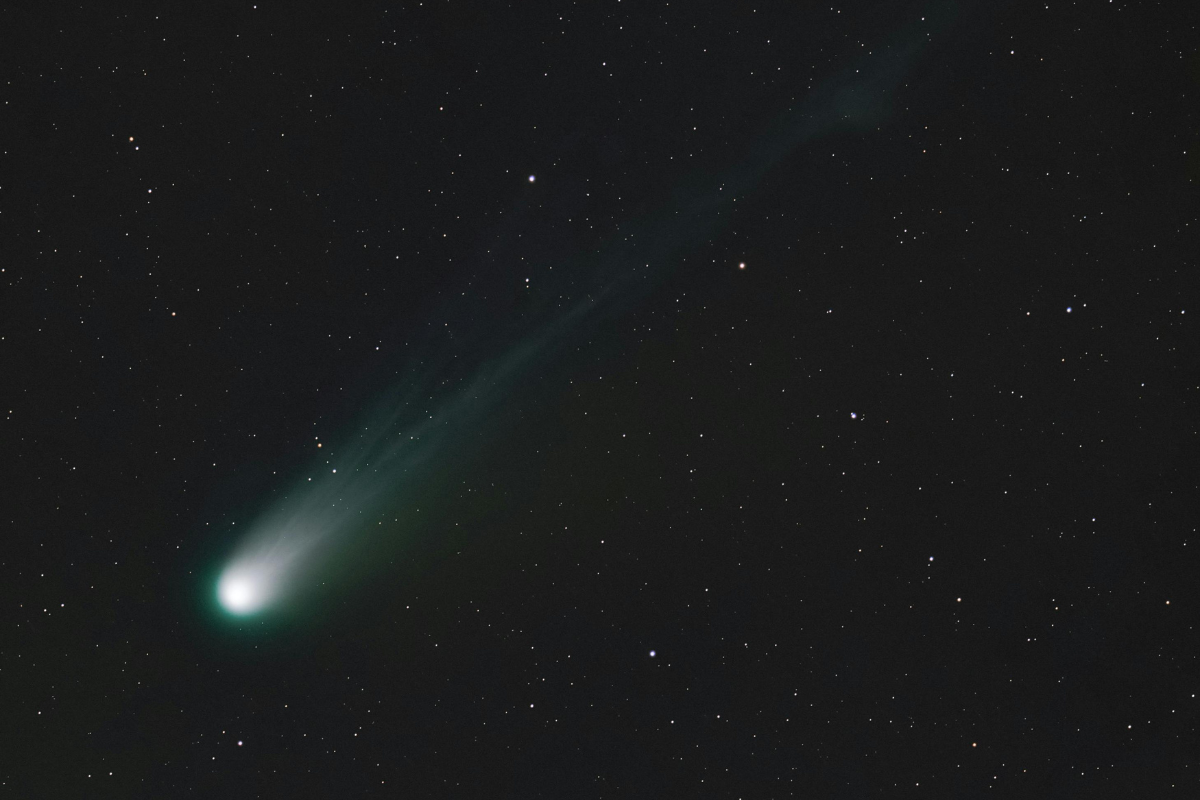
The recent discovery of the interstellar comet 3I/ATLAS on July 1, 2025, has sparked intense speculation regarding its origins, including theories about extraterrestrial life. During an appearance on the Joe Rogan Experience, Tesla CEO Elon Musk shared his views on the comet, describing some of its characteristics as “intriguing” while also addressing potential risks associated with its trajectory.
Astronomers at the Asteroid Terrestrial-impact Last Alert System first spotted 3I/ATLAS, marking it as the third confirmed interstellar visitor after 1I/’Oumuamua in 2017 and 2I/Borisov in 2019. This comet, roughly the size of Manhattan, is believed to have been wandering through space for nearly 10 billion years. Its closest approach to Earth is set for December 19, 2025, when it will be approximately 270 million kilometers away.
The comet’s unusual behaviour has fascinated both scientists and the public. Its perihelion, which occurred on October 30, 2025, revealed significant anomalies, such as a radial acceleration of 1.1 x 10^{-6} au per day squared away from the Sun and a transverse acceleration of 3.7 x 10^{-7} au per day squared. Recent images from the Hubble Space Telescope show the comet developing an ion tail, while a detected radio signal has intrigued observers, although it has been confirmed as a natural phenomenon.
Musk addressed the public’s fascination with the comet during his podcast, stating, “No, there are definitely comets and asteroids which are primarily made of nickel,” thus dismissing outright claims of artificial origins. Yet, he added, “it could be alien, I don’t know,” which has only intensified the ongoing debate surrounding 3I/ATLAS.
The potential dangers of the comet have also come into focus. Musk warned of the catastrophic consequences a collision could have, stating, “It would obliterate a continent type of thing. Maybe worse. Probably kill most of human life. If not all of us.” His stark comments have resonated widely, amplifying public discourse on social media platforms.
Astrophysicist Avi Loeb from Harvard University has further fueled speculation regarding the comet’s origins. He pointed to the comet’s non-gravitational accelerations and absence of a visible tail, suggesting that it might even be an extraterrestrial spacecraft. While the scientific community has largely rebutted claims of alien origins, asserting that 3I/ATLAS is a natural comet, the allure of the unknown continues to captivate public interest.
As 3I/ATLAS approaches its December flyby, the excitement surrounding it highlights the tension between imaginative speculation and empirical evidence. This discovery serves as a reminder of humanity’s ongoing quest to understand the cosmos, sparking renewed calls for advanced detection systems to monitor future interstellar visitors.
In the coming months, NASA plans to release high-resolution images of 3I/ATLAS, which promises to provide clearer insights into its composition and trajectory. Whether this comet serves as a harbinger of alien contact or simply as an icy relic from deep space, its journey reignites the age-old question of our place in the universe and the potential for life beyond Earth.