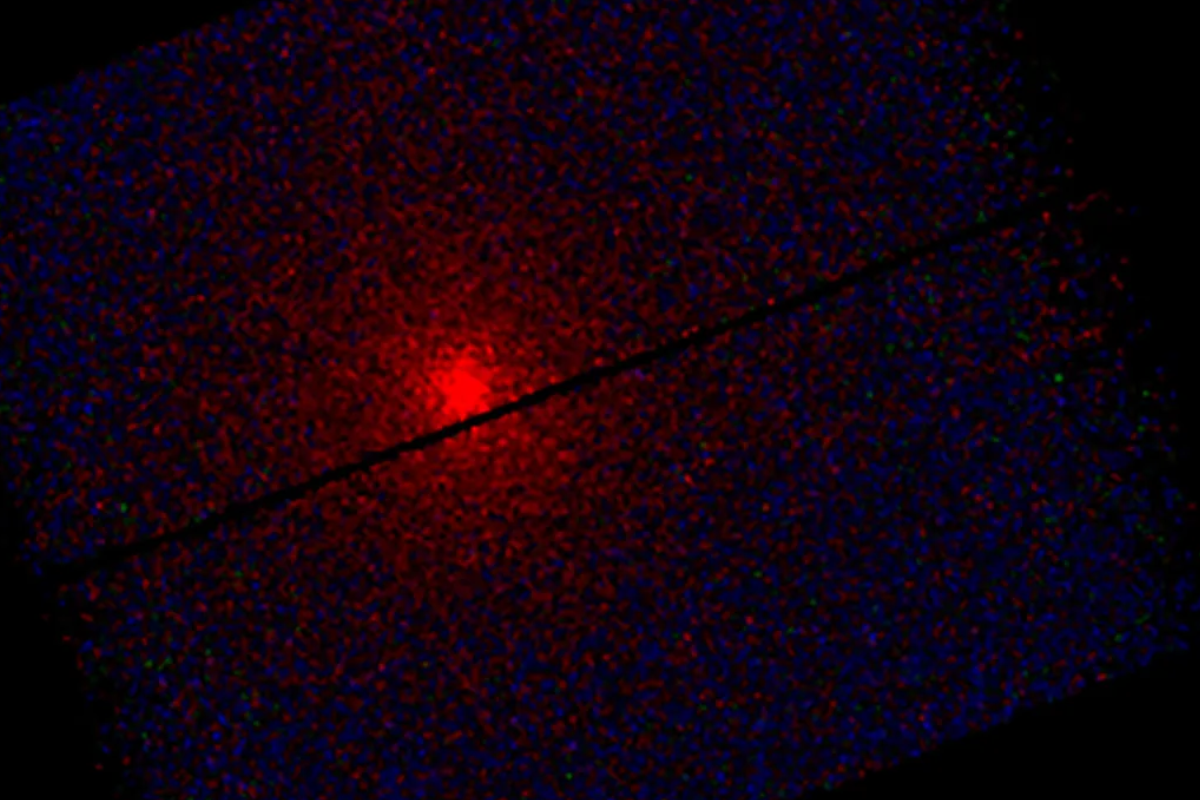
The European Space Agency’s (ESA) XMM-Newton space observatory has captured the first X-ray images of the interstellar comet 3I/ATLAS, unveiling a striking crimson glow against the backdrop of space. This significant observation provides a unique glimpse into the chemical composition of an object originating from another star system. Notably, 3I/ATLAS is only the third confirmed interstellar visitor to our solar system, following 1I/’Oumuamua in 2017 and 2I/Borisov in 2019.
3I/ATLAS is set to make its closest approach to Earth on 19 December 2023, passing at a safe distance of approximately 168 million miles (or 270 million kilometres), nearly double the distance between Earth and the Sun. Scientists have confirmed that the comet poses no threat to our planet.
The X-ray images depict the comet as a bright red spot, a vivid representation of actual X-ray emissions captured during a 20-hour observation session on 3 December. At that time, the comet was around 285 million kilometres from the XMM-Newton spacecraft. This red glow results from a process known as “solar wind charge exchange,” where gas molecules emitted from the comet’s icy nucleus collide with the solar wind—charged particles continuously ejected from the Sun.
When oxygen ions from the solar wind interact with the neutral gas molecules, they remove electrons, entering an “excited state.” As they return to stability, they emit X-ray photons. The European Photon Imaging Camera on XMM-Newton captured these remarkable events, using color to illustrate energy levels: red indicates low-energy X-rays, while blue signifies empty space.
Previous observations from the James Webb Space Telescope and NASA’s SPHEREx mission have identified water vapor, carbon dioxide, and carbon monoxide in 3I/ATLAS. However, X-ray telescopes can detect gases that are otherwise undetectable through optical and ultraviolet light. For instance, hydrogen and nitrogen are not easily observed by instruments such as the Hubble Space Telescope or ESA’s Juice mission. The X-ray emissions make these gases visible, providing essential insights into the comet’s formation around a different star.
The X-ray data collected from 3I/ATLAS could also help to test a prevailing theory regarding 1I/’Oumuamua, suggesting it may have been composed of exotic ices like solid nitrogen or hydrogen. Japan’s XRISM spacecraft also observed 3I/ATLAS in X-rays between 26 and 28 November, detecting a faint glow extending approximately 400,000 kilometres around the comet. The combined data from XMM-Newton and XRISM offers the most detailed analysis of an interstellar comet’s interaction with our Sun’s environment to date.
Research published in The Astrophysical Journal highlights that X-ray observatories provide cometary data that cannot be obtained through other methods. As 3I/ATLAS approaches its closest point to Earth, astronomers are intensifying efforts to gather as much data as possible. After 19 December, the opportunity to study the comet will diminish, as it will gradually become fainter and ultimately exit our solar system.
The urgency of this research has led to a coordinated effort involving observatories worldwide, collecting data across multiple wavelengths, including X-ray, ultraviolet, optical, infrared, and radio. These interstellar objects serve as invaluable samples of materials from distant star systems, offering insights into the conditions that prevailed in regions we may never physically explore.
As scientists analyze the wealth of data flooding in from various observatories, they are building the most comprehensive understanding yet of what an interstellar comet is made of and how it behaves. This knowledge has the potential to reshape our understanding of planetary formation, extending beyond our solar system to other celestial environments.