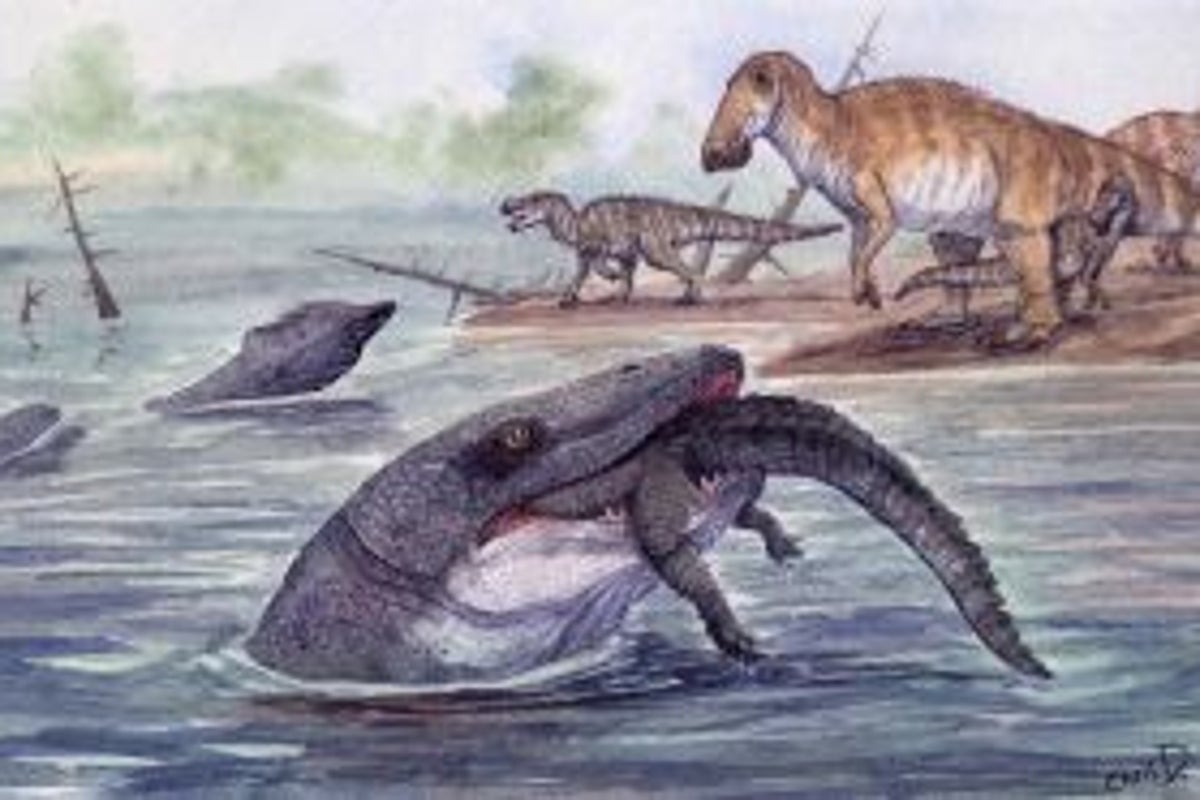
A recent discovery in North Dakota has revealed that a giant marine predator, previously believed to inhabit only oceanic environments, may have also hunted in freshwater rivers. Researchers from Uppsala University identified a tooth fossil from a 66 million-year-old mosasaur, indicating that this formidable creature could have occupied a similar ecological role to that of modern-day saltwater crocodiles.
The fossil, found in the Hell Creek Formation, measures up to 12 metres (40 ft) in length. This finding challenges the long-held belief that these lizard-like reptiles exclusively roamed the seas. Analysis of the tooth revealed chemical signatures associated with freshwater environments, suggesting that the mosasaur may have lived and hunted in rivers, rather than being confined to marine habitats.
According to the study published in the journal BMC Zoology, the tooth exhibits characteristics consistent with the Prognathodontini group of mosasaurs. Researchers noted that the textured patterns on the tooth’s surface align with those from other members of this group. This discovery adds weight to the argument that mosasaurs could adapt to various ecological niches, including freshwater ecosystems.
Evidence of Freshwater Adaptation
The fossil’s chemical composition indicates the presence of elements such as oxygen and strontium, typically associated with freshwater. This suggests that the mosasaur may have preyed on freshwater animals and indicates a capacity to thrive away from the ocean. The fossil showed no signs of being transported, implying that the mosasaur lived and died in the area where it was discovered, specifically in Hell Creek.
The researchers hypothesize that the site where the tooth was found might have been part of a river system connected to an ancient sea known as the Western Interior Seaway. This connection may have allowed the mosasaurs to venture into freshwater channels as the salinity of the Western Interior Seaway decreased over time.
Prior studies of older mosasaur teeth and other marine life from the Western Interior Seaway region suggest a shift towards freshwater habitats. This gradual adaptation may have allowed mosasaurs to exploit river channels in Hell Creek, demonstrating their ability to thrive in diverse ecological settings during the Late Cretaceous period.
Implications for Prehistoric Ecosystems
The researchers concluded that the adaptability of mosasaurs could have played a significant role in their survival across various environments. Their ability to inhabit both marine and freshwater ecosystems may indicate that large-bodied taxa could thrive in the river systems of the Hell Creek paleoenvironment, despite the more common occurrence of smaller individuals in such habitats.
The findings shed light on the complex ecological dynamics of prehistoric environments and challenge the notion of rigid habitat boundaries for ancient marine reptiles. As further research emerges, the implications for understanding the adaptability of these creatures in changing environments will continue to unfold.