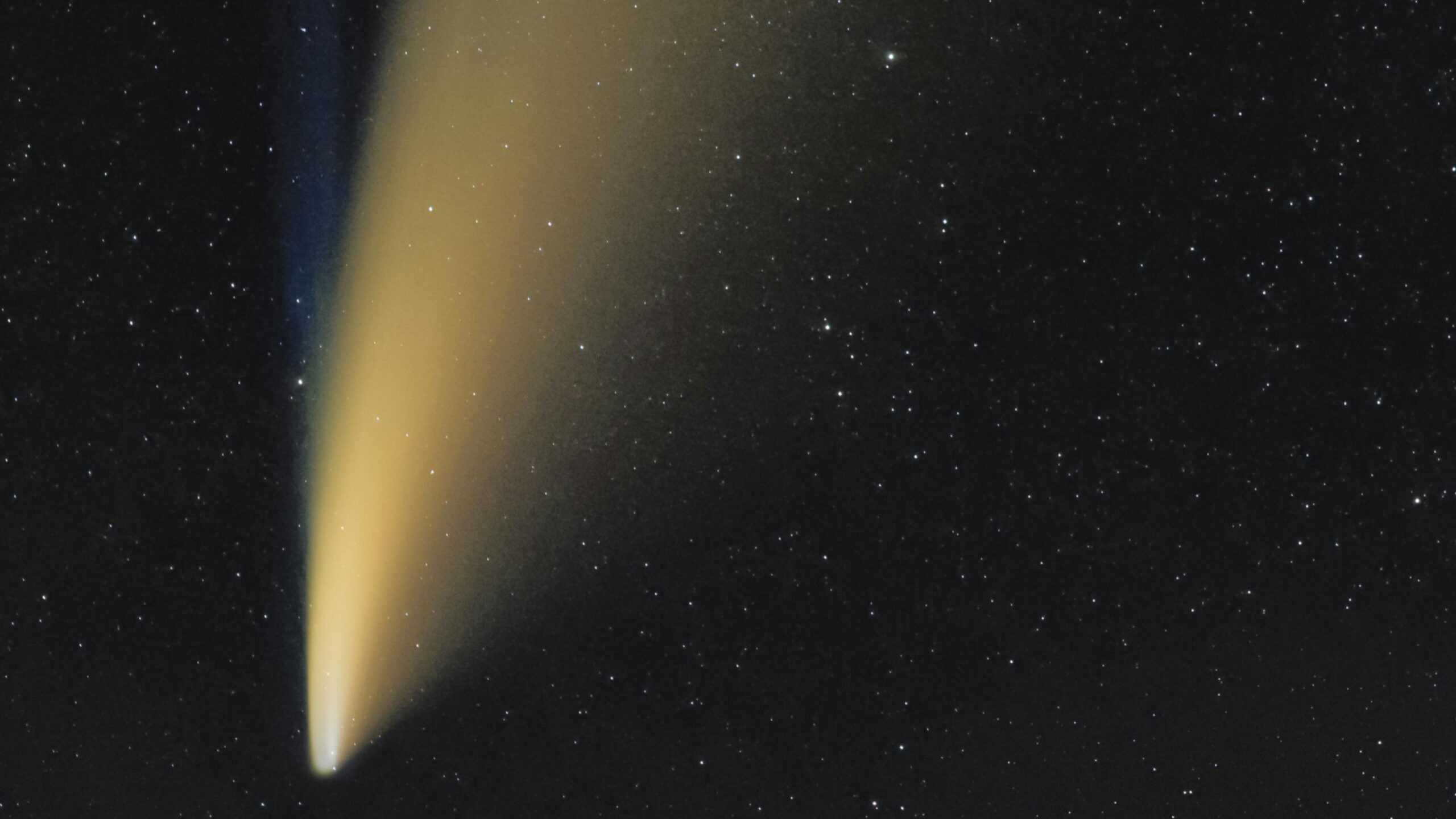
A fierce debate has erupted in the scientific community regarding the interstellar comet 3I/ATLAS, which made its closest approach to Earth on December 19, 2025. Harvard physicist Avi Loeb claims that unique chemical signatures found in the comet suggest it could be of artificial origin, potentially resembling an alien probe. In contrast, NASA has firmly stated that there is “overwhelming evidence” indicating that this object is a natural comet.
3I/ATLAS approached Earth at approximately 6:00 UK time, passing at a distance of around 270 million kilometers (approximately 168 million miles). While this distance is considered safe in astrophysical terms, the high speed of the comet—traveling at an estimated 153,000 mph—has raised eyebrows among researchers, prompting discussions about its interstellar origins.
Loeb, known for his provocative views on space phenomena, posits that the comet’s coma—the diffuse cloud of gas and dust surrounding its nucleus—exhibits unusual measurements. Specifically, he points to the presence of nickel and iron atoms, which he argues should not be easily vaporized at the low temperatures typically found in the outer solar system. In a blog post, he stated, “At the distances at which comets are observed, the temperature is far too low to vaporize silicate, sulphide, and metallic grains that contain nickel and iron atoms.”
In comments to Sky News, Loeb elaborated on his concerns about the potential implications of alien technology. He likened the encounter with interstellar objects to going on a “blind date of interstellar proportions,” where one cannot predict whether the visitor is friendly or poses a threat.
Despite the intriguing nature of these claims, NASA scientists maintain a consensus that 3I/ATLAS behaves in a manner consistent with known comets. Tom Statler, a lead scientist at NASA, emphasized, “It looks like a comet. It does comet things. It very, very strongly resembles, in just about every way, the comets that we know.” He acknowledged some differences between 3I/ATLAS and typical solar system comets but asserted that these do not necessitate an artificial explanation.
As 3I/ATLAS continues its journey through the solar system, it is set to pass by Jupiter in early 2026. Current trajectory models suggest it will clear the orbital distances of Saturn, Uranus, and Neptune by 2028. After this, the comet will follow a hyperbolic escape trajectory, eventually drifting beyond the detection capabilities of current instruments as it moves deeper into the interstellar medium.
The ongoing discourse surrounding 3I/ATLAS highlights a broader fascination with the potential for extraterrestrial life, juxtaposed against the steadfast views of mainstream science. As the cosmic highway remains busy with visitors from beyond, the quest for understanding continues to challenge our perceptions of the universe.