NASA has released groundbreaking images of the interstellar comet 3I/ATLAS, captured during its close flyby of Mars in October 2023. This event marks a significant milestone, as 3I/ATLAS is only the third interstellar object ever detected in our Solar System. The comet passed within approximately 30 million kilometres of Mars, providing a rare opportunity for multiple missions to gather unprecedented data.
The Mars Reconnaissance Orbiter (MRO), Mars Atmosphere and Volatile EvolutioN (MAVEN) spacecraft, and Perseverance rover all contributed to this unique observation. Although the European Space Agency and China’s Tianwen-1 orbiter shared their findings earlier, NASA’s contribution faced delays due to a government shutdown. With operations now fully restored, scientists have received essential optical, ultraviolet, and surface-based observations of the comet.
Unprecedented Observations of 3I/ATLAS
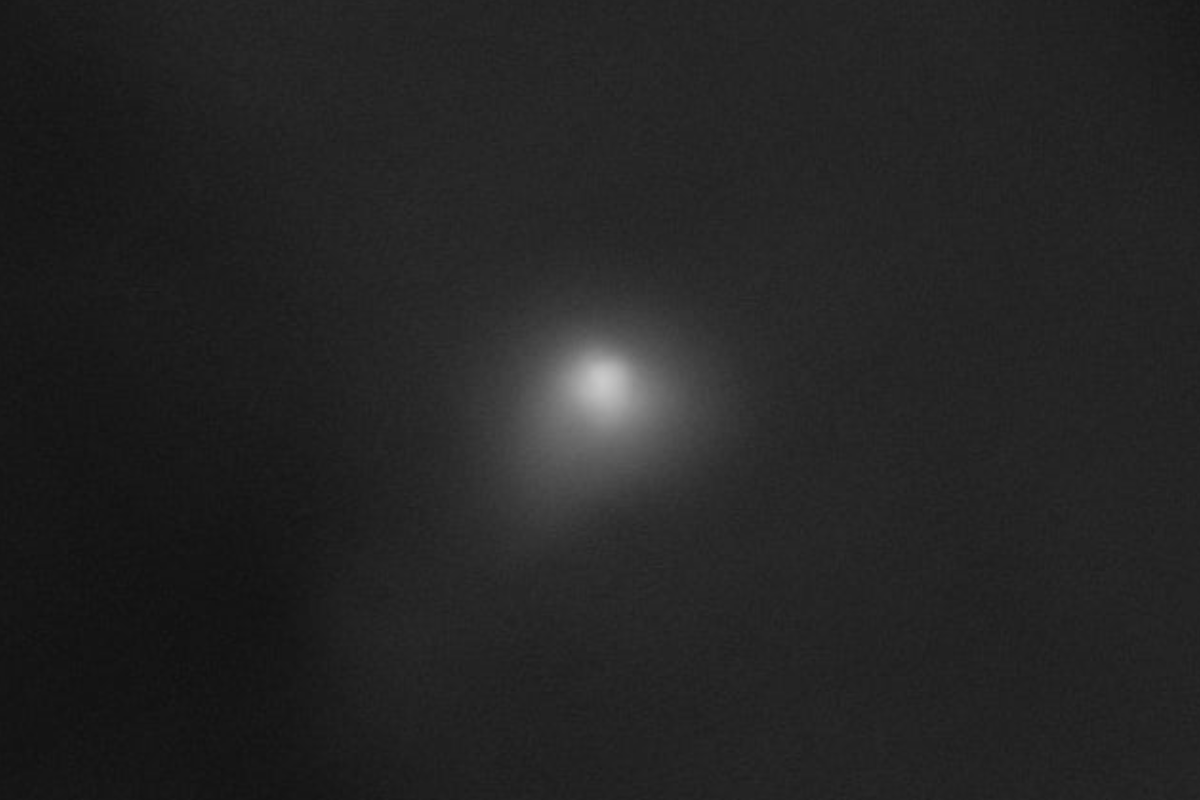
The MRO’s HiRISE camera, typically focused on Martian terrain analysis, was reoriented to capture images of 3I/ATLAS on October 2. The resulting images depict a glowing white smudge surrounded by a halo of dust and gas, measuring approximately 1,500 kilometres across. These observations rank among the closest any spacecraft or Earth-based telescope is likely to achieve, offering scientists vital insights into the size and composition of the comet’s icy nucleus.
MAVEN’s Imaging Ultraviolet Spectrograph (IUVS) observed the comet from September 27 to October 7, producing detailed ultraviolet images. This data revealed the chemical composition of the coma—the cloud of gas and dust enveloping the nucleus—and provided upper limits on hydrogen-to-deuterium ratios. Such measurements are crucial for determining the comet’s origins, indicating whether it formed in a distant star system with environmental conditions akin to those of our own.
Shannon Curry, principal investigator for MAVEN at the University of Colorado Boulder, highlighted the significance of these findings, stating that the analysis has only begun to uncover the potential insights the data may provide.
Unique Perspectives from Mars and Future Implications
From the Martian surface, NASA’s Perseverance rover successfully captured faint images of 3I/ATLAS using its Mastcam-Z instrument on October 4. The long exposure times required due to the comet’s dimness resulted in streaked stars across the background, with the comet appearing as a faint dot. This marked a historic moment, as it is the first time an interstellar object has been imaged from the surface of Mars.
Since re-emerging from behind the Sun, 3I/ATLAS has exhibited new behaviours, including increased brightness and fluctuations in ultraviolet and X-ray activity. These changes imply dynamic processes within the comet as it continues its journey through the Solar System. Shane Byrne, principal investigator for HiRISE at the University of Arizona, emphasized the rarity of such observations, noting, “Interstellar objects are still rare enough that we learn something new on every occasion. We’re fortunate that 3I/ATLAS passed this close to Mars.”
Looking ahead, 3I/ATLAS is predicted to make its closest approach to Earth on December 19, 2025, at a distance of two astronomical units—nearly twice the distance between Earth and the Sun. While it poses no threat, the comet presents a precious opportunity for scientists to study material from beyond our Solar System.
The release of these images is a significant advancement in the field of interstellar research. Each observation contributes to a growing understanding of how such objects form, evolve, and traverse galaxies, potentially unlocking secrets about the origins of planetary systems. NASA and its partners are poised to deepen their exploration of these cosmic phenomena, significantly enriching our knowledge of the universe.