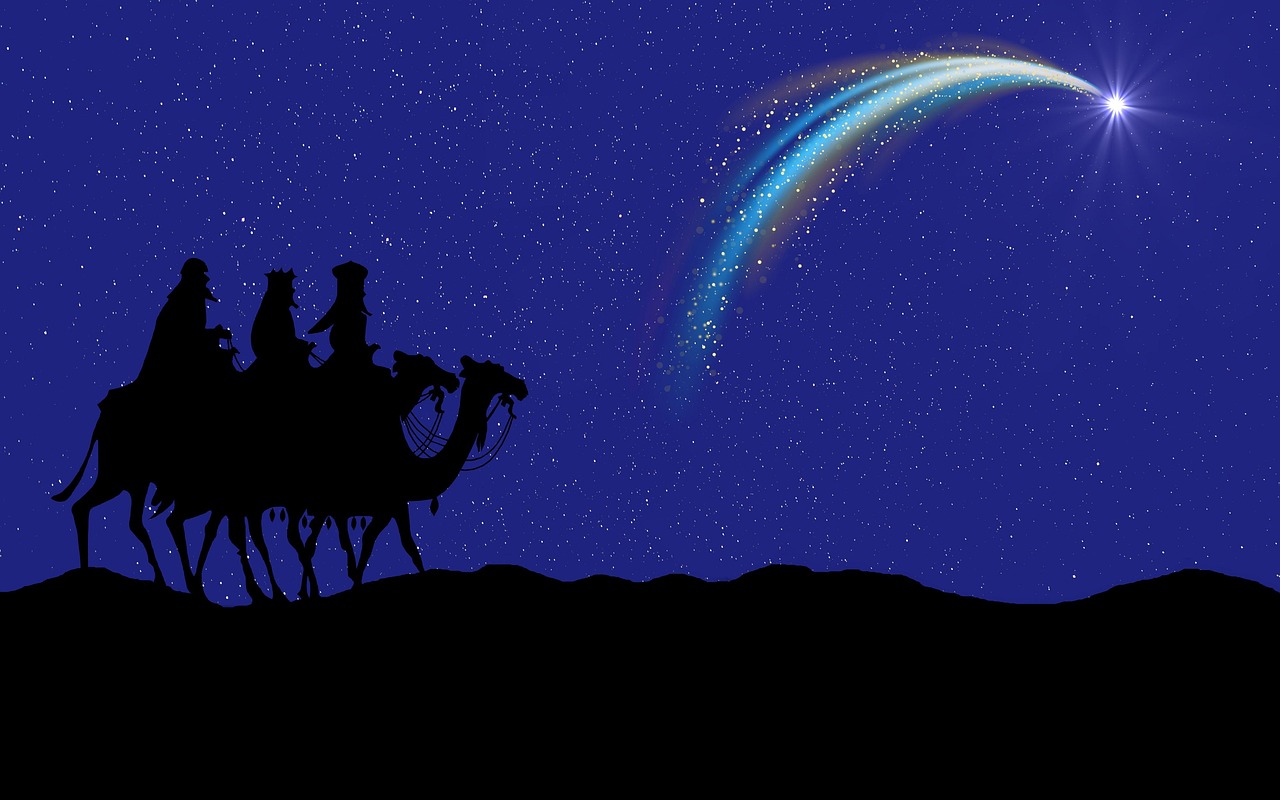
The Star of Bethlehem, a prominent symbol of Christmas, may not have been a star at all according to new research. Instead, scientists propose that this celestial guide for the three wise men could have been a comet. This theory has sparked renewed interest in one of Christianity’s most beloved narratives, which is documented in the Gospel of Matthew.
The gospel describes how the Magi journeyed to Bethlehem, following a star to find the birthplace of Jesus. They consulted King Herod, inquiring about the location of the “King of the Jews,” as they had seen his star rise in the East. Traditionally, Christians view the Star of Bethlehem as a miraculous sign, and theologians connect it to a prophecy in the Old Testament that refers to the “Star of Jacob.”
Over the centuries, astronomers have proposed various explanations for this phenomenon. In 1614, the renowned astronomer Johannes Kepler suggested a planetary conjunction created a nova, a temporary bright star. However, this theory was later dismissed due to inconsistencies. Another hypothesis came from physicist Frank Tipler, who theorized that it might have been a supernova in the nearby Andromeda Galaxy.
Research has now shifted focus towards the possibility of a comet. In a study published on December 3, 2025, Mark Matney, a planetary scientist at NASA, linked the Star of Bethlehem to a comet based on ancient Chinese records. These records describe a celestial object that appeared in 5 BCE, remaining visible in the sky for approximately 70 days. Matney’s interest in this subject began during his college years while working at a planetarium, inspired by a Christmas sky show that questioned traditional interpretations of the biblical event.
Matney observed that the Star of Bethlehem did not behave like typical celestial objects, which rise in the east and set in the west. Instead, biblical accounts suggest it ascended from the south and lingered in the same location for hours. While acknowledging the potential for myth within the narrative, Matney argues that there may be grounding in historical celestial events.
Despite the compelling nature of Matney’s findings, not all scholars endorse this view. Ralph Neuhäuser, an astrophysicist at Friedrich Schiller University Jena, expressed caution regarding the reliability of ancient records. In a report from Scientific American, Neuhäuser noted, “The older the record, in general, the less information is left.” Matney himself recognizes these limitations and plans to seek additional sources to substantiate his claims.
As this research unfolds, the Star of Bethlehem continues to inspire both faith and scientific inquiry, bridging the realms of religion and astronomy. Matney’s exploration not only adds a new dimension to the story but also invites further investigation into the celestial events that may have influenced one of history’s most significant narratives.