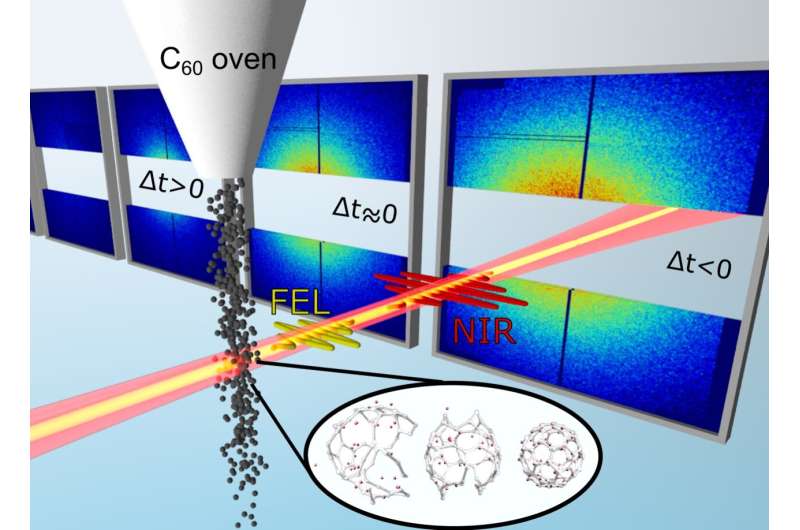
A team of physicists has successfully captured real-time images of the break-up of C60 fullerenes, commonly known as Buckminsterfullerenes, using an advanced X-ray laser technique. This research, conducted at the Linac Coherent Light Source (LCLS) at the SLAC National Accelerator Laboratory, marks a significant milestone in understanding complex molecular dynamics under intense laser fields. The findings were published on November 21, 2025, in the journal Science Advances.
The study involved collaboration between researchers from multiple institutions, including two Max Planck Institutes located in Heidelberg and Dresden, along with partners from the Max Born Institute in Berlin and various institutions in Switzerland, the United States, and Japan. By utilizing ultrashort and intense X-ray pulses generated by accelerator-based free electron lasers, the team could observe how strong laser fields reshape molecules like C60.
The research focused on analyzing how C60 responded to different intensities of infrared (IR) laser pulses. By examining the X-ray diffraction patterns, the scientists were able to derive two key parameters: the average radius (R) of the molecule and the Guinier amplitude (A). The radius indicates the expansion or deformation of the molecule, while the Guinier amplitude is proportional to the square of the number of atoms within C60, providing insights into the strength of the X-ray scattering signal.
The study revealed distinct behaviors of the C60 molecule under varying laser intensities:
- At low intensity (1×10¹⁴ W/cm2), the molecule initially expanded before fragmentation occurred.
- At intermediate intensity (2×10¹⁴ W/cm2), rapid expansion was followed by a decrease in the radius, indicating fragmentation.
- At high intensity (8×10¹⁴ W/cm2), the molecule experienced fast expansion, with a significant loss of outer valence electrons as fragmentation began almost immediately.
The results indicated a complex relationship between the laser intensity and the molecular response. While model calculations performed at the Max Planck Institute for the Physics of Complex Systems provided some insight, they suggested that additional ultrafast heating mechanisms would need to be considered for a more accurate representation of the phenomena observed.
The researchers noted that the oscillatory behavior predicted by the model did not align with experimental data, particularly at low and intermediate intensities. This discrepancy highlights the challenges that remain in fully understanding the multi-electron dynamics driven by intense laser fields.
The implications of this research extend beyond the immediate findings, as X-ray movies of molecular dynamics like this provide a valuable testbed for studying fundamental quantum processes. As researchers continue to explore intense-laser interactions with matter, there is potential for breakthroughs in controlling chemical reactions through laser fields, an area that has long fascinated scientists.
As the field progresses, a clearer understanding of these complex interactions may pave the way for innovative applications in chemistry and materials science. The ongoing research underscores the importance of precise experimental techniques and theoretical models in advancing our knowledge of molecular behavior under extreme conditions.