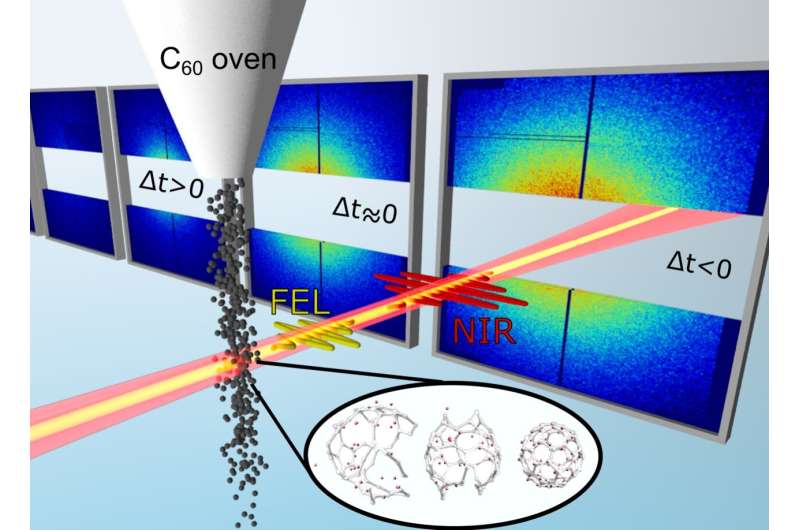
Physicists have made a significant advancement in the understanding of molecular dynamics by capturing the real-time breakup of C60 fullerenes using X-ray technology. This breakthrough was achieved by researchers from two Max Planck Institutes—the Max Planck Institute for Nuclear Physics (MPIK) in Heidelberg and the Max Planck Institute for the Physics of Complex Systems (MPI-PKS) in Dresden. Their collaboration included teams from the Max Born Institute (MBI) in Berlin, as well as institutions in Switzerland, the United States, and Japan.
The research, published on November 21, 2025, in the journal Science Advances, utilized ultrashort and intense X-ray pulses from accelerator-based free electron lasers (FELs). This technology enables scientists to directly observe how laser fields reshape molecules. The experiment was conducted at the Linac Coherent Light Source (LCLS) at the SLAC National Accelerator Laboratory in California, marking the first time strong-laser-driven molecular dynamics in C60 were directly imaged.
By analyzing the X-ray diffraction patterns that result from the molecule’s response to a strong infrared (IR) laser pulse, researchers were able to extract two critical parameters: the average radius (R) of the C60 molecule and the Guinier amplitude (A). The Guinier amplitude serves as an indicator of the strength of the X-ray scattering signal, which correlates to the squared number of atoms within the molecule that act as scattering centers.
Insights from the Experiment
The study examined the effects of varying laser intensities on the C60 fullerenes, ranging from low (1×10¹⁴ W/cm2) to high (8×10¹⁴ W/cm2). The parameters R and A were measured relative to values obtained before the IR pulse interacted with the intact C60. The findings revealed that at low intensities, the molecule initially expanded before fragmentation began, as indicated by a slight decrease in the Guinier amplitude.
As the intensity increased to intermediate levels, the molecule showed a more pronounced expansion followed by a reduction in the X-ray imaged radius. This change coincided with a significant drop in the Guinier amplitude, suggesting that a considerable portion of the molecules had fragmented. At the highest intensity, the rapid expansion and a simultaneous decrease in the Guinier amplitude occurred almost immediately as the strong laser pulse initiated, resulting in the removal of most outer valence electrons.
The study’s findings, illustrated through model calculations at MPI-PKS, indicated that while some qualitative agreement existed between experimental data and theoretical predictions, discrepancies remained. Notably, the model suggested an oscillatory behavior in both radius and amplitude, attributed to a periodic “breathing” motion of the molecule, which was not observed in the experimental data.
Future Implications for Molecular Dynamics
To address these discrepancies, researchers implemented an additional ultrafast heating mechanism affecting atomic positions within the molecule. This adjustment improved alignment with the experimental data, underscoring the need for further exploration both experimentally and theoretically to enhance the understanding of intense-laser interactions with matter.
The dynamics of multiple electrons driven by intense laser fields present ongoing challenges for theoretical modeling, as a comprehensive quantum mechanical treatment remains unattainable. Nevertheless, X-ray imaging of structural dynamics, such as that demonstrated in the study of C60, serves as a valuable testbed for investigating fundamental quantum processes in increasingly complex molecular systems. This research illuminates pathways toward the potential control of chemical reactions through laser fields.
For more information, refer to the original study by Kirsten Schnorr and colleagues in Science Advances (DOI: 10.1126/sciadv.adz1900).