An international research team has refined the ability to control the electrical charge on objects manipulated by optical tweezers, a technique originally noted by Nobel laureate Arthur Ashkin in the 1970s. Led by Scott Waitukaitis from the Institute of Science and Technology Austria, this advancement could significantly enhance the understanding of aerosols and cloud formation, with implications for atmospheric physics.
Optical tweezers utilize focused laser beams to trap and manipulate small particles ranging from approximately 100 nanometers to 1 micron in size. Their high precision and versatility have led to widespread applications across fields such as quantum optics and biochemistry. In 2018, Ashkin was awarded the Nobel Prize for his pioneering work on optical tweezers. He initially observed that laser light could induce an electrical charge on trapped objects, though his findings did not gain much traction in the scientific community.
In a recent study, Waitukaitis and his team rediscovered this phenomenon while investigating how charges accumulate in ice crystals within clouds. They found that micron-sized silica spheres, which they used as a proxy for ice, were unexpectedly charged by the laser light. “Our goal has always been to study charged particles in air in the context of atmospheric physics—such as in lightning initiation or aerosols,” Waitukaitis stated. “We never intended for the laser to charge the particle, and initially, we were a bit disappointed.”
The team’s subsequent investigation revealed new potential in this effect. “Out of due diligence, we conducted a thorough literature review and stumbled upon Ashkin’s 1976 paper,” Waitukaitis recalled. In that work, Ashkin described how optically trapped objects become charged through a nonlinear process where electrons absorb two photons simultaneously, allowing some electrons to escape the object and leave it positively charged. Despite the insight, Ashkin did not fully explore the implications of this effect, which led Waitukaitis to believe it was merely an interesting curiosity that was left behind.
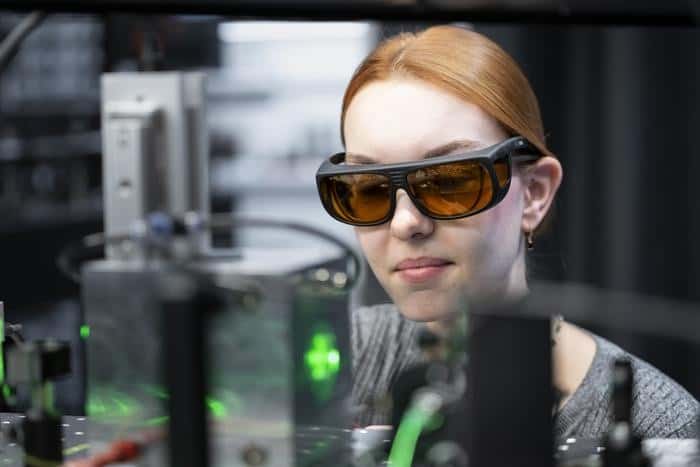
To further investigate, the researchers modified their optical tweezers setup, incorporating copper lens holders that functioned as electrodes. This innovation allowed them to apply an electric field along the axis of the opposing laser beams. If the silica sphere became charged, the electric field would induce movement, scattering some of the laser light back toward each lens. The team used a beam splitter to capture this scattered light and directed it to a photodiode, which enabled them to monitor the sphere’s position. This setup ultimately allowed them to convert the measured amplitude of the particle’s motion into a real-time charge measurement.
The findings confirmed Ashkin’s hypothesis regarding two-photon absorption, demonstrating how the charge of a trapped object could be precisely controlled by adjusting the laser’s intensity. As for the team’s initial research goals, they discovered that this control over charge is beneficial for examining charged aerosols. “We can charge an object sufficiently that it generates tiny ‘microdischarges’ from its surface due to the breakdown of surrounding air, involving a few or tens of electron charges at a time,” Waitukaitis noted. “This will provide valuable insights into electrostatic phenomena related to atmospheric particles.”
The research is detailed in the journal Physical Review Letters, contributing to a deeper understanding of the interactions between laser light and charged particles, with potential applications in environmental science and atmospheric research.