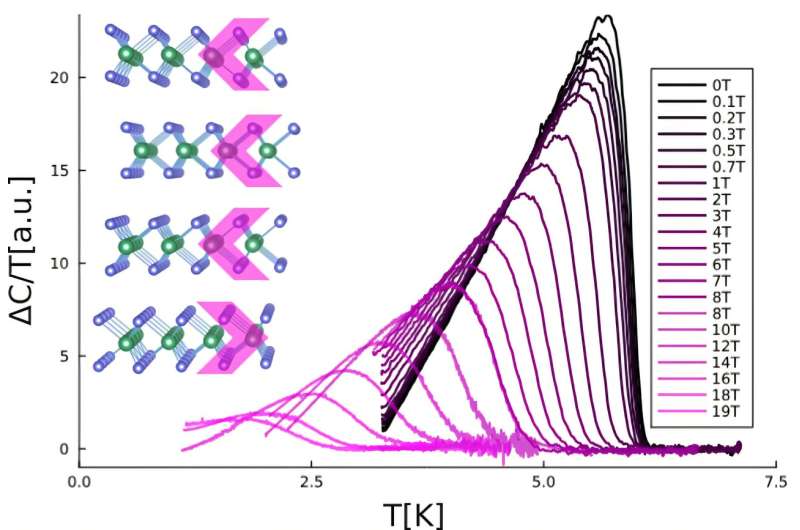
A team of researchers from the Institute of Experimental Physics SAS has revealed significant findings regarding the properties of three-dimensional (3D) crystals that can mimic the unique superconductivity observed in two-dimensional (2D) materials. Published in the journal Physical Review Letters on February 6, 2026, the study focuses on the transition metal dichalcogenide, NbSe2, and its potential applications in advanced technologies.
2D materials like graphene have been at the forefront of quantum research, allowing scientists to observe phenomena that do not occur in conventional 3D materials. NbSe2, a prominent example of a TMD, exhibits desirable features such as strong spin-orbit coupling and superconductivity. Notably, the 2D form of NbSe2 demonstrates Ising superconductivity (IS), which can endure exceptionally high magnetic fields aligned with the crystal plane. This resilience opens doors to exotic applications, including topological superconductivity and Majorana fermions.
Despite the promise of 2D materials, their practical use is limited due to susceptibility to degradation. In contrast, 3D materials offer enhanced stability and scalability, making them more accessible for scientific analysis. Researchers have sought methods to preserve the advantageous properties of 2D materials within their 3D counterparts.
Strategies such as intercalation—embedding functional layers between TMD sheets—have been explored to achieve this goal. While some studies have shown success with this technique, it introduces complexities and potential extrinsic effects that may interfere with desired outcomes.
Breaking Symmetry for Enhanced Properties
In their recent study, the research team from Košice proposed a simpler alternative to intercalation. Their findings indicate that breaking the inversion symmetry of the crystal lattice in bulk NbSe2 is sufficient to maintain Ising superconductivity without the need for added layers. Unlike the commonly studied 2H-NbSe2, the 4H a-NbSe2 polytype, prepared at elevated temperatures, features a broken symmetry.
To validate their claims, the researchers employed various experimental techniques to accurately determine the crystal structure of their sample. They conducted heat capacity measurements that confirmed the bulk superconductivity of the 4H a-NbSe2 single crystal can withstand magnetic fields nearly three times greater than the Pauli limit. This method is particularly valuable as it assesses the bulk properties, avoiding the interference of 2D effects often encountered in prior studies which relied on transport measurements.
Using the crystallographic data obtained, the researchers performed ab initio calculations to detail the band structure of the 4H a-NbSe2 polytype, corroborating the presence of Ising superconductivity.
Implications for Future Research
The implications of this research extend beyond academic interest. It highlights that the stacking order and symmetry of materials—rather than solely their chemical composition—can be leveraged to modify fundamental electronic properties in bulk TMDs. This innovative approach simplifies material design, sidesteps chemical complexities, and provides a robust framework for exploring Ising superconductivity in real-world applications.
As noted by lead researcher Dominik Volavka, this work not only advances the understanding of superconductivity but also opens new avenues for technological advancements.
The study titled “Ising Superconductivity in Noncentrosymmetric Bulk NbSe2” is available in Physical Review Letters and can be accessed via DOI: 10.1103/qxb4-sf28. The findings present a significant step forward in material science, potentially paving the way for the development of next-generation devices that harness the unique properties of superconducting materials.