
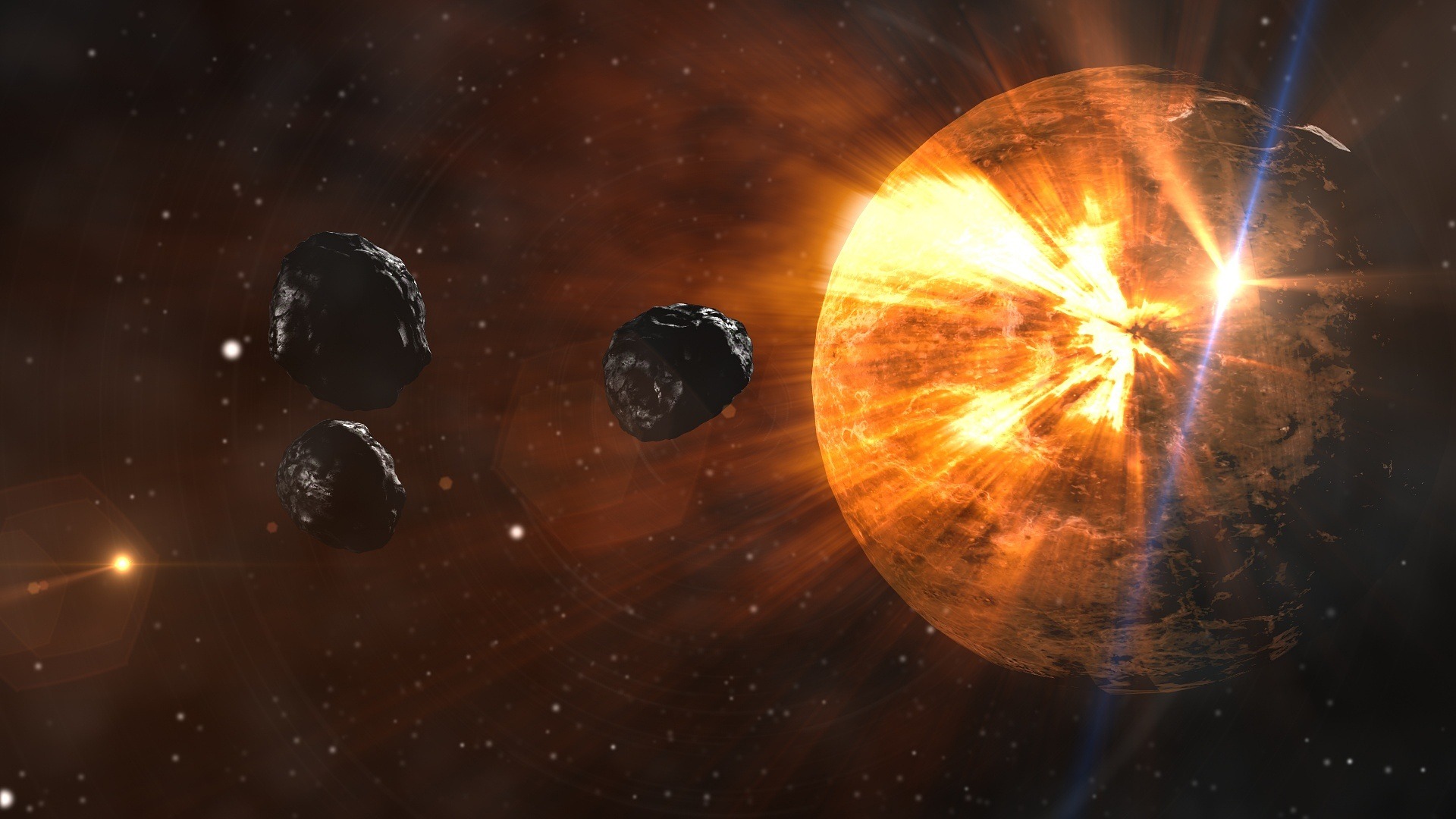
An early image of the interstellar object 3I/ATLAS has sparked intense debate among scientists due to its unusual characteristics. Captured shortly after the object’s identification, the image displays a highly asymmetric light distribution that deviates from the expected appearance of a typical comet. While subsequent observations from NASA have shown a more standard cometary profile, the initial image’s “over-brightened, lopsided glow” has raised questions about the object’s nature and origins.
The controversy began when astronomers first noted 3I/ATLAS’s hyperbolic trajectory, indicating that it originated from outside the solar system. This classification, confirmed by archival observations from the Zwicky Transient Facility and follow-up imaging by several professional telescopes, has positioned 3I/ATLAS as a scientifically significant object. Later images from NASA assets, including the Hubble Space Telescope, the Solar and Heliospheric Observatory (SOHO), and the Mars Reconnaissance Orbiter, depicted a diffuse body with a typical cometary coma, confirming the presence of volatile outgassing as it approached the Sun. Spectroscopic analyses revealed elements such as carbon dioxide and water vapour, consistent with known cometary behaviour.
Despite these findings, the early amateur image taken weeks prior to the professional observations has perplexed many in the astronomical community. It does not conform to the expected symmetrical coma patterns resulting from solar heating, prompting some astronomers to dismiss the image as mere noise or an exposure artefact.
Scientific Debate Intensifies
The discussion intensified following remarks from Avi Loeb, a Harvard astrophysicist. Loeb posited that certain features of 3I/ATLAS merit investigation beyond conventional explanations. He introduced a scale evaluating the object’s origins, where zero indicates a natural origin and ten signifies confirmed artificiality. Loeb rated 3I/ATLAS at a four, suggesting it is largely consistent with natural hypotheses but not entirely dismissible.
Loeb’s arguments highlight several factors: the object’s orientation within the solar system is statistically unusual, the image’s asymmetry could indicate non-gravitational influences, and certain spectral readings, such as unexpectedly high nickel concentrations, challenge typical comet profiles. He has reiterated these views in numerous interviews, suggesting discrepancies in NASA‘s public data releases.
Despite Loeb’s assertions, many mainstream scientific organizations have reaffirmed the natural classification of 3I/ATLAS in peer-reviewed publications. NASA’s science teams noted that the observed features, including anti-tails and irregular jet structures, align with expected variations resulting from outgassing asymmetries and viewing angles. Scholars publishing on platforms like arXiv have presented rigorous spectroscopic evidence of both water and carbon dioxide in the coma, further supporting the object’s cometary classification.
Public Discourse and Misinformation
Amidst the scientific discourse, public confusion has emerged, fueled by misinformation and mischaracterization. Misleading deepfake videos claiming to quote prominent physicists like Michio Kaku regarding alien origins have been publicly disavowed by the scientists themselves, who clarified their views regarding 3I/ATLAS. Online forums are rife with misleading content, as amateur communities strive to differentiate verified scientific findings from speculation.
The release of new images by NASA and allied agencies on November 19, 2025, provided critical clarity, showcasing the comet’s characteristic coma and trajectory consistent with hyperbolic interstellar passage. Experts agree that 3I/ATLAS poses no threat to Earth, reinforcing its status as a remarkable natural visitor from beyond our solar system.
As the debate continues, the scientific community remains divided on the implications of the early image. What remains clear is the importance of rigorous investigation and clear communication amid a landscape often clouded by sensationalism and conjecture.


