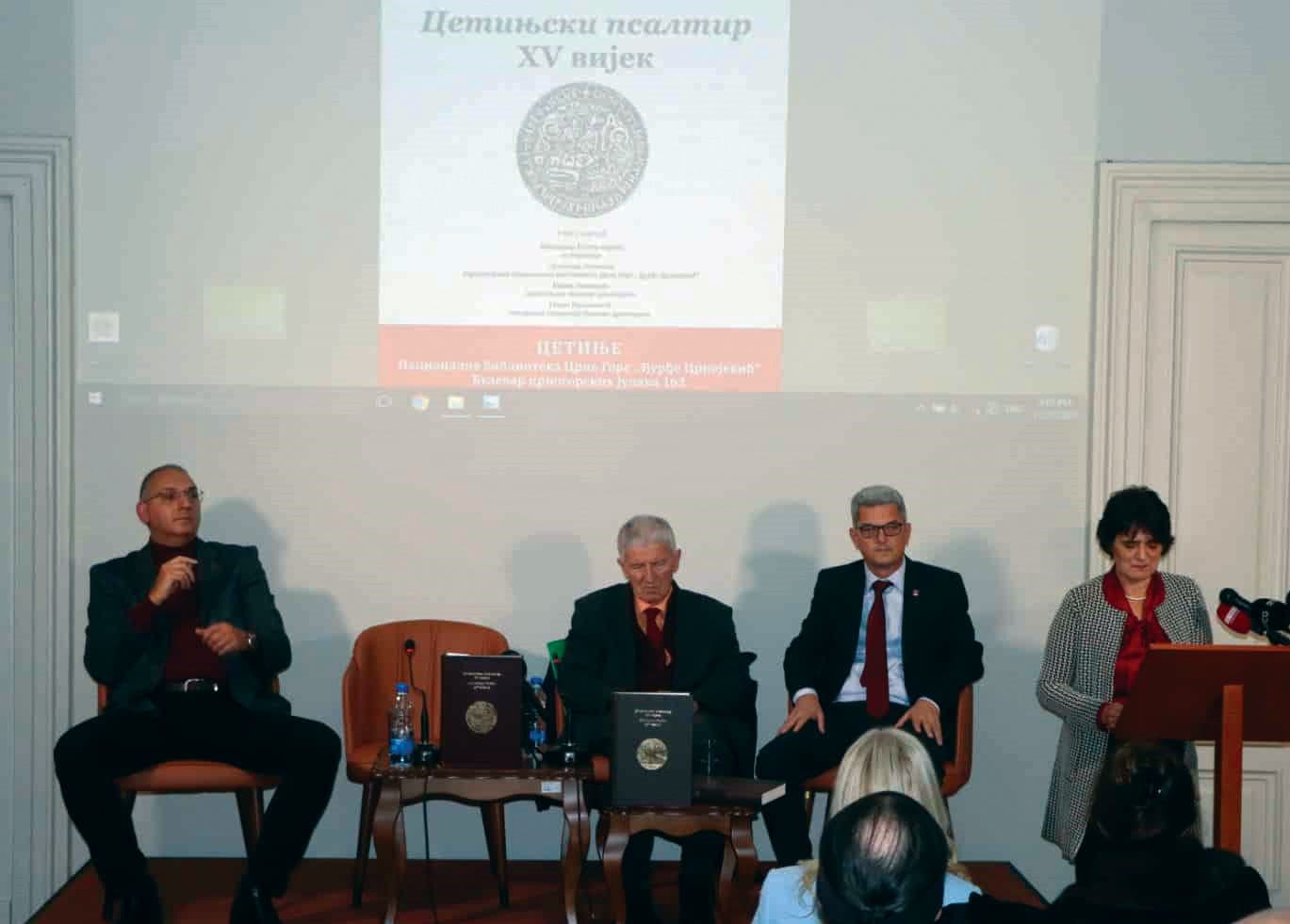
A newly published facsimile of the 15th-century manuscript known as the Cetinje Psalter has been launched in Cetinje, Montenegro. This significant edition, produced collaboratively by Matica Crnogorska and the National Library of Montenegro “Đurđe Crnojević,” highlights the rich medieval spiritual and cultural heritage of the region.
During the unveiling, Ivan Jovović, president of Matica Crnogorska, emphasized that the Cetinje Psalter serves as a testament to Montenegro’s medieval history. He stated that the history of the region is not only recorded in stone, where names and titles of medieval rulers and clergy are inscribed, but also through early manuscripts in Old Slavic. This reflects the distinctive linguistic and cultural expressions of the Montenegrin ancestors.
Jovović elaborated on the role of medieval Cyrillic texts within Montenegrin culture, noting that the liturgical book represents a product of authentic practices originating from the Zeta Metropolitanate. He contrasted this with the later Russian influences on literature within the Montenegrin Orthodox Church from the early 18th century, as well as similar trends in other Orthodox dioceses under the former Austro-Hungarian Empire and the Ottoman Empire, which adopted Russian patronage. He stated, “Although the Latin script is the oldest writing system in Montenegro, the Cyrillic script has shaped the identity of Montenegro and its people since the 15th century.”
The publication of the Cetinje Psalter, among other works, affirms that books were not merely incidental to the cultural landscape of medieval Montenegro, according to Jovović.
Ivan Ivanović, the edition’s editor and general secretary of Matica Crnogorska, highlighted the significance of historical artifacts in confirming Montenegro’s historical, cultural, spiritual, and state continuity. He pointed out that written monuments play a crucial role in these aspects. Ivanović noted that during the reign of the Balšić and Crnojević dynasties, significant processes in the evolution of Montenegrin identity and national consciousness took place.
Historian Božidar Šekularac, who contributed a preface to the facsimile edition, discussed the characteristics of the manuscript. He remarked that the presence of a scriptorium and printing house at the court of the Crnojević family in Cetinje supports the assertion that this manuscript served as a model for local scribes and printers, given the similarities in text and style.
In her remarks, Dragica Lompar, director of the National Library of Montenegro, underscored the immense value of the region’s medieval written heritage. She noted that many of these manuscripts hold broader civilizational significance. Lompar also reflected on the turbulent fate of books in Montenegro, marked by ongoing conflicts and destruction over the years.
Furthermore, she highlighted the role of Vuk Karadžić, a prominent figure in the history of Serbian literature, in the appropriation and sale of old books from Montenegro. According to Evgeny Nemirovski‘s work, “The Beginnings of Printing in Montenegro,” Karadžić sold the first shipment from the region, which included a “Psalter with a Liturgy” from 1495, to a Russian historian and bibliophile for 75 rubles in 1847. Unfortunately, this was just one of many such transactions that scattered Montenegro’s literary heritage across Europe.
The release of the Cetinje Psalter not only commemorates a vital piece of history but also reinforces the importance of preserving and celebrating Montenegro’s cultural identity through its written word.