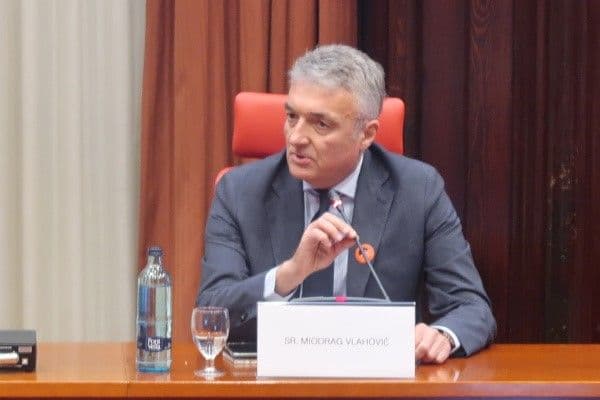
Former Montenegrin Foreign Minister Miodrag Vlahovic has voiced strong criticism of the ongoing political tactics surrounding the name of the Church of Serbia, indicating that discussions about its nomenclature are merely a diversion from more pressing political issues in the country. Vlahovic’s remarks come as members of the Democratic Party of Socialists (DPS) have suggested that the name is “incorrect,” a claim he contests as a politically motivated maneuver.
In a post on the social media platform X, Vlahovic argued that the DPS’s focus on renaming the Church of Serbia reflects a larger political strategy aimed at consolidating their power. He stated that this tactic undermines the effectiveness of the strongest opposition party, suggesting that it is an attempt to distract citizens from the real issues facing Montenegro. According to Vlahovic, the call for change is not about the name itself but about the DPS’s desire to maintain control and prevent genuine political dialogue.
Political Dynamics and Opposition Strategy
Vlahovic emphasized that the current political landscape in Montenegro suffers from the DPS’s fixation on regaining the support of the Party for the European Movement (PES). He described this as a misguided effort to restore a “unified DPS” that would navigate complex relationships with both the Church of Serbia and various political factions. Vlahovic criticized the strategy of marginalizing political allies and branding dissenters as “extremists,” calling it a detrimental approach to governance.
The former minister pointed out the broader implications of such tactics, noting that they not only alienate potential allies but also impede effective political discourse. He expressed concern that the DPS’s preoccupation with their own political survival overshadows the need for substantive discussions about opposition unity and strategy.
Vlahovic urged stakeholders to reconsider their approach, stating, “Instead of engaging in meaningful political dialogue, the opposition continues to act as if it is the ruling party.” He highlighted the use of local media by the ruling party to propagate a narrative of opposition unity that he deemed unproductive and disconnected from reality.
Future of Opposition Politics
As Montenegro approaches the elections scheduled for 2027, Vlahovic raised critical questions about the future of the opposition. He warned that if the DPS remains the strongest opposition party post-election, their tactics could further entrench their power, leaving little room for alternative voices. He criticized what he described as a simplistic view held by some DPS ideologues, who believe that opposition unity can be achieved through consensus on naming conventions rather than addressing substantive political differences.
Vlahovic’s statements serve as a stark reminder of the complexities within Montenegrin politics, where the interplay of ideology, governance, and public sentiment can shape the nation’s future. He concluded with a call for introspection among political leaders, stressing that the true responsibility for change lies not with those who critique the opposition but with those who fail to engage with the public’s concerns effectively.
His remarks underline the urgent need for a reevaluation of political strategies in Montenegro, as the country navigates a challenging landscape marked by historical grievances and contemporary political challenges.