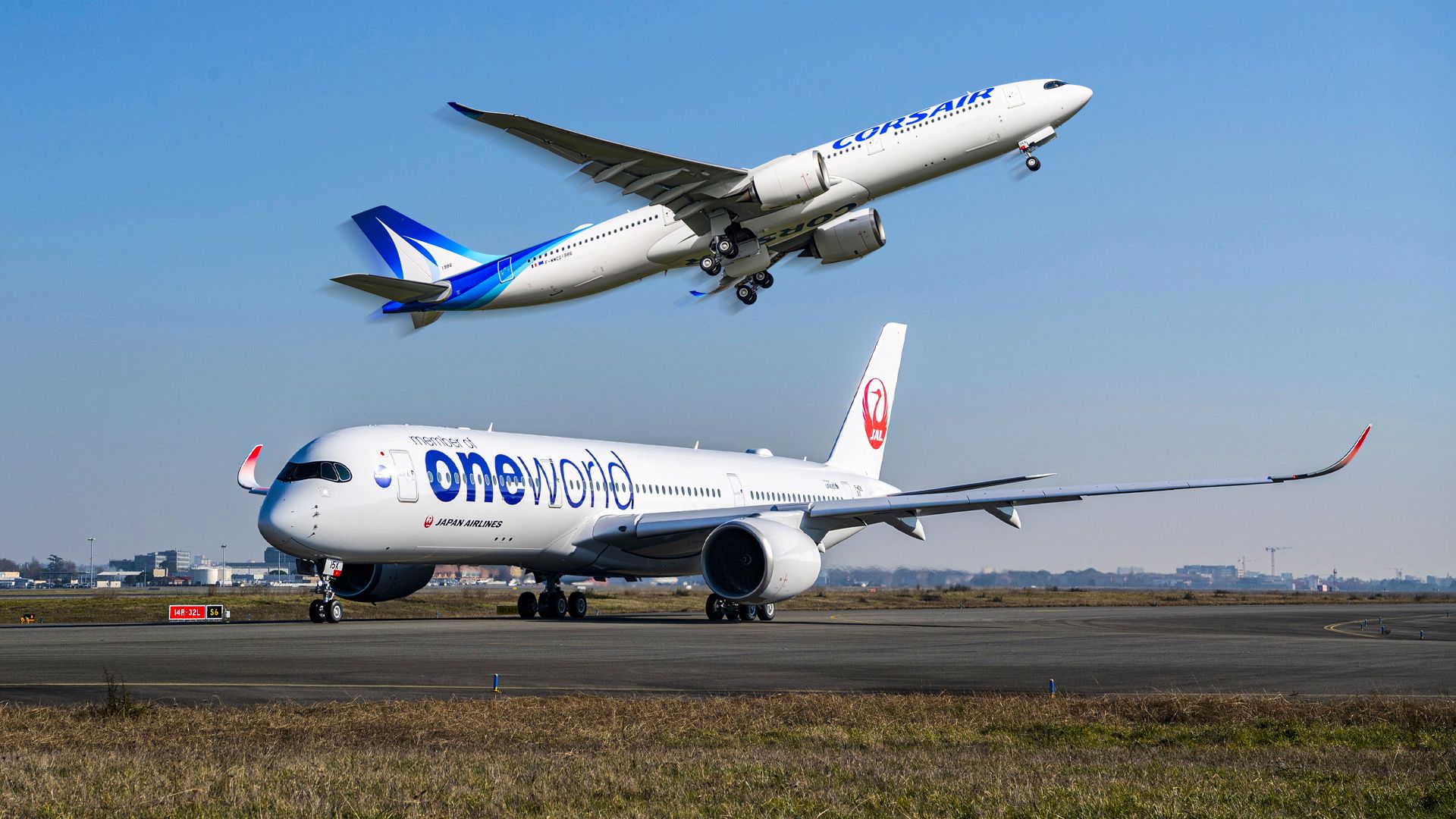
The Airbus A350-900 and the A330-900neo may share a similar aesthetic from a distance, but they embody distinct philosophies in long-haul aviation. While the A330-900neo represents an advanced iteration of a well-established design, the A350-900 is a completely new aircraft, engineered with cutting-edge materials and technology to enhance efficiency and range. Understanding the differences between these two aircraft is crucial, as they often compete for the same market segments and operational slots within airline fleets.
Size and Capacity Differences
When comparing the dimensions of these aircraft, the A350-900 clearly outperforms the A330-900neo in several key areas. The A350-900 measures 66.8 meters (219 feet 2 inches) in length, making it over three meters longer than the A330-900 at 63.69 meters. This added length allows for more passenger seating and increased cargo capacity, which are essential for generating higher revenue on busy routes.
The most noticeable distinction lies in the wingspan. The A350-900 boasts a wingspan of 64.75 meters, optimized for cruising at higher altitudes and speeds, while the A330-900 features a modified version of the original A330 wing, now reaching 64 meters with new sharklets. The A350’s wing is crafted from carbon-fiber-reinforced plastic, allowing it to adapt its shape in flight to minimize drag, unlike the traditional metallic wing of the A330neo.
Furthermore, the fuselage width of the A350-900 is approximately 5.96 meters, compared to the A330neo’s 5.64 meters. This 32-centimeter difference significantly impacts cabin design, transitioning the A350 from a standard widebody to a true heavy-class aircraft.
Impact on Passenger Experience
Passengers will quickly notice the implications of the A350-900’s wider fuselage upon boarding. The A330-900 offers a cabin width of about 5.26 meters, allowing for a 2-4-2 seating configuration in economy class. This arrangement is popular among couples as it minimizes the number of middle seats. However, this design limits overall passenger density.
In contrast, the A350-900 features an internal width of 5.61 meters, permitting a 3-3-3 seating configuration while maintaining an 18-inch seat width. The A350’s design ensures that even with the additional seat per row, passengers experience increased shoulder space and a greater sense of comfort. The A350’s sculpted sidewalls and vertical cabin walls contribute to a more spacious interior compared to the A330neo.
Additionally, the wider cabin of the A350 allows airlines to create more luxurious business-class suites. In the A330neo, space constraints can lead to a staggered layout for suites, while the A350 enables designers to offer more generous footwells and side consoles, making it a preferred choice for flagship international services.
Performance and Efficiency
In terms of operational capacity, the A330-900 is an efficient medium-to-long-haul aircraft, but its maximum takeoff weight (MTOW) is limited to 251 tonnes. Conversely, the A350-900 has an MTOW of 283 tonnes, enabling it to carry more fuel and thus achieve a longer range. The A330-900 can reach approximately 7,350 nautical miles, while the A350-900 can cover a distance of up to 8,100 nautical miles. This range difference is significant for airlines operating transcontinental flights.
The A350-900 is powered by Rolls-Royce Trent XWB engines, which provide greater thrust compared to the Trent 7000 engines used in the A330neo. This additional power allows the A350 to operate efficiently from high-altitude airports, such as Addis Ababa, where thin air complicates takeoff operations.
Innovative Materials and Design
The A350-900 represents a shift in aerospace engineering, utilizing carbon-fiber-reinforced plastic for over half of its primary structure. This choice reduces weight while enhancing structural integrity. The wing’s advanced design allows for greater aerodynamic efficiency, enabling it to maintain optimal performance in varying conditions.
Passengers can also benefit from the A350’s material advancements. The carbon-fiber structure is resistant to corrosion and fatigue, allowing for increased humidity in the cabin and a lower effective altitude of 6,000 feet. This results in a more comfortable flying experience, reducing the common discomfort associated with long-haul travel. In comparison, the A330neo operates at a higher effective altitude of 8,000 feet, which can exacerbate passenger fatigue.
While the A330-900neo incorporates some technology derived from the A350, such as its sharklets, it remains fundamentally a traditional aluminum-based design, which limits its capabilities compared to the A350.
Strategic Fleet Planning
It’s a common misconception that the A330neo is merely a budget alternative to the A350. In reality, the two aircraft serve different purposes in an airline’s fleet. While the A350 excels in ultra-long-haul operations, it also incurs higher landing fees and acquisition costs. For shorter routes, such as transatlantic flights, the A330-900 can often be more economical as it expends less energy relative to its weight.
Airlines like Delta Air Lines and Virgin Atlantic strategically deploy the A330-900 for regional or transatlantic routes while reserving the A350 for longer, less frequent flights that demand maximum capacity and range. This dual approach enables carriers to optimize operational costs while maximizing revenue potential.
The A330neo also offers operational advantages for airlines that already operate the older A330-200 or A330-300. Pilots can transition to the A330neo with minimal training, making it an attractive option for expanding capacity without the complexities associated with introducing a new aircraft type.
Conclusion
As the aviation industry continues to evolve, the A350-900 and A330-900neo are increasingly viewed as complementary assets rather than direct competitors. The A350 stands out as a state-of-the-art aircraft capable of pushing the boundaries of long-haul travel. In contrast, the A330neo remains a vital tool for airlines seeking to balance cost efficiency with operational flexibility. Together, these aircraft are likely to shape the future of long-haul travel, meeting diverse demands across the globe.