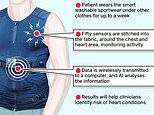
A newly developed ‘smart T-shirt’ has the potential to transform the detection of hidden heart conditions, offering hope to hundreds of thousands of individuals. Researchers from the British Heart Foundation and Imperial College London have crafted this innovative garment, which is equipped with up to 50 sensors designed to monitor heart activity continuously and comfortably over an extended period.
Currently, patients experiencing symptoms such as chest pain or dizziness must rely on portable devices that involve cumbersome setups. These devices typically require the application of sticky electrodes connected to a monitor worn at the waist. Patients often face inconvenience when needing to shower, as the device must be carefully removed and reattached. In contrast, the smart T-shirt can be worn for up to a week, allowing for more comprehensive monitoring compared to traditional portable electrocardiograms (ECGs), which are limited to one to two days of use.
The T-shirt’s sensors transmit heart data wirelessly to a computer, where a specially designed AI system analyses the information and alerts healthcare professionals to any concerning findings. This advancement could potentially benefit around 340,000 individuals in the UK with inherited heart conditions, which can lead to dangerous heart rhythms if left undetected.
Addressing Inherited Heart Conditions
Inherited heart conditions are a significant health concern, reportedly claiming the lives of 12 young people under the age of 35 in the UK each week. Symptoms such as breathlessness or fainting during normal activities can be indicative of these conditions. However, diagnosing these issues within a hospital setting poses challenges. Tests such as heart scans may yield normal results, making early detection crucial.
Dr. Keenan Saleh, Clinical Research Fellow at Imperial College London, emphasised the urgent need for improved detection methods. “Far too many people die from inherited heart conditions which could be treated if they were identified earlier,” he stated. He added that irregular heart rhythms may not always be detectable during routine hospital ECGs, which typically last only ten minutes or include 48-hour monitoring at home.
The smart T-shirt aims to provide a practical solution for extended monitoring, significantly enhancing the chances of early diagnosis. The T-shirt’s prototype has already been developed in collaboration with Carly Benge, a teacher from Watford, who lives with Brugada syndrome, a serious heart rhythm disorder. Benge’s condition also poses risks to her two children, aged seven and ten, highlighting the importance of early detection for families with a history of inherited heart conditions.
Future Implications and Trials
The smart T-shirt will undergo trials with approximately 200 patients and volunteers at Hammersmith Hospital’s Peart-Rose Research Unit. Participants are expected to wear the garment continuously for up to three months to evaluate its effectiveness in identifying serious heart conditions. Designed for comfort, the T-shirt is made from sportswear-style material, allowing it to be worn discreetly beneath regular clothing during daily activities.
As the researchers aim for the technology to be available within five years, they anticipate that it may also benefit children in the future. If successful, this innovative approach could revolutionize heart monitoring, not only for inherited conditions but also for common issues like atrial fibrillation.
Sudden adult death syndrome (SADS) is another area of concern, causing approximately 500 deaths annually in the UK. This syndrome can affect individuals of any age, including those who are physically fit, often with no prior warning signs. The smart T-shirt could play a pivotal role in identifying underlying genetic disorders that lead to such sudden occurrences.
In summary, the smart T-shirt developed by the British Heart Foundation and Imperial College London represents a significant leap forward in heart health monitoring. By leveraging advanced technology and AI, it promises to enhance early detection of potentially life-threatening conditions, ultimately saving lives and improving health outcomes across the population.