UPDATE: Asian shares displayed mixed results on Friday as concerns over substantial investments in artificial intelligence and escalating tensions between the U.S. and Iran weighed heavily on major benchmarks. U.S. futures edged higher, indicating cautious optimism, while oil prices continued their upward trajectory amid fears of conflict.
In Tokyo, the Nikkei 225 plunged 1.2% to 56,797.22, driven down by significant sell-offs in major banks like Mitsubishi UFJ Financial Group, which dropped 2.6% following losses in private credit partner Blue Owl Capital. The potential fallout from AI advancements threatens private credit companies, impacting their borrowers. Notably, Toyota Motor Corp. fell 3.9%, while Sony declined 3.3%.
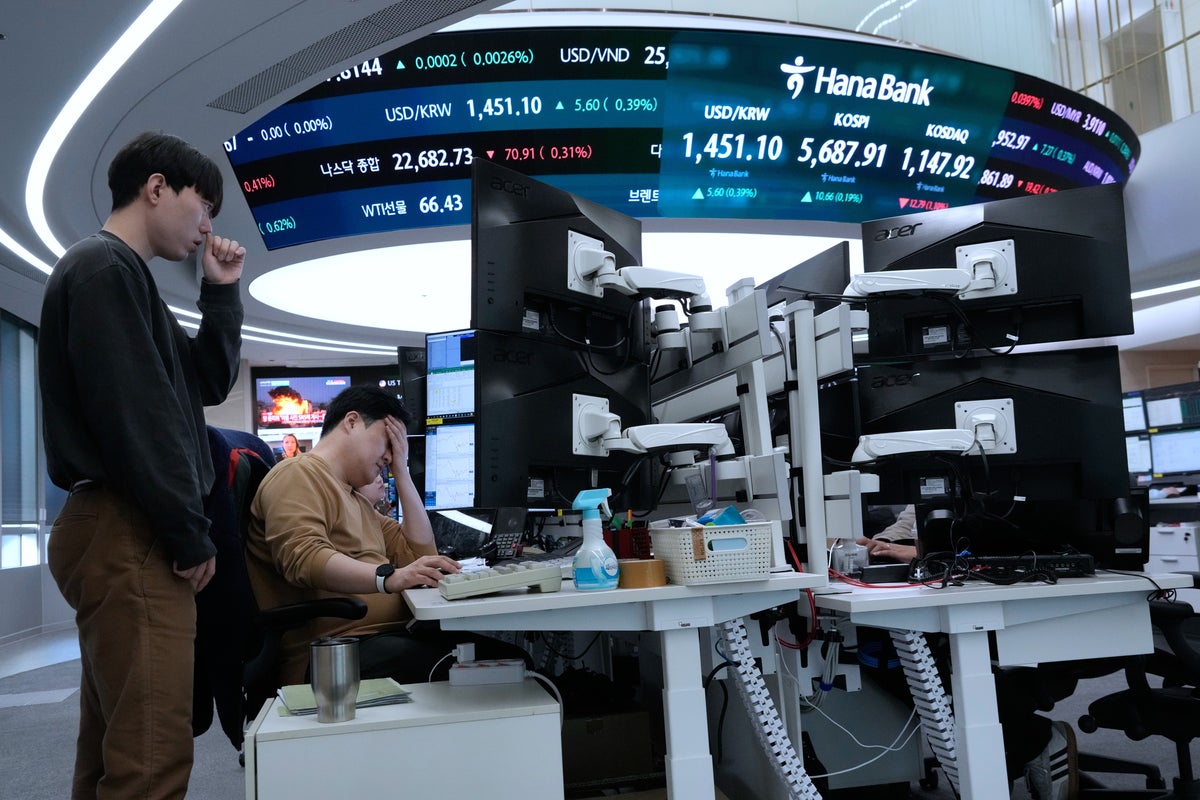
The Hang Seng in Hong Kong dipped 0.6% to 26,544.62 as trading resumed after the Lunar New Year holidays. Meanwhile, markets in mainland China and Taiwan remain closed until next week. Conversely, South Korea’s Kospi surged 2.2% to 5,803.40, propelled by defense stocks like Hanwha Aerospace, which saw its shares soar 8.6% due to increased military spending.
In the U.S., the S&P 500 dipped 0.3% to 6,861.89, with the Dow Jones Industrial Average falling 0.5% to 49,395.16. The Nasdaq composite also lost 0.3%, closing at 22,682.73. Notably, Booking Holdings suffered a severe blow, plummeting 6.1% despite reporting a profit that exceeded analysts’ expectations. The stock has now lost approximately a quarter of its value this year, reflecting growing fears that AI could disrupt its market.
In a volatile session, Carvana sank 7.9% despite reporting stronger-than-expected profits, while retail giant Walmart fluctuated dramatically, initially rising 2.7% before settling down 1.4% after issuing a profit forecast below analysts’ estimates.
Oil prices surged, with benchmark U.S. crude rising 1.9% to $66.43 per barrel, and Brent crude increasing by 1.9% to $71.66 per barrel. Early Friday, U.S. benchmark crude was up 29 cents at $66.69 per barrel, and Brent gained 30 cents to $71.96. The rising oil prices could influence the Federal Reserve to reconsider interest rate cuts, with officials previously indicating a need for further inflation reductions before making adjustments.
In economic news, the number of U.S. workers applying for unemployment benefits has eased, suggesting a potential slowdown in layoffs. Manufacturing growth in the mid-Atlantic region is also reportedly accelerating, although the U.S. trade deficit widened in December, exceeding economists’ predictions.
As of early Friday, the dollar strengthened to 155.24 Japanese yen from 154.99 yen, while the euro slipped to $1.1752 from $1.1775. Precious metals saw gains, with gold rising 0.5% and silver up 0.8%.
Stay tuned for further updates as this situation continues to develop.