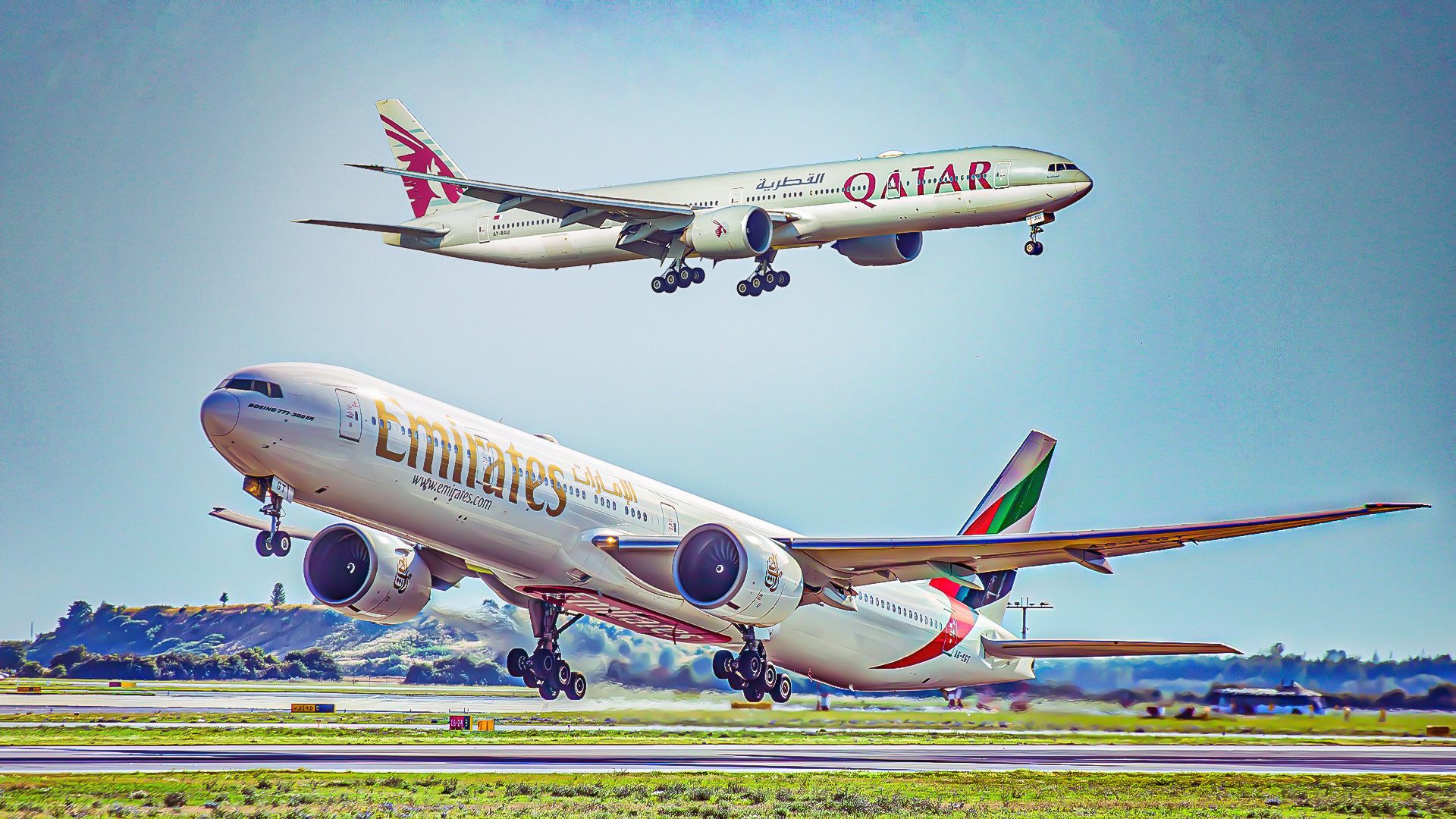
UPDATE: The battle between Emirates and Qatar Airways for Boeing 777 supremacy intensifies as new data reveals fleet sizes and operational strategies. As of 2025, Emirates boasts a staggering 140 Boeing 777s, while Qatar Airways operates 92. This immediate analysis highlights how both airlines leverage the iconic “Triple Seven” to connect global travelers.
The Boeing 777 has been a cornerstone of both Emirates and Qatar Airways for over two decades, facilitating vast networks across Europe, Asia, Africa, and the Americas. With both carriers heavily relying on this aircraft, aviation enthusiasts are eager to see how each airline utilizes their fleets differently.
In a direct fleet comparison, Emirates leads with a diverse lineup that includes 119 Boeing 777-300ERs and 11 777-200F freighters. This heavy focus on the 777-300ER allows Emirates to dominate high-demand routes from its hub in Dubai, where tight connection schedules and high seat counts are crucial for operational efficiency. The airline’s 130 GE9X engines will soon power its new jets, enhancing its long-haul capabilities.
Conversely, Qatar Airways operates 57 Boeing 777-300ERs and an impressive 28 777-200F freighters, making its cargo operations a key aspect of its strategy. The airline’s commitment to premium service is evident in its Qsuite business-class product, which is a standout feature on many of its 777-300ERs.
Passengers flying with Emirates may encounter a denser economy layout featuring ten-abreast seating, while Qatar Airways offers a mix of nine-abreast and ten-abreast configurations, giving travelers more room on certain routes. The experience varies significantly; Emirates’ fleet includes older angled-flat seats alongside newer fully flat options, while Qatar’s Qsuite is widely regarded for its privacy and comfort.
Behind the scenes, fleet strategies differ. Emirates employs the 777-300ER as its primary vehicle for high-capacity operations, while Qatar Airways integrates the 777 into a mixed fleet with Airbus A350s, optimizing each aircraft for specific routes. Qatar’s cargo capabilities enable it to operate flexibly, capitalizing on freight demand even when passenger traffic fluctuates.
As both airlines prepare for the next chapter with the upcoming Boeing 777X, the competition continues to heat up. For passengers and aviation enthusiasts alike, the real takeaway is that both Emirates and Qatar Airways have transformed the 777 into a pivotal tool for global connectivity.
So, who truly wins the battle? Emirates leads in fleet size and capacity, making it a formidable player in the long-haul market. However, Qatar Airways counters with a premium passenger experience and a robust freighter fleet, offering unique advantages in cargo operations.
This ongoing rivalry not only shapes the future of air travel but also impacts millions of passengers worldwide. As travelers weigh their options, these developments are crucial for anyone planning international journeys through the Gulf. Stay tuned for more updates as this compelling story unfolds.